How to Cook for Your Gut Health: What You Need to Know
What it means to cook for your gut health
Cooking for your gut health means making most of your meals at home around foods that feed your gut bacteria: vegetables, fruits, beans, whole grains, nuts and seeds, plus some fermented foods. It also means handling food safely, since food poisoning is one of the fastest ways to upset your gut.
Home cooking gives you control over what goes on the plate. In a national survey of 9,569 U.S. adults, people in households that cooked dinner 6 to 7 nights a week ate fewer calories, less fat and less sugar on an average day than those in households that cooked 0 to 1 nights a week (Wolfson and Bleich, Public Health Nutrition, 2015). That study shows a link, not proof that cooking caused the difference, but it fits common sense.
Why cooking matters for your gut
Your gut bacteria live mostly on what your own body cannot digest. Several lines of research point the same way:
- Fiber feeds helpful bacteria: Mayo Clinic notes that some fiber “serves as food for ‘good’ bacteria in the gut” (Mayo Clinic).
- Variety may matter: in the American Gut Project, a large citizen-science study of over 10,000 people, those who reported eating more than 30 types of plants a week had more of some fiber-fermenting bacteria than those eating 10 or fewer (McDonald et al., mSystems, 2018). The participants chose to join and reported their own diets, so this is a link, not proof.
- Fermented foods may add diversity: in a 17-week Stanford trial with 18 healthy adults per group, a diet high in fermented foods steadily raised gut microbe diversity and lowered several inflammation markers. The high-fiber group did not see the same rise in diversity during the study (Wastyk et al., Cell, 2021).
- Some additives may disturb gut bacteria: in a small 11-day feeding study, 7 healthy adults given 15 g a day of the emulsifier carboxymethylcellulose had less diverse gut bacteria and slightly more belly discomfort than 9 adults on the same diet without it (Chassaing et al., Gastroenterology, 2022). This was a high dose in a tiny study, but cooking from scratch is one easy way to eat fewer additives.
How to cook for your gut

Build meals around plants
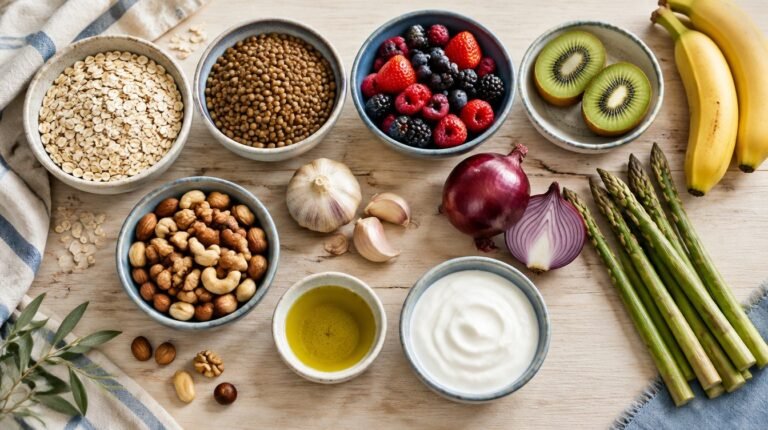
Start with the foods Mayo Clinic lists as good fiber sources: whole grains such as barley, bulgur and brown rice, fruits, vegetables, beans, peas and other legumes, and nuts and seeds. Adults need about 21 to 38 grams of fiber a day depending on age and sex (Mayo Clinic).
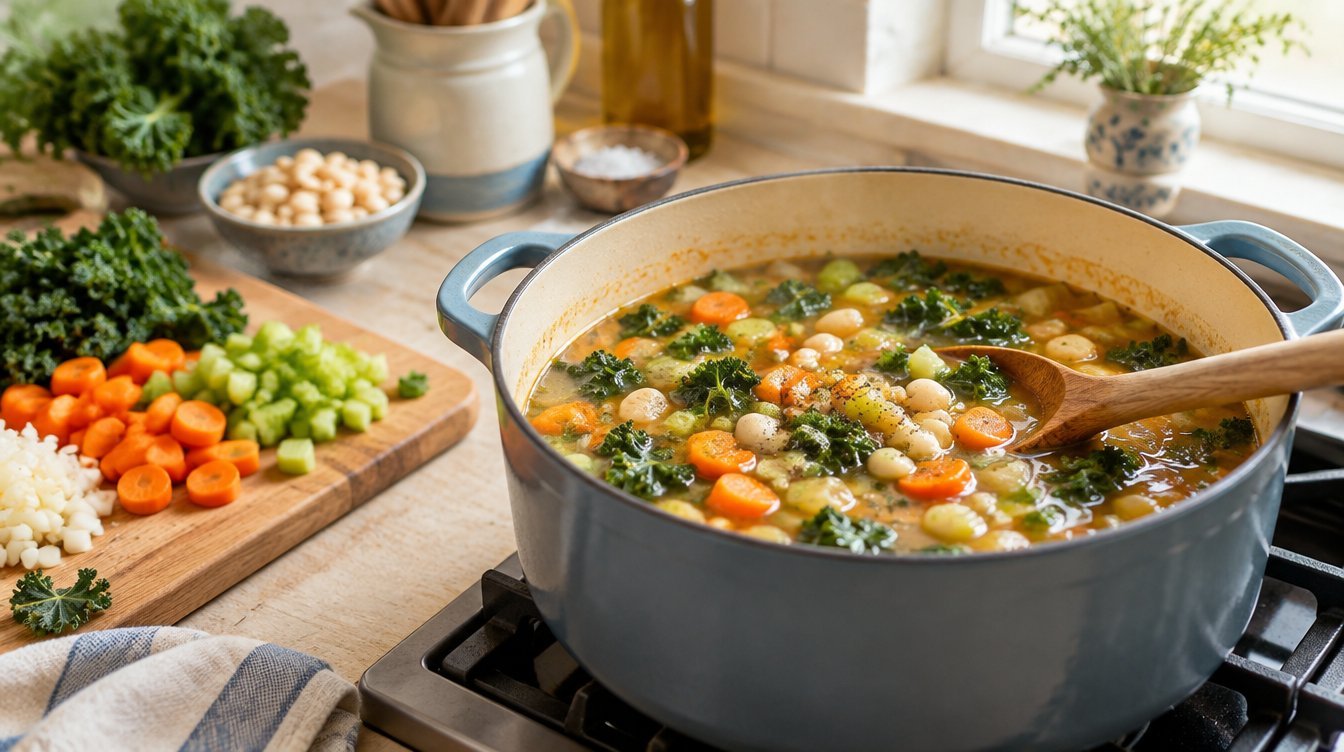
- Add a can of rinsed beans or lentils to soups, chili and pasta sauce.
- Swap white rice or pasta for barley, bulgur or brown rice a few nights a week.
- Fill half the plate with vegetables, roasted, steamed or sauteed.
- Cook with olive oil in place of butter, one of the swaps Mayo Clinic suggests for a Mediterranean-style diet (Mayo Clinic). Our guide to olive oil for gut health covers what the research shows.
Go slowly. Adding too much fiber too quickly can cause gas, bloating and cramps, so increase it over a few weeks and drink plenty of water (Mayo Clinic). If raw vegetables bother you, our list of easy-to-digest vegetables can help.
Mix up your plants
You do not need to count to 30, but rotating ingredients is an easy way to eat more kinds of plants. Buy a different vegetable each week, use mixed beans, and top meals with nuts or seeds. Our gut health diet plan shows what a varied week can look like.
Cook and cool your starches
Cooking rice, potatoes or pasta and then cooling them forms resistant starch, a type of starch that passes undigested into the large intestine, where it feeds helpful bacteria (Cleveland Clinic). In one study, white rice cooled for 24 hours at 39°F (4°C) and then reheated had more than twice the resistant starch of freshly cooked rice (1.65 vs 0.64 g per 100 g), and it raised blood sugar less in 15 healthy adults (Sonia et al., Asia Pacific Journal of Clinical Nutrition, 2015).
Batch-cooking rice or potatoes for the week works well here, as long as you follow leftover rules. Refrigerate cooked food within 2 hours, use it within 3 to 4 days, and reheat it to 165°F (USDA FSIS).
Add fermented foods
Plain yogurt, kefir, sauerkraut and kimchi are easy to work into meals: yogurt in dressings and marinades, kimchi in fried rice, sauerkraut on sandwiches. Our guide to fermented foods for gut health explains which ones contain live cultures, and how to make yogurt at home walks through making your own.
Go gentle when your gut is sensitive
For people with IBS, the NHS advises not delaying or skipping meals, not eating too quickly, and not eating lots of fatty, spicy or processed foods (NHS). Baking, steaming and simmering instead of deep-frying, and keeping portions of rich sauces modest, follow the same idea. Our diet for a sensitive stomach has more options.
Cook safely
A gut-friendly kitchen is also a safe one. Use a food thermometer and cook to these minimum internal temperatures (FoodSafety.gov):
| Food | Safe minimum internal temperature |
|---|---|
| Chicken, turkey and other poultry | 165°F (74°C) |
| Ground beef, pork and sausage | 160°F (71°C) |
| Beef and pork steaks, roasts and chops | 145°F (63°C), then rest 3 minutes |
| Fish | 145°F (63°C), or until flesh is opaque and flakes with a fork |
| Egg dishes such as frittata or quiche | 160°F (71°C) |
| Leftovers and casseroles | 165°F (74°C) |
Cool big batches quickly by dividing them into shallow containers, and throw out perishable food left at room temperature for more than 2 hours, or 1 hour when it is above 90°F (USDA FSIS).
When to see a doctor
This article is general information, not medical advice. Changing how you cook can help everyday digestion, but it is not a fix for ongoing symptoms. Warning signs that need a doctor’s attention include anemia, bleeding from the rectum, bloody or black and tarry stools, and weight loss (NIDDK). With constipation, see a doctor right away for constant belly pain, vomiting, fever, being unable to pass gas, or lower back pain (NIDDK).
What is the best way to cook vegetables for gut health?
The method matters less than eating them often and in variety. Roasting, steaming and sauteing all work, and some fiber in vegetables feeds gut bacteria (Mayo Clinic).
Is reheated rice good for your gut?
Cooked rice that is cooled and reheated has more resistant starch, which feeds gut bacteria (Cleveland Clinic). Refrigerate it within 2 hours and use it within 3 to 4 days (USDA FSIS).
How much fiber should I aim for?
About 25 grams a day for women 50 or younger and 38 grams for men 50 or younger, with slightly less after 50 (Mayo Clinic).
Related topics
- Gut Healthy Meals: meal ideas built around fiber and fermented foods.
- Gut Health Recipes: recipes to put these habits into practice.
- Best Foods for Gut Health: the ingredients worth keeping on hand.
- Olive Oil for Gut Health: what the research says about the main Mediterranean fat.
- Coconut Oil for Gut Health: how coconut oil compares.
- How to Improve Gut Health: habits beyond the kitchen.
Sources
- Dietary fiber: Essential for a healthy diet (Mayo Clinic)
- Mediterranean diet for heart health (Mayo Clinic)
- Are Foods With Resistant Starch Good for You? (Cleveland Clinic)
- Cook to a Safe Minimum Internal Temperature (FoodSafety.gov)
- Leftovers and Food Safety (USDA Food Safety and Inspection Service)
- Diet, lifestyle and medicines for IBS (irritable bowel syndrome) (NHS)
- Diagnosis of Irritable Bowel Syndrome (National Institute of Diabetes and Digestive and Kidney Diseases)
- Symptoms and Causes of Constipation (National Institute of Diabetes and Digestive and Kidney Diseases)
- Wolfson JA, Bleich SN. Is cooking at home associated with better diet quality or weight-loss intention? (Public Health Nutrition, 2015)
- McDonald D, et al. American Gut: an Open Platform for Citizen Science Microbiome Research (mSystems, 2018)
- Wastyk HC, et al. Gut-microbiota-targeted diets modulate human immune status (Cell, 2021)
- Chassaing B, et al. Randomized Controlled-Feeding Study of Dietary Emulsifier Carboxymethylcellulose Reveals Detrimental Impacts on the Gut Microbiota and Metabolome (Gastroenterology, 2022)
- Sonia S, et al. Effect of cooling of cooked white rice on resistant starch content and glycemic response (Asia Pacific Journal of Clinical Nutrition, 2015)
This article is for general information and is not medical advice. Talk to your doctor or a registered dietitian before changing your diet, supplements or medication, especially if you have a health condition.