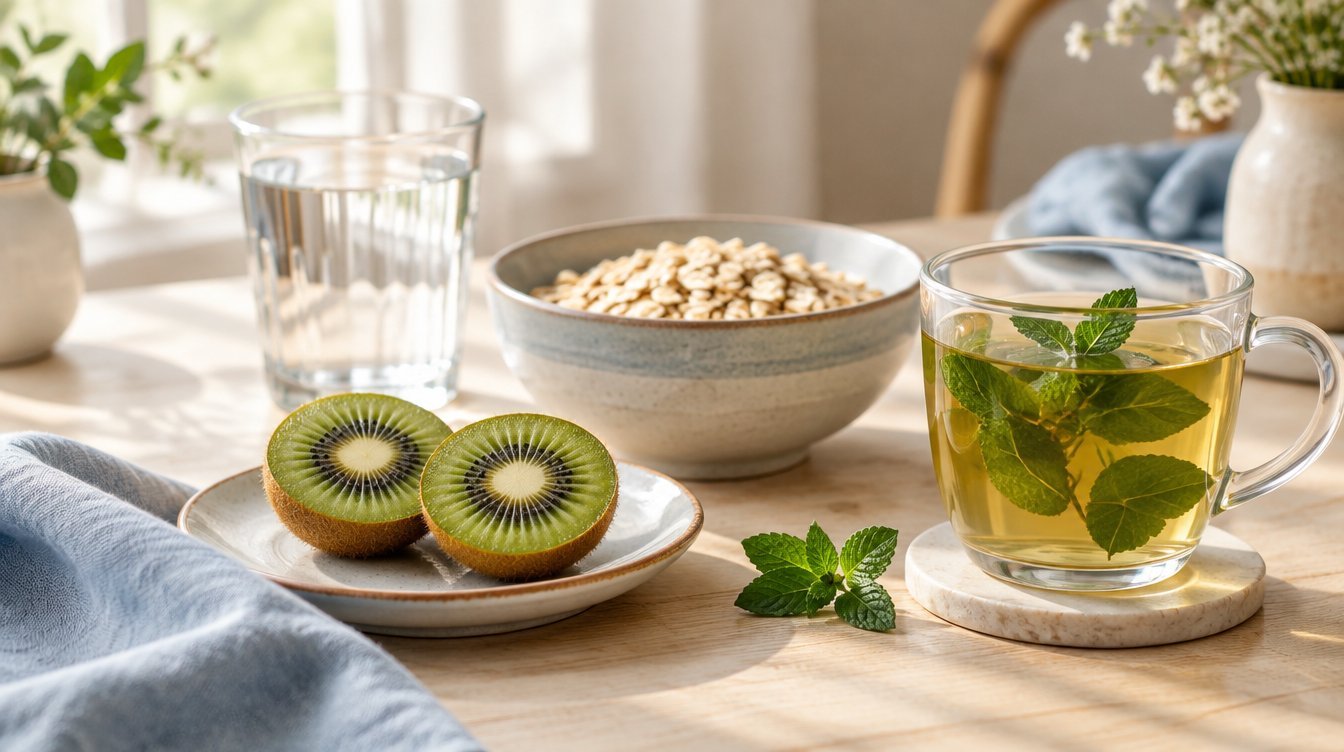
Foods That Help with Bloating: A Practical Guide
What bloating is and why food matters
Bloating is a feeling of fullness or swelling in your belly. When the belly actually gets larger, doctors call it distention, and only about half of people with bloating also have it, according to the National Institute of Diabetes and Digestive and Kidney Diseases (NIDDK). Some gas and bloating during or after meals is normal.
Most gut gas comes from two places, NIDDK explains: air you swallow, and bacteria in the large intestine breaking down carbohydrates your stomach and small intestine did not fully digest. No food flattens a belly on its own, but some give gas-making bacteria less to work with, and a few have small studies behind them. This guide is general information, not medical advice.
Foods and drinks that may help with bloating

Several of these are better described as lower-gas swaps than remedies.
| Food or drink | Why it may help | Strength of evidence |
|---|---|---|
| Green kiwifruit | Eased bloating scores in adults with constipation | One small 4-week trial |
| Oats and linseed (flaxseed) | Soluble fiber for bloating linked to constipation | NHS advice |
| Water | Helps fiber work and softens stool | NHS and NIDDK advice |
| Plain yogurt, hard cheese, lactose-free milk | Less lactose, or cultures that help digest it | Small studies plus NIDDK advice |
| Low-FODMAP fruits and vegetables | Fewer fermentable carbohydrates | Strongest for people with IBS |
| Eggs, plain meat, fish, firm tofu | Naturally free of FODMAPs | Monash University food lists |
| Peppermint tea | Peppermint oil capsules help some IBS symptoms | Little research on the tea itself |
| Ginger | Sped stomach emptying in one tiny trial | Weak; symptoms did not change |
| Lower-salt meals | High sodium raised bloating risk | Randomized feeding trial, 412 adults |
Kiwifruit
In a 2021 U.S. trial, 79 adults with chronic constipation ate two green kiwifruit a day, 100 grams of prunes, or 12 grams of psyllium for four weeks. All three helped bowel movements. Only the kiwifruit group reported a significant improvement in bloating, and it had the fewest side effects. The study was small and about constipation, so it does not show kiwi helps bloating from other causes.
Oats, linseed and soluble fiber
The NHS suggests foods high in soluble fiber, such as oats or linseed, if you are bloated because you are constipated. NIDDK advises adding fiber slowly, by 2 to 3 grams a day, to help prevent gas and bloating, and notes that soluble fiber seems more helpful than insoluble fiber for IBS symptoms.
A supplement is not automatically gentler than food: Mayo Clinic notes psyllium fiber supplements may increase colon gas. Drink with your fiber. NIDDK says water and other liquids help fiber work better and make stools softer. See our constipation relief guide.
Yogurt, hard cheese and lactose-free milk
If dairy bloats you, lactose may be the reason. Lactose intolerance can cause bloating, gas and diarrhea within a few hours, NIDDK says, but you may not need to give dairy up. Many people with lactose intolerance can have about 12 grams of lactose, the amount in a cup of milk, with mild or no symptoms. NIDDK suggests yogurt and hard cheeses such as cheddar or Swiss, which are lower in lactose, and lactose-free milk.
Yogurt has an extra edge. In a small 1984 study, lactase-deficient adults who ate 18 grams of lactose in yogurt produced about a third as much breath hydrogen, a sign of undigested lactose, as they did with milk, and reported less diarrhea and flatulence. The live cultures release their own lactase in the gut. Our article on whether Greek yogurt gives you gas covers this in more detail.
Lower-FODMAP swaps
FODMAPs are carbohydrates that are hard to digest. Monash University, which developed the low-FODMAP diet, lists easy swaps: oranges, kiwifruit, pineapple, blueberries or cantaloupe in place of apples, pears, mango or watermelon, and carrot, cucumber, green beans, eggplant, lettuce or potato in place of onion, garlic, mushrooms or asparagus. Eggs, firm tofu and plain cooked meat, poultry and fish are naturally free of FODMAPs. Oats and rice are lower-FODMAP grains.
The full low-FODMAP diet is meant for irritable bowel syndrome. NIDDK describes trying it for a few weeks and then adding foods back slowly, and Monash advises working with a dietitian.
Peppermint and ginger
Peppermint oil in enteric-coated capsules may improve IBS symptoms, according to the National Center for Complementary and Integrative Health (NCCIH), which cites a 2022 review of 10 studies with 1,030 participants. Very little research has looked at peppermint leaf, though peppermint tea appears safe. Peppermint can also cause heartburn. Treat the tea as a comfort drink, not a proven fix; see our comparison of teas for digestion.
Ginger has even thinner support for bloating. In a trial of 11 people with functional dyspepsia, 1.2 grams of ginger in capsules made the stomach empty faster than placebo but did not change symptoms such as fullness. NCCIH notes that ginger has mostly been studied for nausea, and that it can cause abdominal discomfort and heartburn.
Less salt
In the DASH-Sodium trial, 412 adults ate controlled diets at three sodium levels for 30 days each. High sodium raised the risk of bloating by about 27 percent, on either diet. The high-fiber DASH diet raised it too, and the authors suggest cutting sodium may partly offset that.
Foods and habits that commonly make bloating worse
NIDDK lists foods that often lead to extra gas: apples, peaches, pears and fruit juice; broccoli, cauliflower, kale and other cruciferous vegetables; beans, peas and lentils; milk, ice cream and yogurt; whole wheat; drinks with high-fructose corn syrup; and sweeteners ending in “-ol,” such as sorbitol, xylitol and erythritol. High-fat foods can increase bloating too, and Mayo Clinic adds that soda and beer increase stomach gas.
Many of these are healthy, so cut back on the ones that bother you rather than whole food groups. Our list of foods that are hard to digest goes further. How you eat matters as well. NIDDK and the NHS suggest these habits:
- Eat slowly, and sit down to eat when you can.
- Have smaller, more frequent meals instead of large ones, and avoid big meals late at night.
- Limit gum, hard candy, fizzy drinks and drinking through a straw, which all add swallowed air.
- Chew with your mouth closed, and avoid talking while you eat.
- Exercise regularly; the NHS says it can also help when you already feel bloated.
How to put this together
- Keep a diary for a week or two. Note what you eat and when you feel bloated. NIDDK notes a diary can help a doctor or dietitian spot trigger foods.
- Change one thing at a time. Swap one suspect food and give it a few days.
- Raise fiber slowly. Add a few grams a day from oats, kiwifruit or linseed, with plenty of water.
- Test dairy. Try lactose-free milk or a small serving of plain yogurt with a meal instead of a glass of milk.
- Get help for suspected IBS. A doctor or dietitian can guide a short low-FODMAP trial. Our easy-to-digest foods list is a gentler place to start.
When to see a doctor
The NHS advises seeing a doctor if you feel bloated regularly, if diet changes have not helped, or if bloating comes with unintentional weight loss or blood in your stool. It advises urgent care if bloating comes with vomiting, diarrhea or constipation, stomach pain, a fever, a swelling or lump in your belly, or if you cannot pee, poo or pass gas. It also notes that bloating that does not go away can sometimes be a sign of something more serious, such as ovarian cancer.
Mayo Clinic says to seek immediate care for prolonged stomach pain or chest pain, and NIDDK advises talking with a doctor if your symptoms change suddenly. Get emergency help for severe, sudden belly pain or vomiting blood. This article is general information and is not medical advice.
Related topics
- Does Coconut Water Help with Bloating? What the Evidence Says: a popular drink, checked against the research.
- What to Eat when your Stomach Hurts from Gas? A Clear Answer: gentle meals for a gassy day.
- Diet for Sensitive Stomach: building everyday meals around easier foods.
- Does Greek Yogurt Give You Gas? What the Evidence Says: lactose, cultures and what else is in the cup.
- Best Tea for Digestion: Compared (2026): peppermint, ginger and other teas.
Sources
- Symptoms and Causes of Gas in the Digestive Tract (NIDDK)
- Eating, Diet, and Nutrition for Gas in the Digestive Tract (NIDDK)
- Symptoms and Causes of Lactose Intolerance (NIDDK)
- Eating, Diet, and Nutrition for Lactose Intolerance (NIDDK)
- Eating, Diet, and Nutrition for Irritable Bowel Syndrome (NIDDK)
- Eating, Diet, and Nutrition for Constipation (NIDDK)
- Bloating (NHS)
- Gas and gas pains: Symptoms and causes (Mayo Clinic)
- High and low FODMAP foods (Monash University)
- Peppermint Oil: Usefulness and Safety (NCCIH)
- Ginger: Usefulness and Safety (NCCIH)
- Chey SW, et al. Exploratory Comparative Effectiveness Trial of Green Kiwifruit, Psyllium, or Prunes in US Patients With Chronic Constipation (American Journal of Gastroenterology, 2021)
- Peng AW, et al. Effects of the DASH Diet and Sodium Intake on Bloating: Results From the DASH-Sodium Trial (American Journal of Gastroenterology, 2019)
- Hu ML, et al. Effect of ginger on gastric motility and symptoms of functional dyspepsia (World Journal of Gastroenterology, 2011)
- Kolars JC, et al. Yogurt: an autodigesting source of lactose (New England Journal of Medicine, 1984)
This article is for general information and is not medical advice. Talk to your doctor or a registered dietitian before changing your diet, supplements or medication, especially if you have a health condition.