Best Mushroom Coffee for Gut Health: Compared (2026)
Best Mushroom Coffee for Gut Health: Our Picks
No mushroom coffee has been shown in a published human trial to improve gut health. What the research does show is that plain coffee is linked with changes in gut bacteria and gets the bowels moving, and that some mushroom fibers act like prebiotics in early studies. So we picked by what each label actually adds for your gut, not by brand popularity:
- Best for added probiotics: Four Sigmatic Gut Health, the only one here with a named probiotic strain (Bacillus subtilis DE111, 1 billion CFU) plus yacon and turkey tail.
- Best for added fiber: RYZE Mushroom Coffee, with 2 grams of fiber per serving from acacia, inulin and tapioca fiber and six mushrooms.
- Best for lower caffeine and a clear label: MUD\WTR Coffee, 45 mg of caffeine and the amount of each mushroom listed.
- Best if you want lion’s mane: Four Sigmatic Focus, coffee with lion’s mane and chaga extracts. Its research is about the brain, not the gut.
- Best coffee-free option: MUD\WTR :rise, a cacao and spice blend with 35 mg of caffeine from black tea.
- Food first: a regular cup of coffee plus mushrooms on your plate. It costs less and gives you more mushroom fiber than a spoonful of powder.
Ultimate Gut is published by Ultimate Health Solutions, which sells a yogurt maker, probiotic capsules and an inulin fiber supplement. None of the products reviewed here are ours, and these brands don’t pay us.
Mushroom coffees compared
Everything in this table comes from each brand’s own product page and Nutrition Facts panel, with labels checked in October 2026. Prices are list prices for a one-time order on those pages and change often.
| Product | Mushrooms (as labeled) | Other gut-related add-ins | Caffeine per serving | Fiber per serving | Mushroom amounts listed? | List price per serving |
|---|---|---|---|---|---|---|
| Four Sigmatic Gut Health (ground) | Chaga and turkey tail extracts | B. subtilis DE111 (1 billion CFU), yacon powder | Not given in mg (brand calls it regular caffeine) | Not a significant source | No | About $1.54 ($20 for about 13 servings) |
| RYZE Mushroom Coffee (instant) | Cordyceps, reishi, king trumpet, shiitake, turkey tail, lion’s mane; 2,000 mg total | Acacia, inulin and tapioca fiber | About 50 mg | 2 g | Total only | $1.50 ($45 for 30); $0.90 on subscription |
| MUD\WTR Coffee (instant) | Lion’s mane, cordyceps, reishi, chaga, 563 mg each (mushroom and mycelium grown on oats and/or sorghum) | L-theanine 125 mg | 45 mg | 0 g | Yes | About $2.00 ($60 starter kit, 30 servings); about $1.14 on subscription |
| Four Sigmatic Focus (ground) | Lion’s mane and chaga extracts | None | Not given in mg | Not a significant source | No | About $1.54 ($20 for about 13 servings) |
| MUD\WTR :rise (not coffee) | Chaga, reishi, lion’s mane, cordyceps, 560 mg each (mushroom and mycelium) | Cacao, spices | 35 mg | 1 g | Yes | About $2.00 ($60 starter kit, 30 servings); about $1.14 on subscription |
What the research shows about coffee, mushrooms and your gut
The coffee itself
Coffee is the part of a mushroom coffee with the most gut research behind it. In a 2024 study combining data from 22,867 people in the US and UK with public data from more than 54,000 others, coffee drinkers reliably carried more of one gut bacterium, Lawsonibacter asaccharolyticus, and lab tests showed coffee helps it grow. That is an association. What it means for health is not yet known.
Coffee also moves things along. In a small 1998 study of 12 healthy adults, caffeinated coffee stirred up the colon about as much as a 1,000-calorie meal, 60% more than water and 23% more than decaf. A 2022 review found clear effects of coffee on stomach acid, bile and colon movement, while its links with reflux and ulcers remain disputed.
Mushroom fibers and beta-glucans
Mushrooms contain fibers such as beta-glucans and chitin that the small intestine does not digest. A 2026 review says gut bacteria ferment these into short-chain fatty acids, but notes that preparations vary widely and well-designed human trials are scarce. For turkey tail, one randomized trial in 24 healthy volunteers found that a purified extract called PSP shifted gut bacteria in a way consistent with a prebiotic. That was a concentrated extract, not a spoonful in coffee.
Lion’s mane
The only gut-specific human study of lion’s mane we found was a 2021 pilot in which 13 healthy adults took 3 grams a day of lion’s mane powder for 7 days. Their gut bacteria became more diverse, and some fiber-fermenting species increased. There was no placebo group. Other trials looked at the brain: a 16-week trial in 30 older Japanese adults with mild memory problems used 3 grams a day, and a 28-day pilot in 41 young adults used 1.8 grams a day with mostly null results.
Added probiotics
Bacillus subtilis DE111 is a spore-forming strain, which is why it can be added to hot coffee. In a four-week pilot trial in healthy adults funded by the strain’s maker, it changed some immune cell responses in the lab, but perceived gut health, gut bacteria and markers of gut barrier function were largely unaffected. The authors say the study may have been too small to detect differences.
How each mushroom coffee stacks up
Four Sigmatic Gut Health: best for added probiotics
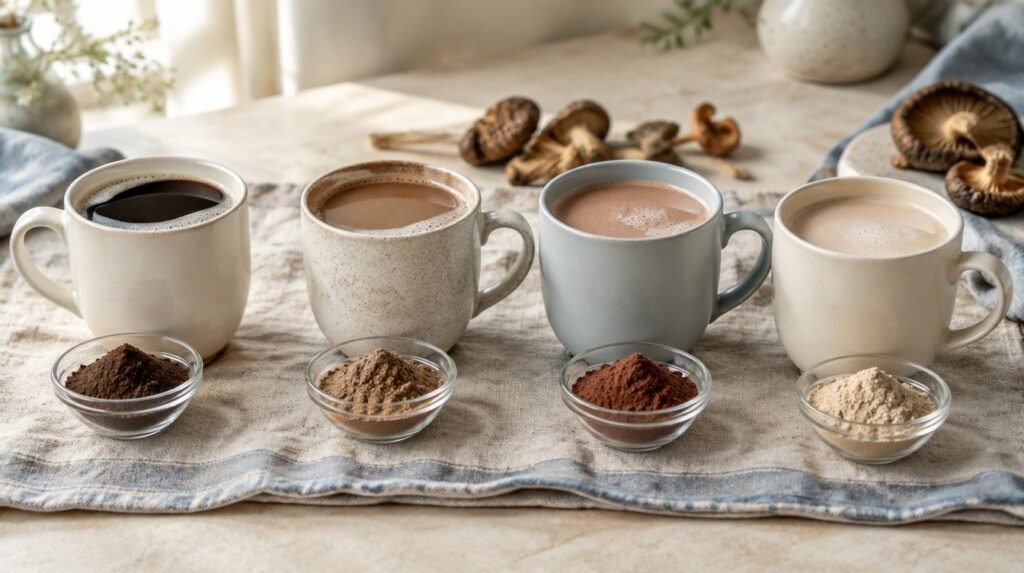
This ground medium roast lists organic coffee, organic chaga extract, organic turkey tail extract, organic yacon powder and B. subtilis DE111 at 1 billion CFU, per the Four Sigmatic product page. A serving is 4 tablespoons (21 grams) and a 10-ounce bag holds about 13 servings. It is the only product here with a named strain and a CFU count.
The catch: the label does not say how much chaga, turkey tail or yacon is in a cup, and the panel says it is not a significant source of fiber. So treat the prebiotic and mushroom claims as unmeasured. The caffeine is listed as regular, with no milligram figure.
RYZE Mushroom Coffee: best for added fiber
RYZE is an instant powder. Its Nutrition Facts panel lists organic instant coffee, a six-mushroom blend (cordyceps, reishi, king trumpet, shiitake, turkey tail and lion’s mane) totaling 2,000 mg, and an organic prebiotic blend of acacia, inulin and tapioca fiber. One tablespoon (6 grams) gives 2 grams of fiber and about 50 mg of caffeine, which the brand says is half that of traditional coffee.
Two grams of fiber is a modest, real addition. Inulin can cause gas in some people, because gut bacteria ferment it in the large intestine, as the NIDDK explains. The label gives only the total mushroom weight, not each mushroom, so you can’t compare its lion’s mane with the doses used in studies.
MUD\WTR Coffee: best for lower caffeine and a clear label
The MUD\WTR Coffee page lists a blend of regular and Swiss Water decaf Arabica coffee, 563 mg each of lion’s mane, chaga, reishi and cordyceps, and 125 mg of L-theanine, with 45 mg of caffeine per tablespoon. It is the only coffee here that lists each mushroom’s amount, which makes it the easiest to judge.
Those amounts are small next to the research doses. Its 563 mg of lion’s mane is about a fifth of the 3 grams a day used in the gut and memory studies above. The label also says the mushrooms are mushroom and mycelium cultured on oats and/or sorghum, and it doesn’t say how much of each is in the blend. There is no added fiber.
Four Sigmatic Focus: best if you want lion’s mane
Focus is Four Sigmatic’s best-known coffee. The product page lists organic coffee, organic lion’s mane extract and organic wildcrafted chaga extract, 4 tablespoons per serving and about 13 servings a bag. Amounts of each mushroom are not given, and it adds nothing aimed at the gut. Pick it for taste or the lion’s mane idea, not for digestion.
MUD\WTR :rise: best coffee-free option
Strictly speaking, :rise is not coffee. The product page lists 560 mg each of chaga, reishi, lion’s mane and cordyceps, plus cacao, a masala chai spice blend, black tea powder and salt. It has 35 mg of caffeine and 1 gram of fiber per tablespoon. If coffee upsets your stomach, a lower-caffeine drink like this may be easier to tolerate, though there are no trials of the product itself.
Food first: coffee plus mushrooms on your plate
A plain cup of coffee already brings the coffee-related gut effects described above. If you want mushroom fiber, cooked mushrooms in a stir-fry, soup or omelet give you far more mushroom than 2 grams of powder in a mug. See our look at whether mushrooms are high in fiber and our list of the best foods for gut health.
Who should be careful
Mushroom coffees are sold as foods or dietary supplements. The FDA does not approve dietary supplements for safety or effectiveness before they are sold. A few cautions are worth knowing:
- Chaga and kidney stones or kidney disease: chaga contains oxalates. Memorial Sloan Kettering lists case reports of oxalate kidney damage after months of large daily amounts, including a 69-year-old man who took 10 to 15 grams of chaga powder a day for 3 months. A cup of mushroom coffee contains far less, but ask your doctor first if you have kidney problems.
- Blood thinners: Memorial Sloan Kettering says both chaga and reishi may raise bleeding risk with drugs such as warfarin, and it lists rare reports of liver injury with powdered reishi.
- Shiitake: a 2026 case report described shiitake dermatitis, a streaky skin rash, linked to drinking mushroom coffee. RYZE is the only product here that lists shiitake.
- Caffeine: the FDA says 400 mg a day, about two to three 12-ounce cups of coffee, is not generally linked with negative effects in most adults, though sensitivity varies.
- Reflux: the NIDDK lists coffee and other sources of caffeine among drinks commonly linked to GERD symptoms. A 2026 meta-analysis of 40 studies found coffee drinkers had a slightly higher rate of GERD, of unclear clinical importance. Our GERD diet guide has more.
- Added probiotics: the NIH says probiotics may cause gas in healthy people, and NCCIH notes the risk of harm is greater in people with severe illnesses or compromised immune systems. If you are immunocompromised, seriously ill, pregnant or have a central line, talk to your doctor before choosing the probiotic version.
When to see a doctor
This article is general information, not medical advice. If coffee of any kind gives you heartburn that doesn’t settle with simple changes, see a doctor. The NIDDK says to get help for trouble or pain swallowing, persistent vomiting, vomit that looks like coffee grounds, black or tarry stools, or unexplained weight loss. For diarrhea, talk to a doctor right away if it lasts more than 2 days or comes with high fever, severe belly pain, bloody stools or signs of dehydration.
How We Compared
We did not test, taste or lab-analyze any of these products. We compared what each brand publishes, using these criteria in order:
- Gut-relevant ingredients on the label, such as a named probiotic strain with a CFU count, or added fiber in grams.
- Whether the label lists the amount of each mushroom, so it can be compared with the doses used in research.
- Published human research on those ingredients, with study size and limits.
- Caffeine per serving, because caffeine affects reflux and bowel habits.
- Safety notes from sources such as the FDA, NIH and Memorial Sloan Kettering.
- List price per serving where the brand page shows both price and servings.
What labels can tell you: ingredients, serving size, calories, fiber and, sometimes, caffeine and CFU counts. What they can’t tell you: how much active compound such as beta-glucan is in each cup, whether a proprietary blend is mostly fruiting body, mycelium or the grain it grew on, or whether the product does anything measurable for your gut. Claims such as “supports gut health” don’t need FDA approval before they appear on a supplement label.
Related topics
- Is Coffee a Probiotic?: what coffee does and doesn’t do for gut bacteria.
- Coffee and Gut Inflammation: the research on coffee and an irritated gut.
- Are Mushrooms High in Fiber?: how much fiber whole mushrooms give you.
- Gut Health Drinks: other drinks people try for digestion.
- Gut Health Powder: how to read powdered supplement labels.
- Best Tea for Digestion: a gentler hot drink if coffee bothers you.
Sources
- Gut Health Ground Coffee – Medium, product page and Nutrition Facts (Four Sigmatic, checked October 2026)
- Focus Ground Coffee, product page and Nutrition Facts (Four Sigmatic, checked October 2026)
- Mushroom Coffee, product page and Nutrition Facts (RYZE, checked October 2026)
- Coffee Starter Kit, product page and Nutrition Facts (MUD\WTR, checked October 2026)
- Original (:rise) Starter Kit, product page and Nutrition Facts (MUD\WTR, checked October 2026)
- Manghi P, et al. Coffee consumption is associated with intestinal Lawsonibacter asaccharolyticus abundance and prevalence across multiple cohorts (Nature Microbiology, 2024)
- Rao SS, et al. Is coffee a colonic stimulant? (European Journal of Gastroenterology & Hepatology, 1998)
- Nehlig A. Effects of Coffee on the Gastro-Intestinal Tract: A Narrative Review and Literature Update (Nutrients, 2022)
- Mattioli LB, et al. Edible Mushrooms as Emerging Prebiotic Sources: Gut Microbiota Modulation and SCFA-Mediated Health Effects (Foods, 2026)
- Pallav K, et al. Effects of polysaccharopeptide from Trametes versicolor and amoxicillin on the gut microbiome of healthy volunteers: a randomized clinical trial (Gut Microbes, 2014)
- Xie XQ, et al. Influence of Short-Term Consumption of Hericium erinaceus on Serum Biochemical Markers and the Changes of the Gut Microbiota: A Pilot Study (Nutrients, 2021)
- Mori K, et al. Improving effects of the mushroom Yamabushitake (Hericium erinaceus) on mild cognitive impairment: a double-blind placebo-controlled clinical trial (Phytotherapy Research, 2009)
- Docherty S, et al. The Acute and Chronic Effects of Lion’s Mane Mushroom Supplementation on Cognitive Function, Stress and Mood in Young Adults (Nutrients, 2023)
- Freedman KE, et al. Examining the Gastrointestinal and Immunomodulatory Effects of the Novel Probiotic Bacillus subtilis DE111 (International Journal of Molecular Sciences, 2021)
- Kwon O, et al. Chaga mushroom-induced oxalate nephropathy that clinically manifested as nephrotic syndrome: A case report (Medicine (Baltimore), 2022)
- Mijares J, Ramachandran V. Flagellate Erythema From Mushroom Coffee: A Novel Exposure Route for Shiitake Dermatitis (International Journal of Dermatology, 2026)
- Muftah M, et al. Association of Coffee Intake With Risk of Gastroesophageal Reflux Disease and Complications: A Systematic Review and Meta-Analysis (Clinical and Translational Gastroenterology, 2026)
- Chaga Mushroom (Memorial Sloan Kettering Cancer Center)
- Reishi Mushroom (Memorial Sloan Kettering Cancer Center)
- Spilling the Beans: How Much Caffeine is Too Much? (U.S. Food and Drug Administration)
- Questions and Answers on Dietary Supplements (U.S. Food and Drug Administration)
- Probiotics: Fact Sheet for Consumers (NIH Office of Dietary Supplements)
- Probiotics: Usefulness and Safety (National Center for Complementary and Integrative Health)
- Symptoms & Causes of Gas in the Digestive Tract (NIDDK)
- Eating, Diet, & Nutrition for GER & GERD (NIDDK)
- Symptoms & Causes of GER & GERD (NIDDK)
- Symptoms & Causes of Diarrhea (NIDDK)
This article is for general information and is not medical advice. Talk to your doctor or a registered dietitian before changing your diet, supplements or medication, especially if you have a health condition.