Propionibacterium freudenreichii: Can You Culture It at Home?
What Propionibacterium freudenreichii is
Propionibacterium freudenreichii is the bacterium that puts the holes in Swiss cheese. It has been used for a long time as a ripening culture in Swiss-type cheeses, and researchers now also study it as a possible probiotic (Thierry et al., International Journal of Food Microbiology, 2011). The name honors Edouard von Freudenreich, the Swiss bacteriologist who first isolated it (LPSN).
It is not a lactic acid bacterium like the cultures in yogurt. Its main end product is propionic acid, and it releases carbon dioxide as it works. In a ripening cheese, that gas collects into the round “eyes” of Emmental-style cheese, while propionic acid and other compounds add the sweet, nutty flavor (Rossi et al., Biomolecules, 2025). It can also make all its own amino acids and many vitamins, including vitamin B12 (Thierry et al., 2011).
The species is considered “Generally Recognized As Safe,” and it is used in three main ways: as a cheese starter, as an industrial source of vitamin B12 and propionic acid, and as a probiotic for people and animals (Falentin et al., Standards in Genomic Sciences, 2016).
Can you make Propionibacterium freudenreichii yogurt?
Not in the usual sense. There is no standard home method that grows this bacterium into a set yogurt, which is why its incubation numbers read “n/a.” Three things stand in the way.
- It runs cool. One sequenced probiotic strain has a listed optimum of 32°C (about 90°F) and was grown in the lab at 30°C (86°F) (Falentin et al., 2016). Yogurt cultures work best near 110°F, so the two do not share an incubator setting.
- Many strains skip lactose. In a study of 28 strains, 13 did not fit the old subspecies split based on lactose use, and 6 neither fermented lactose nor reduced nitrate (de Freitas et al., Dairy Science and Technology, 2015). A strain that cannot use milk sugar has little to eat in fresh milk.
- It works late, not first. It can use a variety of carbon sources (Thierry et al., 2011), and in cheese it does its work during ripening, after the lactic starter has acidified the curd. In a Swiss-type Maasdam cheese, the lactic acid bacterium Lactococcus lactis made up about 80 to 90% of the microbial community, and the cheese moved through warm-room and cold-room ripening stages (Duru et al., International Journal of Food Microbiology, 2018).
So at home, it fits best as a passenger in yogurt you make the usual way, or as one ingredient in a Swiss-type cheese recipe. The protocol below covers the yogurt route.
Where it sits in the family tree
The table follows the NCBI Taxonomy database. Unlike yogurt bacteria, which belong to Bacillota, P. freudenreichii sits in Actinomycetota, the high-GC group that also includes Bifidobacterium. It is the type species of the genus Propionibacterium (LPSN). A 2016 reclassification moved several former members into new genera, including Cutibacterium (the skin bacteria) and Acidipropionibacterium, but P. freudenreichii kept its name; LPSN lists the 2016 proposal among its references.
| Domain | Phylum | Genus | Species | Strain |
|---|---|---|---|---|
| Bacteria | Actinomycetota (formerly Actinobacteria) | Propionibacterium | P. freudenreichii | Type strain DSM 20271 (ATCC 6207); studied strains include JS, CIRM-BIA 129 and LMGT 2951 |
Between phylum and genus it belongs to the class Actinomycetes, order Propionibacteriales and family Propionibacteriaceae. Older labels split it into subsp. freudenreichii and subsp. shermanii (often sold as “P. shermanii“). LPSN now lists both subspecies names as synonyms, and the 2015 strain study argued against the split altogether (de Freitas et al., 2015).
What the research says
Flavor and holes in cheese
In Swiss-type cheese, P. freudenreichii produces a range of flavor compounds: propionic acid, free fatty acids released from milk fat, and compounds from the breakdown of amino acids. Many of these traits, along with its value as a probiotic, are “highly strain-dependent” (Thierry et al., 2011). In the Maasdam study, most of the microbes slowed their central metabolism during cold-room ripening, which suggests less propionate and flavor were being made at that stage (Duru et al., 2018).
Vitamin B12 in fermented foods
Because it makes vitamin B12, researchers use it to enrich plant foods, which naturally lack the vitamin. In a 2026 lab study, faba beans fermented with P. freudenreichii plus a mold reached 2.1 to 2.2 micrograms of active B12 per gram of dry weight after 66 hours, 170 to 200 times more than with the bacterium alone. In a simulated digestion, only 42 to 54% of that B12 was released (Sihvola et al., Current Research in Food Science, 2026).
Whether such foods improve B12 levels in people is not settled. A systematic review of human studies found that evidence for B12 from fermented foods is “limited or inconsistent” (Keyvan et al., Frontiers in Nutrition, 2025). Do not count on homemade ferments as a B12 source.
Studies in people
In 18 healthy adults who took propionibacteria for 2 weeks, fecal counts of the bacteria rose during dosing and returned to baseline afterward, and bifidobacteria counts rose modestly. Transit slowed in one section of the colon (Bouglé et al., Scandinavian Journal of Gastroenterology, 1999). The study had no placebo group.
In an open-label trial of 36 adults, a mix including strain JS was given as capsules, yogurt or cheese for 2 weeks. Yogurt delivered the highest fecal counts of JS, and cheese the lowest (Saxelin et al., International Journal of Food Microbiology, 2010). A crossover trial in 38 men with mildly high cholesterol found that capsules of JS plus a Lactobacillus rhamnosus strain did not change blood lipids over 4 weeks (Hatakka et al., Journal of the American College of Nutrition, 2008).
In a 2025 trial, 60 Nordic skiers ate a cheese made with strain LMGT 2951 or a similar cheese without it for 24 weeks. Strength, lean mass and fitness rose in both groups, with no significant differences between them (Lundberg et al., Journal of the International Society of Sports Nutrition, 2025). A 2025 review notes that most of the striking results so far come from animal models and that clinical trials in people are still needed (Rossi et al., 2025).
Safety
An analysis of six randomized trials with 1,909 participants found no difference in adverse events between placebo and probiotic mixes that included strain JS (Tapiovaara et al., Beneficial Microbes, 2016). The general cautions still apply: NCCIH says the risk of harm from probiotics is greater in people with severe illness or weakened immune systems (NCCIH), and the NIH Office of Dietary Supplements notes that most reported infections involved people who were severely ill or immunocompromised (NIH ODS). If you are pregnant, critically ill, immunocompromised or have a central line, talk with your doctor before using live cultures as a supplement.
How to add P. freudenreichii to homemade yogurt

This method uses a normal yogurt culture to do the fermenting and adds P. freudenreichii afterward, the way it was delivered in yogurt in the 2010 trial above. The yogurt steps follow the University of Alaska Fairbanks Cooperative Extension Service. For the base method in more detail, see how to make yogurt at home.
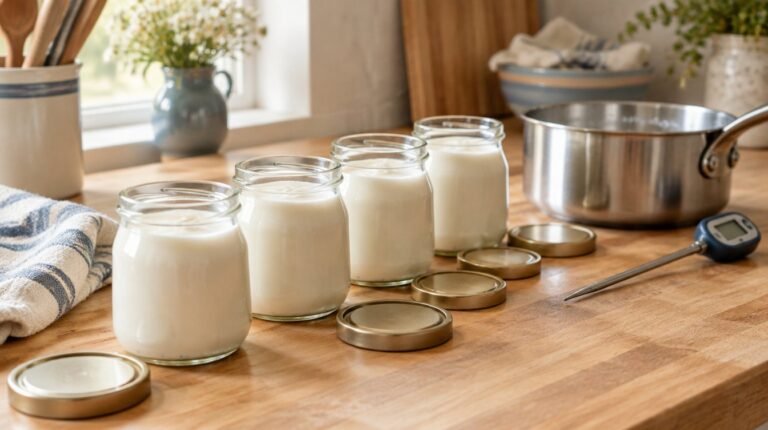
You will need: 1 quart of pasteurized whole or 2% milk; a yogurt starter (1/4 cup of plain yogurt with live cultures, or a dry starter); a propionic culture sold for cheese making, labeled Propionibacterium freudenreichii or P. shermanii; a pot, an instant-read thermometer and clean jars.
- Clean everything. Wash the pot, whisk, thermometer and jars in hot, soapy water.
- Heat the milk to 185°F (85°C). Hold it there for 10 minutes, or up to 20 for thicker yogurt, without boiling (UAF Extension).
- Cool to 112 to 115°F (44 to 46°C). A cold-water bath speeds this up.
- Add the yogurt starter only. Whisk it into a cup of warm milk, then back into the pot. The mix should be about 110 to 112°F.
- Incubate at about 110°F (43°C). UAF gives 4 to 7 hours at 110°F, plus or minus 5°F. Stop when it is set and tart. See how to incubate yogurt for ways to hold the heat.
- Chill to 40°F (4°C) or below. The yogurt culture has done the setting; the propionic culture goes into the finished, cold yogurt.
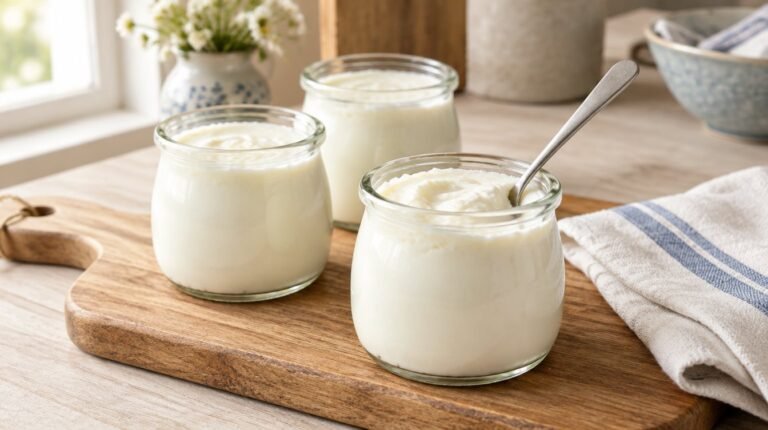
- Stir in the propionic culture. Use the smallest amount the supplier suggests for a batch of milk, sprinkled over the cold yogurt and folded in gently with a clean spoon. Do not incubate again.
- Refrigerate and eat within the usual window. UAF says homemade yogurt keeps about 10 to 21 days at 40°F or below. How many propionibacteria survive that long in homemade yogurt has not been measured, so fresher is a safer bet. See how long homemade yogurt lasts.
For Swiss-type cheese, use a published cheese recipe from your culture supplier and follow its temperatures and ripening times. The bacterium does its work over weeks of ripening, not hours in a jar. If you want a fermented food with more human research behind its cultures, start with L. reuteri or the classic pair in S. thermophilus yogurt.
How to tell it worked
Be realistic: there is no kitchen test that shows live P. freudenreichii in a jar of yogurt. Only lab counting can do that. What you can check:
- The base yogurt set properly. It should hold together when you tilt the jar and taste clearly tart. Food-grade pH strips should read 4.6 or lower, the UAF target.
- The culture was in date and stored as directed. Check the packet before you use it.
- The yogurt still looks and smells like yogurt. If you see bubbles, a domed lid or an off smell in the fridge, discard it.
- In cheese, look for eyes. Round holes and a sweet, nutty taste after ripening show the propionic culture was active (Rossi et al., 2025).
Common problems and fixes
| Problem | Likely cause | Fix |
|---|---|---|
| Yogurt did not set | The propionic culture was added in place of a yogurt starter, or the milk was too hot | Ferment with a yogurt culture first. Add starter only below 115°F. |
| Propionic culture added before incubating | Its listed optimum is near 90°F, far below the 110°F yogurt setting | Add it after chilling, as in step 7. |
| Gassy, domed lid or fizzy texture | Contamination or yeast, or the jar sat warm too long | Discard it. Keep the yogurt at 40°F or below. |
| Swiss cheese without eyes | Culture not active, or ripening conditions off | Check culture freshness and follow the recipe’s warm-room stage. |
| Mold, pink or orange spots | Contamination | Throw it out and start over with clean equipment. |
The USDA says to discard yogurt and soft cheese with mold, since high-moisture foods can be contaminated below the surface (USDA FSIS, Molds on Food).
Related topics
- Lactobacillus delbrueckii: How to Culture It at Home: a culture used in both yogurt and Swiss-type cheese.
- Lactobacillus helveticus: How to Culture It at Home: another Swiss cheese culture.
- Fermented Cheese: which cheeses keep live cultures.
- Is Cheese a Probiotic?: what the evidence says about cheese cultures.
- Yogurt Starter: how to choose a base culture.
Sources
- Making Yogurt at Home (FNH-00062) (University of Alaska Fairbanks Cooperative Extension Service)
- Species Propionibacterium freudenreichii (LPSN, List of Prokaryotic names with Standing in Nomenclature, DSMZ)
- Propionibacterium freudenreichii, Taxonomy Browser (National Center for Biotechnology Information)
- Probiotics: What You Need To Know (National Center for Complementary and Integrative Health)
- Probiotics: Fact Sheet for Health Professionals (NIH Office of Dietary Supplements)
- Molds on Food: Are They Dangerous? (USDA Food Safety and Inspection Service)
- Thierry A, et al. New insights into physiology and metabolism of Propionibacterium freudenreichii (Int J Food Microbiol, 2011)
- Rossi F, et al. Dairy propionibacteria: probiotic properties and their molecular bases (Biomolecules, 2025)
- Falentin H, et al. Permanent draft genome sequence of the probiotic strain Propionibacterium freudenreichii CIRM-BIA 129 (ITG P20) (Stand Genomic Sci, 2016)
- de Freitas R, et al. New insights about phenotypic heterogeneity within Propionibacterium freudenreichii argue against its division into subspecies (Dairy Sci Technol, 2015)
- Duru IC, et al. Metagenomic and metatranscriptomic analysis of the microbial community in Swiss-type Maasdam cheese during ripening (Int J Food Microbiol, 2018)
- Sihvola J, et al. Solid-state co-fermentation enables exceptionally high vitamin B12 enrichment but limited bioaccessibility in faba beans (Curr Res Food Sci, 2026)
- Keyvan E, et al. Vitamins formed by microorganisms in fermented foods: effects on human vitamin status, a systematic narrative review (Front Nutr, 2025)
- Bouglé D, et al. Effect of propionibacteria supplementation on fecal bifidobacteria and segmental colonic transit time in healthy human subjects (Scand J Gastroenterol, 1999)
- Saxelin M, et al. Persistence of probiotic strains in the gastrointestinal tract when administered as capsules, yoghurt, or cheese (Int J Food Microbiol, 2010)
- Hatakka K, et al. Lactobacillus rhamnosus LC705 together with Propionibacterium freudenreichii ssp shermanii JS administered in capsules is ineffective in lowering serum lipids (J Am Coll Nutr, 2008)
- Lundberg HE, et al. Comparison of cheese with and without Propionibacterium freudenreichii subsp. shermanii LMGT 2951 on off-season muscle strength and VO2 max development in Nordic skiers: a randomized clinical trial (J Int Soc Sports Nutr, 2025)
- Tapiovaara L, et al. Absence of adverse events in healthy individuals using probiotics: analysis of six randomised studies by one study group (Benef Microbes, 2016)