Lactobacillus gasseri: How to Culture It at Home (100°F / 36h)
What Lactobacillus gasseri is
Lactobacillus gasseri is a lactic acid bacterium that lives naturally in people: in the mouth, the gut and the vagina. A review in FEMS Microbiology Reviews describes it as a native resident of these surfaces that tolerates acid and bile and sticks to the lining of the gut (Selle and Klaenhammer, 2013). It belongs to the “acidophilus complex”, a group of close relatives that includes L. acidophilus.
It was described as a separate species in 1980 and named after the French bacteriologist F. Gasser (LPSN). Like other gut lactobacilli, it ferments lactose into lactic acid, so it can sour and thicken milk. It is not one of the two bacteria the law requires in anything sold as yogurt, which are L. bulgaricus and Streptococcus thermophilus (21 CFR 131.200).
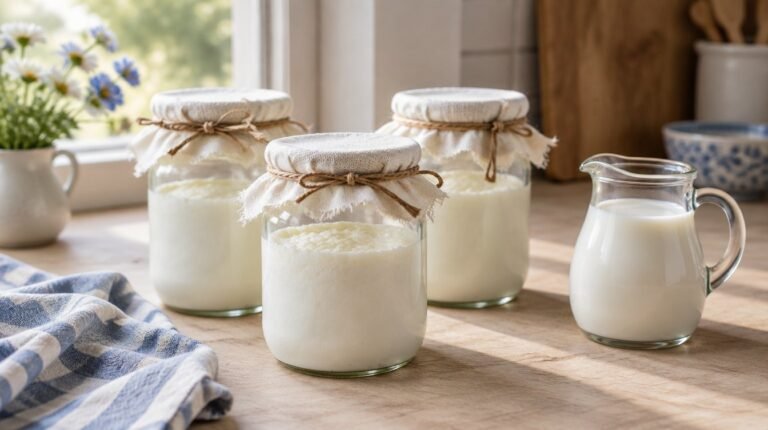
Because it is adapted to body temperature, a lactobacillus gasseri yogurt is made cooler and longer than ordinary yogurt: about 100°F (38°C) for up to 36 hours. The result is usually softer and more sour than store yogurt.
Where it sits in the family tree
| Domain | Phylum | Genus | Species | Strain |
|---|---|---|---|---|
| Bacteria | Bacillota (formerly Firmicutes) | Lactobacillus | L. gasseri | Varies by product; SBT2055, BNR17, OLL2716 and CP2305 are well-studied examples |
When taxonomists split the old Lactobacillus genus into 25 genera in 2020, L. gasseri was one of the species that kept its name (Zheng et al., 2020). Unlike L. reuteri (now Limosilactobacillus), there is no new genus name to watch for on labels. The LPSN database lists it as a correct name in risk group 1, the lowest-risk category, with type strain ATCC 33323. Bacillota replaced the phylum name Firmicutes in 2021 (Oren and Garrity, 2021).
The strain code is the part that matters. The strains below were studied for quite different things, and a result for one does not carry over to another, or to the culture in your capsule.
What the research shows
Several human trials of L. gasseri used fermented milk or yogurt, which makes this species unusually relevant to home fermenters. None of them tested homemade yogurt, and several had authors from the companies behind the strains.
Belly fat in fermented milk (SBT2055)
In a 12-week double-blind trial in Japan, 87 adults with a higher body mass index and more abdominal fat drank 200 g a day of fermented milk with or without strain SBT2055. The SBT2055 group lost an average of 4.6% of visceral (deep belly) fat area, measured by CT scan, and about 1.4% of body weight; the control group did not (Kadooka et al., 2010).
A follow-up trial of 210 adults tested lower doses for 12 weeks. Visceral fat area fell by about 8% in both active groups, and the effect faded within 4 weeks of stopping (Kadooka et al., 2013). These are real but modest changes, in people who kept drinking the product. The researchers made their fermented milk with ordinary yogurt cultures plus SBT2055, incubated at 40°C (104°F) for 3.5 to 4 hours (Ogawa et al., 2015).
Visceral fat in capsules (BNR17)
BNR17 was isolated from human breast milk. In a 12-week trial of 90 adults with obesity, the higher dose (10 billion CFU a day) reduced visceral fat area compared with placebo, and waist size fell in both dose groups, while blood markers did not change (Kim et al., 2018).
Stomach symptoms in yogurt (OLL2716)
In a 12-week trial, 131 adults infected with H. pylori ate yogurt containing OLL2716 or a placebo yogurt. Tests for the infection did not differ between the groups, but fullness after meals improved over the trial in the OLL2716 group, and fewer people in that group reported marked bloating than in the placebo group (Takagi et al., 2016). The yogurt did not clear the infection, which needs medical treatment.
Sleep and stress (CP2305)
Sixty Japanese medical students preparing for national exams took a tablet of heat-inactivated CP2305 or a placebo for 24 weeks. The CP2305 group reported less anxiety and better sleep (Nishida et al., 2019). The bacteria were dead, so this study says nothing about live cultures in yogurt, and one author worked for the strain’s maker.
Vaginal health (a four-strain yogurt drink)
In a pilot trial, 36 women with bacterial vaginosis took the antibiotic metronidazole and drank either a yogurt drink with four lactobacillus strains, including L. gasseri LbV 150N, or acidified milk for four weeks. Fewer women in the yogurt group still had the condition at the end (Laue et al., 2018). It was small, used several strains together, and added to standard treatment, not instead of it.
How well does it grow in milk?
Less vigorously than classic yogurt cultures. In one lab study, strain 505 fermented milk on its own, but adding a plant leaf extract sped up acidification and growth (Oh et al., 2016). Commercial products such as the SBT2055 fermented milk pair L. gasseri with ordinary yogurt cultures to get a quick, firm set.
That is why the home method uses a long, warm hold. At about 100°F the culture is close to its home temperature inside the body, and 36 hours gives a slow grower time to acidify the milk. If you want a thicker, more reliable batch, whisk in a tablespoon of plain live yogurt, knowing you are then making a mixed yogurt.
How to culture Lactobacillus gasseri at home
This makes 1 quart. Active time is about 30 minutes, plus up to 36 hours of incubation and at least 6 hours of chilling. The heating and cooling steps follow the University of Missouri Extension.
You will need: 1 quart of pasteurized whole or 2% milk (or half-and-half for a richer set), a capsule or starter that names the L. gasseri strain, an instant-read thermometer, a clean pot, clean jars, and an incubator that holds 100°F steadily for 36 hours. Our guide to how to incubate yogurt covers yogurt makers, ovens and other setups.
- Clean everything. Wash the pot, whisk, thermometer and jars in hot, soapy water and rinse well. A 36-hour ferment at body temperature gives stray microbes plenty of time.
- Heat the milk to 180°F (82°C). Warm it gently, stirring, until it reaches 180°F. This kills competing bacteria and denatures the whey proteins (University of Missouri Extension).
- Cool to 100 to 105°F (38 to 41°C). Use a cold-water bath and stir so the temperature is even. Adding culture to milk that is too hot can weaken it.
- Add the culture. Empty one capsule, or the amount the starter packet gives per quart, into a cup of the warm milk. Whisk until smooth, then stir it back into the pot.
- Fill the jars and cover them loosely. Move them into the incubator.
- Incubate at 100°F (38°C) for up to 36 hours. Keep it between 98 and 102°F, and check with a thermometer rather than trusting the dial. Some starter packets give a warmer, shorter schedule, such as about 109°F for 24 hours; if yours does, follow the packet.
- Check at 24 hours. If it has set and tastes clearly sour, you can stop. If it is still loose, give it up to 12 more hours.
- Chill promptly. Refrigerate for at least 6 hours. Cold stops the ferment. For keeping times, see how long homemade yogurt lasts.
- Save 2 tablespoons from a fresh, clean-smelling batch to start the next one. Restart from a capsule every few batches, since the culture can drift.
How to tell it worked
- It has thickened. Tip the jar. The yogurt should move as one soft mass. A single-strain batch is often looser than store yogurt.
- The pH is 4.6 or lower. That is the acidity the FDA requires of yogurt (21 CFR 131.200). Food-grade pH strips are cheap. If a batch has not reached it by 36 hours, discard it.
- It tastes and smells clean and sour. Long ferments are tangier than store yogurt. Yeasty, cheesy or rotten smells are a bad sign.
- Some whey is normal. A layer of clear liquid is common after 36 hours. Stir it back in or pour it off.
Common problems and fixes

| Problem | Likely cause | Fix |
|---|---|---|
| Still liquid at 36 hours | Incubator ran cool or hot, culture added to hot milk, or few live cells | Check the temperature with a thermometer in a jar of water. Add culture below 105°F. Use a fresh capsule. Discard the unset batch. |
| Thin but sour | Slow-growing strain, low-fat milk | Use whole milk or half-and-half, or add 1 tablespoon of plain live yogurt. |
| Very sour with lots of whey | Ran long or warm | Stop at 24 to 30 hours. Strain the whey for a thicker yogurt. |
| Bubbly, yeasty or fizzy | Wild yeast contamination | Discard it, sanitize your jars and restart from a capsule. |
| Each batch weaker than the last | Culture drift over many transfers | Restart from a capsule. See heirloom starter weakened over time. |
| Mold, pink or orange color | Contamination | Throw out the whole jar. |
The USDA advises throwing out yogurt with mold, because soft, moist foods can be contaminated below the surface (USDA FSIS). Do not taste a batch that smells wrong to find out.
Safety note
Probiotics are generally considered safe in healthy people, but the risk of harmful effects is greater in people with severe illnesses or compromised immune systems, and serious infections have been reported in premature infants given probiotics (NCCIH). The NIH Office of Dietary Supplements suggests asking your health care provider before trying probiotics (NIH ODS). If you are pregnant, immunocompromised, critically ill or have a central line, talk to your clinician first.
L. gasseri capsules are sold as dietary supplements. The FDA does not approve supplements for safety or effectiveness before sale; their makers are responsible for evaluating safety and labeling (FDA). This article is general information, not medical advice.
Related topics
- Lactobacillus reuteri: another long, cool human-gut ferment.
- Bacillus coagulans GBI-30: How to Culture It at Home: a spore-forming culture that likes it hotter.
- Lactobacillus acidophilus: How to Culture It at Home: a close relative in the acidophilus group.
- Best Probiotic for Women: where vaginal-health strains fit.
- Best Probiotic for Weight Loss: how the SBT2055 and BNR17 trials compare with others.
Sources
- Selle K, Klaenhammer TR. Genomic and phenotypic evidence for probiotic influences of Lactobacillus gasseri on human health (FEMS Microbiol Rev, 2013)
- Lactobacillus gasseri (List of Prokaryotic names with Standing in Nomenclature, DSMZ)
- 21 CFR 131.200 Yogurt (U.S. Food and Drug Administration, Electronic Code of Federal Regulations)
- Zheng J, et al. A taxonomic note on the genus Lactobacillus: description of 23 novel genera, emended description of the genus Lactobacillus Beijerinck 1901, and union of Lactobacillaceae and Leuconostocaceae (Int J Syst Evol Microbiol, 2020)
- Oren A, Garrity GM. Valid publication of the names of forty-two phyla of prokaryotes (Int J Syst Evol Microbiol, 2021)
- Kadooka Y, et al. Regulation of abdominal adiposity by probiotics (Lactobacillus gasseri SBT2055) in adults with obese tendencies in a randomized controlled trial (Eur J Clin Nutr, 2010)
- Kadooka Y, et al. Effect of Lactobacillus gasseri SBT2055 in fermented milk on abdominal adiposity in adults in a randomised controlled trial (Br J Nutr, 2013)
- Ogawa A, et al. Lactobacillus gasseri SBT2055 suppresses fatty acid release through enlargement of fat emulsion size in vitro and promotes fecal fat excretion in healthy Japanese subjects (Lipids Health Dis, 2015)
- Kim J, et al. Lactobacillus gasseri BNR17 supplementation reduces the visceral fat accumulation and waist circumference in obese adults: a randomized, double-blind, placebo-controlled trial (J Med Food, 2018)
- Takagi A, et al. Effects of Lactobacillus gasseri OLL2716 on Helicobacter pylori-associated dyspepsia: a multicenter randomized double-blind controlled trial (Gastroenterol Res Pract, 2016)
- Nishida K, et al. Health benefits of Lactobacillus gasseri CP2305 tablets in young adults exposed to chronic stress: a randomized, double-blind, placebo-controlled study (Nutrients, 2019)
- Laue C, et al. Effect of a yoghurt drink containing Lactobacillus strains on bacterial vaginosis in women: a double-blind, randomised, controlled clinical pilot trial (Benef Microbes, 2018)
- Oh NS, et al. The growth kinetics and metabolic and antioxidant activities of the functional synbiotic combination of Lactobacillus gasseri 505 and Cudrania tricuspidata leaf extract (Appl Microbiol Biotechnol, 2016)
- Making Yogurt at Home (Preserve It Fresh, Preserve It Safe, HES126) (University of Missouri Extension)
- Molds on Food: Are They Dangerous? (USDA Food Safety and Inspection Service)
- Probiotics: Usefulness and Safety (National Center for Complementary and Integrative Health)
- Probiotics: Fact Sheet for Consumers (NIH Office of Dietary Supplements)
- Dietary Supplements (U.S. Food and Drug Administration)