Lactobacillus helveticus: How to Culture It at Home (108-112°F / 12h)
What Lactobacillus helveticus is
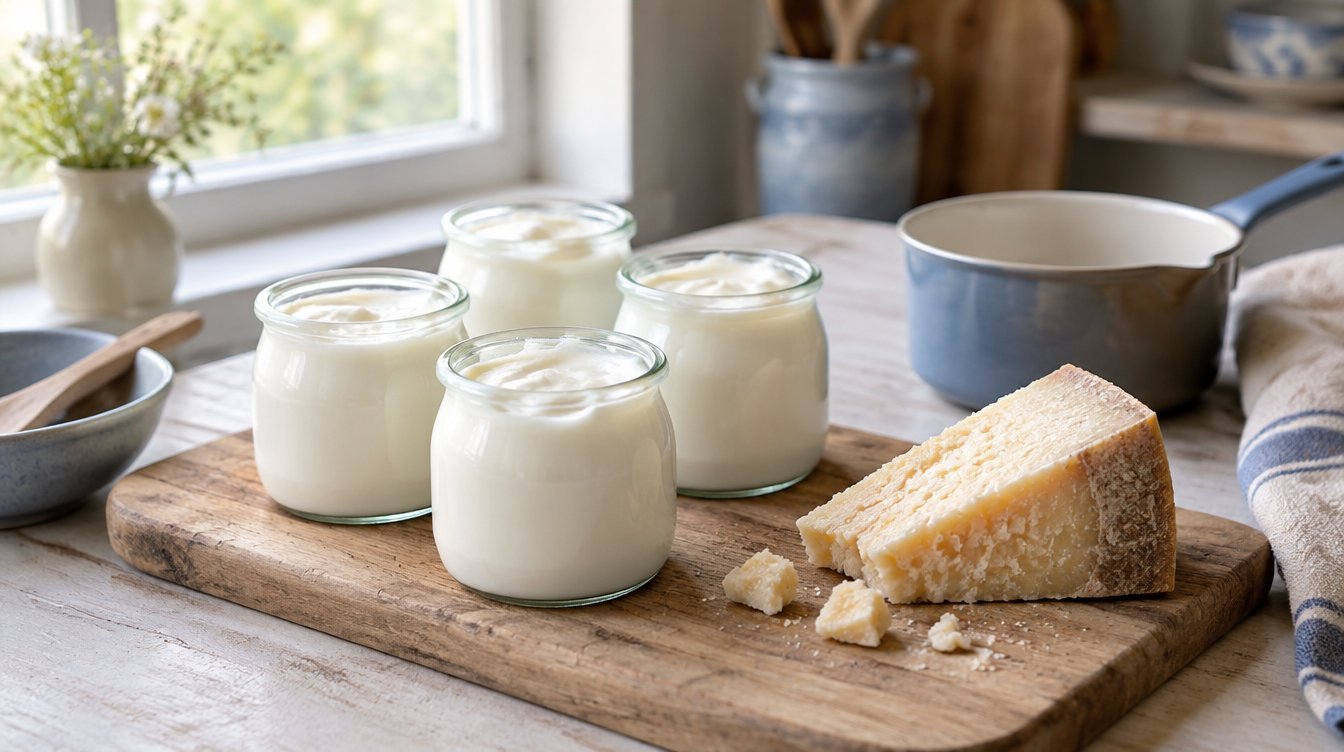
Lactobacillus helveticus is a heat-loving lactic acid bacterium that turns milk sugar into lactic acid. It is a workhorse of the cheese world: it is traditionally used to make Swiss-type and long-aged Italian cheeses such as Emmental, Gruyère, Grana Padano and Parmigiano Reggiano, and it is the main species found in the natural whey starters used for traditional Italian cheese (Giraffa, Frontiers in Microbiology, 2014). The name points to its Swiss roots; Helvetia is the Latin name for Switzerland.
It is not one of the two bacteria that legally define yogurt. The FDA standard requires L. bulgaricus and Streptococcus thermophilus and allows other cultures as optional extras (21 CFR 131.200). So a Lactobacillus helveticus yogurt is a regular yogurt with L. helveticus added, or a sour fermented milk made mostly with it.
What sets L. helveticus apart is how well it breaks down milk protein. Its cell-surface enzymes and peptidases cut casein into small peptides, which feed the bacterium and also release compounds that researchers have studied for blood pressure and other effects (Griffiths and Tellez, Frontiers in Microbiology, 2013). That protein-cutting skill is also why it helps aged cheeses develop flavor.
Where it sits in the family tree
The table follows the NCBI Taxonomy database. The phylum Bacillota was formerly called Firmicutes. When scientists split the old genus Lactobacillus into 25 genera in 2020, the original name was kept for the group of host-adapted species around L. delbrueckii (Zheng et al., International Journal of Systematic and Evolutionary Microbiology, 2020), and NCBI still files this species as Lactobacillus helveticus.
| Domain | Phylum | Genus | Species | Strain |
|---|---|---|---|---|
| Bacteria | Bacillota (formerly Firmicutes) | Lactobacillus | L. helveticus | Many; DPC 4571, LBK-16H, CP790 and R0052 appear in the research below |
The genome of strain DPC 4571, a cheese culture, shows how far this species has adapted to milk. It shares 65 to 75 percent of its genes with three gut lactobacilli, but it carries 213 mobile DNA elements, ten times more than they do, and it has lost many genes linked to living in the gut (Callanan et al., Journal of Bacteriology, 2008). In practical terms, L. helveticus is a dairy specialist. Most health research uses one named strain, so a culture you buy may behave differently from the one in a study.
What the research says
Blood pressure and milk peptides
The best-known human studies tested sour milks fermented with L. helveticus. In a placebo-controlled trial, 30 older adults with high blood pressure, most of them already on medication, drank 95 mL a day of a Japanese sour milk made with L. helveticus and a yeast, Saccharomyces cerevisiae, for 8 weeks. Systolic pressure fell by an average of 14.1 mm Hg in that group, with no significant change on the placebo drink (Hata et al., American Journal of Clinical Nutrition, 1996).
A Finnish trial gave 39 people with high blood pressure 150 mL a day of milk fermented with strain LBK-16H, or a control drink, for 21 weeks. Systolic pressure ended 6.7 mm Hg lower in the test group, while the diastolic difference was not statistically significant (Seppo et al., American Journal of Clinical Nutrition, 2003).
Pooled data give a more modest picture. A meta-analysis of 14 trials in 1,306 Europeans found the two milk peptides behind this effect, IPP and VPP, lowered systolic pressure by about 1.3 mm Hg and diastolic by about 0.6 mm Hg on average (Cicero et al., American Journal of Hypertension, 2013). A homemade batch has no known peptide content, so it should not be treated as a blood pressure remedy. Anyone with high blood pressure should keep following their doctor’s plan.
Digestion and mood
In a 2024 trial, 120 healthy Japanese adults who tended toward constipation drank 100 mL a day of heat-treated milk fermented with strain CP790, or a placebo, for four weeks. The test group reported better stool consistency, less straining and better mood scores (Tanihiro et al., Nutrients, 2024). The drink was heat-treated, so it held no live bacteria, and six of the seven authors were employees of an Asahi Group company.
Strain R0052 has been studied in a capsule with Bifidobacterium longum R0175. Healthy volunteers who took the pair for 30 days scored lower on several psychological distress scales than those on a placebo (Messaoudi et al., British Journal of Nutrition, 2011). That is early evidence for a two-strain capsule, not for yogurt. Results are not all positive either: the NIH Office of Dietary Supplements notes that a mix of L. rhamnosus GG and L. helveticus R0052 did no better than placebo for children with stomach flu, and that L. helveticus was not linked with lower cholesterol in one meta-analysis.
A 2012 review of the wider literature concluded that L. helveticus has many common probiotic traits, such as surviving gut transit in lab tests, though much of the work was done in cells and mice (Taverniti and Guglielmetti, Frontiers in Microbiology, 2012).
How it behaves in milk
L. helveticus grows well on lactose and its building blocks. One strain from fermented camel milk, SH4, grew best at about 39.7°C (103°F) and pH 7.2 in lab tests (Ospanova et al., Frontiers in Microbiology, 2026). In cow’s milk, a study that paired S. thermophilus with L. helveticus at a 10-to-1 ratio and fermented at 42°C (108°F) reached pH 4.6 in about 4.2 hours (Zhao et al., Molecules, 2024).
Those numbers explain the protocol below. A temperature of 108 to 112°F (42 to 44°C) suits both L. helveticus and the faster S. thermophilus. A mixed culture may set in 4 to 6 hours; the 12-hour hold gives L. helveticus time to keep working on protein and acid, which makes a firmer, much tangier yogurt.
Safety and supplements
Probiotics are unlikely to harm healthy people, and side effects are usually minor (NIH ODS). The risk is higher for people who are severely ill or have weakened immune systems (NCCIH). If you are immunocompromised, seriously ill, pregnant or have a central line, talk with your doctor before using probiotic products. Probiotic supplements are not approved by the FDA for safety or effectiveness before they are sold; the companies are responsible for that (FDA).
How to culture Lactobacillus helveticus at home
The most reliable approach pairs L. helveticus with S. thermophilus, with or without L. bulgaricus. The streptococcus sets the milk fast while L. helveticus adds tang and protein breakdown. Some thermophilic cheese cultures and yogurt starter blends list L. helveticus on the label; check before you buy. The heating and cooling steps follow the University of Alaska Fairbanks Cooperative Extension Service, and the 12-hour hold is adjusted for this culture. Our yogurt starter guide explains culture types.
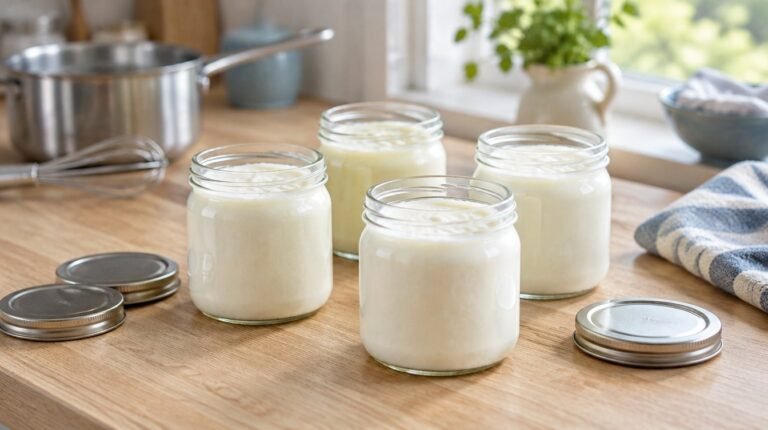
You will need: 1 quart of pasteurized whole or 2% milk, a starter that lists L. helveticus plus S. thermophilus (or an L. helveticus capsule plus 2 tablespoons of live plain yogurt), a heavy pot, an instant-read thermometer, clean jars and an incubator that holds 108 to 112°F for 12 hours.
- Clean everything. Wash the pot, whisk, thermometer and jars in hot, soapy water and rinse well. A long ferment gives stray microbes more time to grow.
- Heat the milk to 185°F (85°C). Warm it gently without boiling and hold it at 185 to 200°F for 10 to 20 minutes (UAF Extension). Longer holds give a thicker yogurt.
- Cool to 110 to 112°F (43 to 44°C). Use a cold-water bath and stir. Never add culture above 115°F.
- Add the starter. Stir the packet amount, or the capsule contents and yogurt, into a cup of the warm milk, then mix it back into the pot. Scaling up? See how much starter for a gallon of milk.
- Fill and cover the jars. Loose lids are fine.
- Incubate at 108 to 112°F (42 to 44°C) for 12 hours. Keep the jars still and check the temperature a few times. Our guides to how to incubate yogurt and how long to incubate yogurt cover setups and timing.
- Check at 6 hours. A mixed culture is often set by then. Chill it now for a milder yogurt, or let it run to 12 hours for the full tang.
- Chill. Refrigerate at 40°F (4°C) or colder. The UAF guide gives about 10 to 21 days of keeping time; see how long homemade yogurt lasts.
- Re-culture with care. In mixed cultures the balance between bacteria can shift from batch to batch. Restart from a fresh packet every few batches if you want L. helveticus to stay in the mix.
About capsules: a capsule on its own has no fast partner, so pure-capsule batches can take the full 12 hours or fail to set. Supplement labels are only required to list the total weight of microorganisms, which can include dead cells, and CFU counts are voluntary (NIH ODS). The spoonful of live plain yogurt is what makes the set reliable.
How to tell it worked

- It sets. The yogurt holds together and pulls away cleanly from the side of the jar when tilted.
- The pH is 4.6 or lower. That is the FDA mark for yogurt (21 CFR 131.200) and the set point in the UAF guide. Food-grade pH strips work. A 12-hour L. helveticus batch often reads lower, which is normal.
- It tastes clean, sharp and tart. A 12-hour batch is noticeably more sour than store yogurt. Off smells, fizz, pink or orange spots are not normal.
- Know the limits. A good set and a low pH prove that acid-making bacteria grew. They do not tell you how much L. helveticus is in the jar; only a lab count can.
Common problems and fixes
| Problem | Likely cause | Fix |
|---|---|---|
| Still liquid at 12 hours | Capsule-only culture or weak starter | Add live plain yogurt or a mixed starter next time. |
| No set at all | Culture added too hot, or incubator ran above 115°F | Check the temperature at every step and verify the incubator with a thermometer. |
| Very sour, lots of whey | Ran long or the temperature crept up | Chill at 6 to 8 hours next time. See whey from yogurt. |
| Grainy or crumbly texture | Strong protein breakdown and acid over a long hold | Shorten the hold, or whisk gently after chilling. |
| Each batch weaker | Culture drift over many transfers | Start again from a fresh packet. |
| Mold, pink or orange spots, yeasty smell | Contamination | Throw it out and start over with clean equipment. |
The USDA advises throwing out yogurt with mold, because soft foods can be contaminated below the surface and bacteria can grow alongside the mold (USDA FSIS, Molds on Food). Do not taste a batch that smells wrong. If you like the extra tang on purpose, see how to make sour yogurt.
This article is general information about home fermentation and is not medical advice.
Related topics
- Streptococcus thermophilus: How to Culture It at Home: the fast partner that sets the milk.
- Lactobacillus acidophilus: How to Culture It at Home: a close relative at the same temperature.
- Lactobacillus bulgaricus: How to Culture It at Home: the classic yogurt rod.
- Yogurt Temperature: how heat shapes each culture.
- Fermented Cheese: where L. helveticus does most of its work.
Sources
- 21 CFR 131.200 Yogurt (U.S. Food and Drug Administration, Electronic Code of Federal Regulations)
- Making Yogurt at Home (University of Alaska Fairbanks Cooperative Extension Service)
- Lactobacillus helveticus, Taxonomy Browser (National Center for Biotechnology Information)
- Molds on Food: Are They Dangerous? (USDA Food Safety and Inspection Service)
- Probiotics: Fact Sheet for Health Professionals (NIH Office of Dietary Supplements)
- Probiotics: What You Need To Know (National Center for Complementary and Integrative Health)
- Dietary Supplements (U.S. Food and Drug Administration)
- Giraffa G. Lactobacillus helveticus: importance in food and health (Front Microbiol, 2014)
- Griffiths MW, Tellez AM. Lactobacillus helveticus: the proteolytic system (Front Microbiol, 2013)
- Taverniti V, Guglielmetti S. Health-promoting properties of Lactobacillus helveticus (Front Microbiol, 2012)
- Zheng J, et al. A taxonomic note on the genus Lactobacillus: description of 23 novel genera, emended description of the genus Lactobacillus Beijerinck 1901, and union of Lactobacillaceae and Leuconostocaceae (Int J Syst Evol Microbiol, 2020)
- Callanan M, et al. Genome sequence of Lactobacillus helveticus, an organism distinguished by selective gene loss and insertion sequence element expansion (J Bacteriol, 2008)
- Hata Y, et al. A placebo-controlled study of the effect of sour milk on blood pressure in hypertensive subjects (Am J Clin Nutr, 1996)
- Seppo L, et al. A fermented milk high in bioactive peptides has a blood pressure-lowering effect in hypertensive subjects (Am J Clin Nutr, 2003)
- Cicero AF, et al. Do the lactotripeptides isoleucine-proline-proline and valine-proline-proline reduce systolic blood pressure in European subjects? A meta-analysis of randomized controlled trials (Am J Hypertens, 2013)
- Tanihiro R, et al. Effects of heat-treated Lactobacillus helveticus CP790-fermented milk on gastrointestinal health in healthy adults: a randomized double-blind placebo-controlled trial (Nutrients, 2024)
- Messaoudi M, et al. Assessment of psychotropic-like properties of a probiotic formulation (Lactobacillus helveticus R0052 and Bifidobacterium longum R0175) in rats and human subjects (Br J Nutr, 2011)
- Ospanova A, et al. Modeling growth of Lactobacillus helveticus and Kluyveromyces marxianus isolated from fermented camel milk (shubat) (Front Microbiol, 2026)
- Zhao X, et al. Fermentation characteristics of fermented milk with Streptococcus thermophilus CICC 6063 and Lactobacillus helveticus CICC 6064 and volatile compound dynamic profiles during fermentation and storage (Molecules, 2024)