Lactobacillus plantarum: How to Culture It at Home (86-95°F / 24h)
What Lactobacillus plantarum is
Lactobacillus plantarum, now officially Lactiplantibacillus plantarum, is a lactic acid bacterium that turns up almost everywhere food ferments. A genome study of 54 strains from different habitats found it in a wide variety of places and described its lifestyle as “nomadic,” with no strain group tied to one home (Martino et al., 2016). Its genome carries swappable clusters of genes for using different sugars, which is why one review called it “a natural metabolic engineer” (Siezen and van Hylckama Vlieg, 2011).
Its name means “of plants,” and its home turf is the vegetable crock. The species’ reference strain was isolated from pickled cabbage and is grown at 30°C, or 86°F (DSMZ), and it is one of the main lactic acid bacteria found in commercial sauerkraut (Plengvidhya et al., 2007).
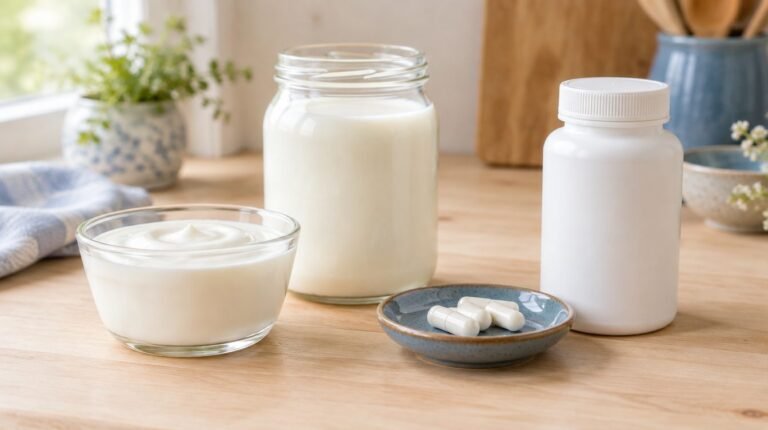
Milk is a harder fit. Researchers note that L. plantarum has “poor proteolytic ability,” meaning it breaks down milk protein poorly, and acidifies milk weakly (Hang et al., 2020). So lactobacillus plantarum yogurt needs a cooler, longer ferment than ordinary yogurt: 86 to 95°F (30 to 35°C) for about 24 hours, plus a little extra food. Standard yogurt incubates at 108 to 115°F for 6 to 10 hours (University of Illinois Extension).
Taxonomy at a glance
| Domain | Phylum | Genus | Species | Strain |
|---|---|---|---|---|
| Bacteria | Bacillota (formerly Firmicutes) | Lactiplantibacillus (formerly Lactobacillus) | L. plantarum | Varies by product, for example 299v (DSM 9843) or P-8 |
In 2020, taxonomists split the old genus Lactobacillus into 25 genera based on whole-genome comparisons, and L. plantarum moved to the new genus Lactiplantibacillus (Zheng et al., 2020). The List of Prokaryotic names with Standing in Nomenclature (LPSN) lists Lactiplantibacillus plantarum as the correct name, in risk group 1, the lowest-risk category. The phylum name Bacillota replaced Firmicutes in 2021 (Oren and Garrity, 2021).
The abbreviation stays the same, L. plantarum, so older and newer labels match. As always, the strain code is what links a product to a study, and strains of this species differ a lot from one another.
What the research shows
L. plantarum has a long history in food fermentation and is used both as a starter and as a probiotic (Behera et al., 2018). Most human trials, though, tested one strain, 299v, in capsules or drinks, not homemade yogurt.
IBS symptoms (strain 299v): mixed results
In a 4-week double-blind trial of 214 adults with irritable bowel syndrome, the 299v group reported less abdominal pain and bloating than the placebo group (Ducrotté et al., 2012). An earlier 4-week trial of 40 patients also reported strong benefits (Niedzielin et al., 2001). But an 8-week trial in South Africa found no difference from placebo in pain relief or quality of life, with a large placebo effect in both groups (Stevenson et al., 2014). Taken together, the evidence is mixed, and none of it shows the strain treats IBS.
Iron absorption (strain 299v)
In two small single-blind crossover trials in women, a fruit drink with 299v raised absorption of the iron in the drink from about 18.5% to 28.6% in one trial of 10 women; with a higher dose in a second trial of 11 women, the difference did not reach statistical significance (Hoppe et al., 2015). An oat gruel fermented with live 299v also raised iron absorption from a meal in 24 women (Bering et al., 2006). Yet adding freeze-dried 299v to a heat-treated fermented gruel made no difference in 18 women (Bering et al., 2007). These are short, lab-style absorption studies, not proof that the strain fixes low iron.
Why L. plantarum is slow in milk, and what helps
The problem is mostly food, not temperature. In a 2023 study, a non-dairy L. plantarum strain grew poorly in milk, and changing the type of milk, sugar, temperature or time did not fix it. What did help was soluble protein, as in yeast extract and malt extract (Phirom-On et al., 2023). In another study, adding oat extract or malt extract to milk sped up the growth of a different strain at 35°C, with oat extract working best (Hang et al., 2020).
Strains vary. In a study of bacteria isolated from the human gut, every exopolysaccharide-producing strain tested, including L. plantarum H2, could grow in and acidify milk, and H2 thickened stirred fermented milk about as well as a standard yogurt bacterium (Salazar et al., 2009). Another option is to add L. plantarum to a regular yogurt batch: in one lab study, milk fermented with strain P-8 alongside ordinary yogurt bacteria showed no change in acidity, viscosity or whey separation compared with yogurt made without it (Dan et al., 2019).
For home use, that means three things. Add milk solids, consider a small amount of malt extract, and accept a softer, milder result than store-bought yogurt.
Before you start: a short safety note
In healthy people, probiotics may cause gas but rarely cause infections; in people who are seriously ill or have weak immune systems, they can cause bacterial infections (NIH Office of Dietary Supplements). The risk of harmful effects is greater in people with severe illnesses or compromised immune systems (NCCIH). If that applies to you, or you are pregnant or making this for an infant, check with your health care provider first.
Probiotic capsules are usually sold as dietary supplements, and their makers, not the FDA, are responsible for checking safety and labeling before sale (FDA). This article is general information, not medical advice.
Home protocol: L. plantarum yogurt at 86-95°F for 24 hours
This makes 1 quart. Plan on about 30 minutes of hands-on time, 24 hours of incubation and at least 6 hours in the fridge.
Equipment
- An incubator that holds 86 to 95°F: a yogurt maker with an adjustable temperature, a proofing box, or an oven with only the light on, checked with a thermometer. Many yogurt makers are built for higher temperatures, so test yours with water first. See How to Incubate Yogurt.
- A probe thermometer.
- Clean glass jars with lids.
Ingredients
- 1 quart (946 mL) whole milk.
- 1/4 cup nonfat dry milk for extra protein and a thicker set.
- Optional: 1 tablespoon dry malt extract, the plain kind sold for baking or brewing. It is a home stand-in for the malt extract used in the lab studies; no study has tested this exact amount.
- L. plantarum starter: a capsule or powder that lists L. plantarum or Lactiplantibacillus plantarum, ideally with a strain code. Start with the label’s serving size, and see how much starter to use to scale up.
Steps
- Whisk the dry milk and malt extract into the cold milk and heat slowly to 180 to 185°F (82 to 85°C), stirring (University of Illinois Extension). Heating to 180°F kills competing bacteria and changes the whey proteins so the milk sets (University of Missouri Extension). This matters more than usual, because a slow culture at a mild temperature gives other microbes more time.
- Cool to 90°F (32°C). Do not add the culture above 95°F.
- Stir the starter into a few spoonfuls of the warm milk until smooth, then stir it into the rest.
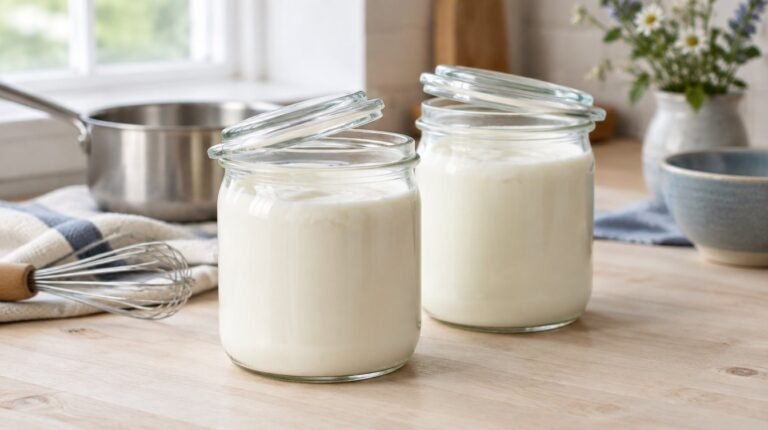
- Pour into jars and close the lids.
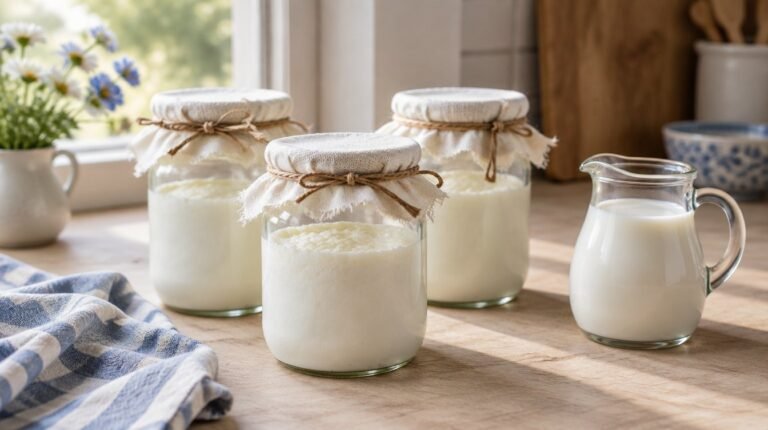
- Incubate at 86 to 95°F for 24 hours without moving the jars. Check one at 18 hours; stop when it has thickened and smells pleasantly sour.
- Chill at 40°F or below for at least 6 hours.
- Eat within 14 days (University of Illinois Extension).
If you want a firmer yogurt, the other route is a normal batch made with a standard starter at 108 to 115°F, with L. plantarum added alongside it. Yogurt Temperature explains how each temperature range changes the result, and our L. reuteri guide shows another long, low-temperature ferment.
How to tell it worked
- Texture: a soft set or a thick, pourable yogurt. Some strains thicken more than others.
- Smell and taste: clean and sour, more like buttermilk than vinegar. In one milk study, most lactobacilli made lactic acid as their main product (Salazar et al., 2009).
- Acidity (optional): pH strips should show a clear drop from fresh milk’s 6.7. In a lab study of other probiotic lactobacilli and a bifidobacterium in milk at 37°C, pH reached 3.9 to 4.4 after 24 hours (Østlie et al., 2003). A weak-acidifying plantarum batch may stop higher.
- No change after 24 hours means the culture did not grow, or the milk was too hot when it went in.
You cannot confirm at home which bacteria grew or how many are alive. That takes lab plating. A clean sour smell and a thickened texture are the best signs you have.
Failure modes and fixes
| Problem | Likely cause | Fix |
|---|---|---|
| Still liquid after 24 hours | Weak growth in milk, or culture added too hot | Add the dry milk and malt extract, add the culture at 90°F, and confirm the incubator temperature |
| Slightly thick, barely sour | A strain that acidifies milk slowly | Give it the full 24 hours, or add it to a standard yogurt batch instead |
| Lumpy curds and lots of whey | Incubator ran hot, or fermented too long | Keep to 86 to 95°F and stop as soon as it sets |
| Fizzy, yeasty, cheesy or rotten smell | Contamination | Discard, wash jars and tools in hot soapy water, start over |
| Fuzzy spots, or pink, orange or dark patches | Mold or spoilage | Throw out the whole batch |
The USDA says to discard yogurt with mold, since moist foods can be contaminated below the surface and bacteria may grow along with the mold (USDA FSIS). If a clean-smelling batch just weeps whey, see Whey from Yogurt.
Where L. plantarum does best: vegetables
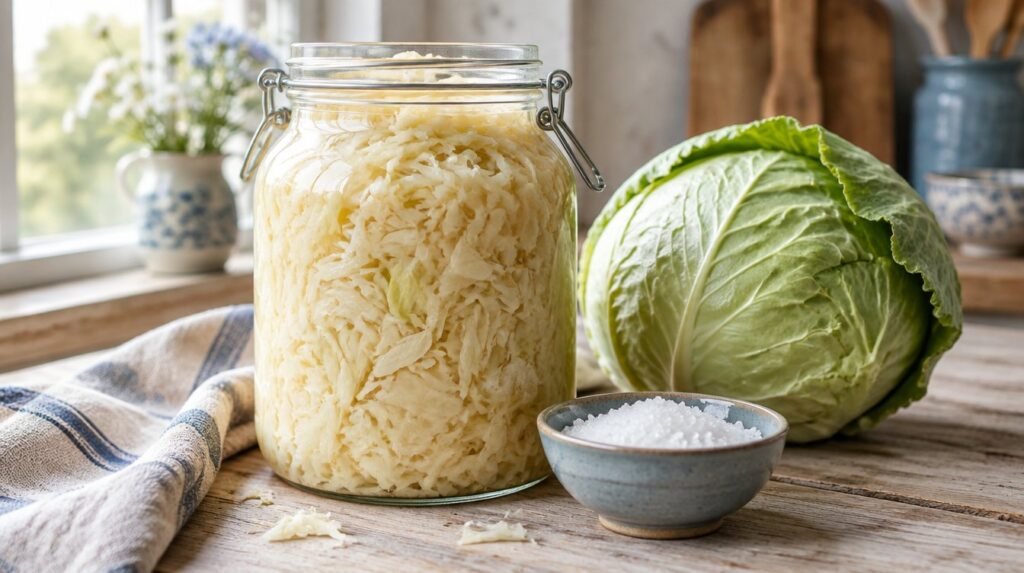
If you want this bacterium in your diet, a vegetable ferment may be easier than milk. Sauerkraut is fermented at a cooler 70 to 75°F for about 3 to 4 weeks, and above 75°F it may turn soft (National Center for Home Food Preservation). Wild sauerkraut relies on bacteria already on the cabbage, and L. plantarum is one of the main species found in it (Plengvidhya et al., 2007), so no capsule is needed. See Raw Sauerkraut for what to look for in store-bought jars.
Reusing a milk batch as starter is not reliable with this species. Use a fresh capsule each time, for the reasons in Heirloom Starter Weakened Over Time.
Why is L. plantarum fermented cooler than regular yogurt?
It is a plant-associated bacterium; its reference strain is grown at 86°F (30°C), far below the 108 to 115°F that yogurt bacteria prefer (DSMZ).
Is Lactiplantibacillus plantarum the same as Lactobacillus plantarum?
Yes. The species was moved to the new genus Lactiplantibacillus in 2020; the bacterium is the same.
Can I use L. plantarum to make non-dairy yogurt?
Many strains grow well on plant foods, but results in nut or oat bases vary by strain and recipe, so start with a small batch.
Related topics
- Lactobacillus reuteri: another low-temperature, 24-hour culture.
- Lactococcus lactis: a room-temperature dairy culture.
- Leuconostoc mesenteroides: the bacterium that often starts vegetable ferments.
- Sauerkraut Benefits: what the research says about fermented cabbage.
- Yogurt Starter: choosing and handling starter cultures.
- How Long to Incubate Yogurt: how time changes tang and texture.
Sources
- Martino ME, et al. Nomadic lifestyle of Lactobacillus plantarum revealed by comparative genomics of 54 strains isolated from different habitats (Environmental Microbiology, 2016)
- Siezen RJ, van Hylckama Vlieg JE. Genomic diversity and versatility of Lactobacillus plantarum, a natural metabolic engineer (Microbial Cell Factories, 2011)
- Lactiplantibacillus plantarum DSM 20174 (type strain) (DSMZ German Collection of Microorganisms and Cell Cultures)
- Plengvidhya V, et al. DNA fingerprinting of lactic acid bacteria in sauerkraut fermentations (Applied and Environmental Microbiology, 2007)
- Hang F, et al. Preliminary study for the stimulation effect of plant-based meals on pure culture Lactobacillus plantarum growth and acidification in milk fermentation (Journal of Dairy Science, 2020)
- Making Yogurt at Home (University of Illinois Extension)
- Zheng J, et al. A taxonomic note on the genus Lactobacillus: description of 23 novel genera, emended description of the genus Lactobacillus Beijerinck 1901, and union of Lactobacillaceae and Leuconostocaceae (International Journal of Systematic and Evolutionary Microbiology, 2020)
- Species: Lactiplantibacillus plantarum (LPSN, Leibniz Institute DSMZ)
- Oren A, Garrity GM. Valid publication of the names of forty-two phyla of prokaryotes (International Journal of Systematic and Evolutionary Microbiology, 2021)
- Behera SS, et al. Lactobacillus plantarum with functional properties: an approach to increase safety and shelf-life of fermented foods (BioMed Research International, 2018)
- Ducrotté P, et al. Clinical trial: Lactobacillus plantarum 299v (DSM 9843) improves symptoms of irritable bowel syndrome (World Journal of Gastroenterology, 2012)
- Niedzielin K, et al. A controlled, double-blind, randomized study on the efficacy of Lactobacillus plantarum 299V in patients with irritable bowel syndrome (European Journal of Gastroenterology and Hepatology, 2001)
- Stevenson C, et al. Randomized clinical trial: effect of Lactobacillus plantarum 299 v on symptoms of irritable bowel syndrome (Nutrition, 2014)
- Hoppe M, et al. Probiotic strain Lactobacillus plantarum 299v increases iron absorption from an iron-supplemented fruit drink: a double-isotope cross-over single-blind study in women of reproductive age (British Journal of Nutrition, 2015)
- Bering S, et al. A lactic acid-fermented oat gruel increases non-haem iron absorption from a phytate-rich meal in healthy women of childbearing age (British Journal of Nutrition, 2006)
- Bering S, et al. Viable, lyophilized lactobacilli do not increase iron absorption from a lactic acid-fermented meal in healthy young women, and no iron absorption occurs in the distal intestine (British Journal of Nutrition, 2007)
- Phirom-On K, et al. Understanding the hindrance factor of bacterial proliferation and γ-aminobutyric acid-producing capability of nondairy strains of Lactiplantibacillus plantarum in milk fermentation (Scientific Reports, 2023)
- Salazar N, et al. Production of exopolysaccharides by Lactobacillus and Bifidobacterium strains of human origin, and metabolic activity of the producing bacteria in milk (Journal of Dairy Science, 2009)
- Dan T, et al. Influence of Lactobacillus plantarum P-8 on fermented milk flavor and storage stability (Frontiers in Microbiology, 2019)
- Probiotics: Fact Sheet for Consumers (NIH Office of Dietary Supplements)
- Probiotics: Usefulness and Safety (National Center for Complementary and Integrative Health)
- Dietary Supplements (U.S. Food and Drug Administration)
- Preserve It Fresh, Preserve It Safe: 2019, No. 1 (University of Missouri Extension)
- Østlie HM, et al. Growth and metabolism of selected strains of probiotic bacteria in milk (International Journal of Food Microbiology, 2003)
- Molds on Food: Are They Dangerous? (USDA Food Safety and Inspection Service)
- How Do I Ferment? Sauerkraut (National Center for Home Food Preservation, University of Georgia)