Bifidobacterium longum: How to Culture It at Home (100-105°F / 24h)
What Bifidobacterium longum is
Bifidobacterium longum is one of the most common bifidobacteria in the human gut, found in babies and adults alike. When researchers sequenced an infant-derived strain, they found an unusually large share of its genes devoted to breaking down complex sugars, including plant fibers that people cannot digest on their own, which helps explain how it holds its place in the colon (Schell et al., 2002). The reference strain kept by the German culture collection DSMZ was isolated from the intestine of an adult and is grown without oxygen at 37°C, or 98.6°F (DSMZ).
That last detail tells you most of what you need to know before making bifidobacterium longum yogurt. This is a body-temperature, low-oxygen organism, not a yogurt bacterium. Researchers at a Japanese dairy company described growing bifidobacteria in milk as “a difficult and industrially valuable task” (Yonezawa et al., 2010). The home protocol below uses 100 to 105°F (38 to 41°C) for about 24 hours, plus a few tricks to make milk a friendlier place.
For comparison, ordinary homemade yogurt incubates at 108 to 115°F for 6 to 10 hours (University of Illinois Extension). Expect a slower, softer and milder result than that.
Taxonomy at a glance
| Domain | Phylum | Genus | Species | Strain |
|---|---|---|---|---|
| Bacteria | Actinomycetota (formerly Actinobacteria) | Bifidobacterium | B. longum (subspecies longum, infantis, suis and others) | Varies by product, for example BB536, 1714 or NCC3001 |
The List of Prokaryotic names with Standing in Nomenclature (LPSN) lists B. longum (first described in 1963) as a validly published species in risk group 1, the lowest-risk category. In 2008, taxonomists split the species into subspecies, so the bacterium once called B. infantis is now B. longum subsp. infantis, and most strains sold simply as “B. longum” belong to subsp. longum (Mattarelli et al., 2008). The phylum name Actinomycetota replaced Actinobacteria in 2021 (Oren and Garrity, 2021).
This matters on a label. A capsule that says “B. longum” with no subspecies or strain code could hold any of several quite different bacteria. The strain code is what ties a product to a particular study. Our guide to Bifidobacterium infantis covers the infant-adapted subspecies separately.
What the research shows
Human studies of B. longum test single strains, usually as capsules or powders, and many were run or funded by the company that owns the strain. None tested homemade yogurt, so treat these results as background on the species, not as a promise for your jar.
Pollen allergy symptoms (strain BB536)
In a 13-week double-blind trial, 44 adults with Japanese cedar pollen allergy took BB536 or a placebo during pollen season. The BB536 group reported less runny nose and nasal blockage, and fewer dropped out because of severe symptoms (Xiao et al., 2006). The study was small, the authors work for the strain’s maker, and it does not show that the strain prevents allergies.
Stress and memory in healthy volunteers (strain 1714)
In a study of 22 healthy volunteers who each took a placebo and then the 1714 strain, the rise in cortisol and anxiety during a lab stress test was smaller after the probiotic, and daily reported stress was lower (Allen et al., 2016). The authors called the memory changes “subtle.” With 22 people and one group, this is an early signal, not proof of a mood benefit.
Mood in adults with IBS (strain NCC3001)
In a 6-week double-blind pilot trial of 44 adults with irritable bowel syndrome and mild to moderate anxiety or depression, 14 of 22 people taking NCC3001 had a drop in depression scores, compared with 7 of 22 on placebo. The strain did not improve anxiety or IBS symptoms (Pinto-Sanchez et al., 2017). It is a pilot study, and it does not show that B. longum treats depression or IBS.
Lactose digestion
In a small crossover study of 15 people who do not digest lactose well, milk containing B. longum led to less breath hydrogen than plain milk, but only when the bacteria had been grown on lactose alone, which raised their lactose-splitting enzyme (Jiang et al., 1996). How a culture is grown changed the result, a useful reminder that one strain can behave very differently from batch to batch.
Why B. longum struggles in milk, and what helps

Two problems stand out in the dairy research. Bifidobacteria grow better in milk when its casein has been broken into small pieces (Yonezawa et al., 2010), and their survival improves with oxygen-tight containers and added peptides and amino acids (Shah, 2000). The studies point to four fixes you can copy at home.
- Feed it small proteins. In yogurts made with a mixed starter, adding cysteine, whey protein concentrate, casein hydrolysate or tryptone improved bifidobacteria survival, while plain whey powder did not; the authors linked the benefit to peptides and amino acids (Dave and Shah, 1998).
- Keep oxygen out. When BB536 was grown with a particular Lactococcus lactis strain, dissolved oxygen stayed lower during storage and more bifidobacteria survived (Odamaki et al., 2011). An earlier study found that some Lactococcus strains also boosted bifidobacteria growth in skim milk by breaking casein into usable amino acids (Yonezawa et al., 2010).
- Add a fiber it likes. In a 2025 study, adding inulin to a co-culture of a B. longum strain with Lactobacillus paracasei raised B. longum counts about a hundredfold (Xiao et al., 2025).
- Do not expect long shelf life. In lab yogurts stored at 39°F (4°C), BB536 stayed above one million live cells per gram for 28 days, but its presence also cut the survival of the regular yogurt bacteria (Xie et al., 2024).
Lactococcus cultures are normally fermented at room temperature, well below the range used here, so that trick belongs in a factory more than a home kitchen; see Lactococcus lactis for how those cultures behave. Nonfat dry milk, inulin and full, tightly closed jars are the practical home versions.
Before you start: a short safety note
In healthy people, probiotics rarely cause problems beyond gas, but they can cause infections in people who are seriously ill or have weak immune systems (NIH Office of Dietary Supplements). The risk of harmful effects is greater in people with severe illnesses or compromised immune systems (NCCIH). If that describes you, or if you are pregnant or making this for a baby, talk with your health care provider first.
Probiotic capsules are usually sold as dietary supplements, and their makers, not the FDA, are responsible for checking safety and labeling before sale (FDA). This article is general information, not medical advice.
Home protocol: B. longum yogurt at 100-105°F for 24 hours
This makes 1 quart. Allow about 30 minutes of hands-on time, 24 hours of incubation and at least 6 hours in the fridge.
Equipment
- An incubator that holds 100 to 105°F for a full day: an adjustable yogurt maker, a multicooker with a low yogurt setting, or a proofing box. See How to Incubate Yogurt.
- A probe thermometer, to check your incubator with a jar of warm water before you trust its dial.
- Small glass jars with tight lids, so each one can be filled to the rim with little air on top.
Ingredients
- 1 quart (946 mL) whole milk: fat and solids give weak-setting cultures a better texture.
- 1/4 cup nonfat dry milk: more milk protein and a thicker result.
- 1 teaspoon inulin powder: a fiber bifidobacteria can use.
- B. longum starter: a capsule or powder that names B. longum, ideally with a subspecies and strain code. Start with the label’s serving size; our guide on how much starter to use explains how to scale up.
- Optional helper: a pinch of a mild starter based on Streptococcus thermophilus, for a firmer set.
Steps
- Whisk the dry milk into the cold milk, then heat slowly to 180 to 185°F (82 to 85°C), stirring gently (University of Illinois Extension). Heating to 180°F kills competing bacteria and changes the whey proteins so the milk sets better (University of Missouri Extension). It also drives off some dissolved air.
- Cool to 102°F (39°C) without whisking. Never add the culture above 105°F.
- Mix the starter and inulin into a few spoonfuls of the warm milk until smooth, then fold it gently into the rest so you do not beat in air.
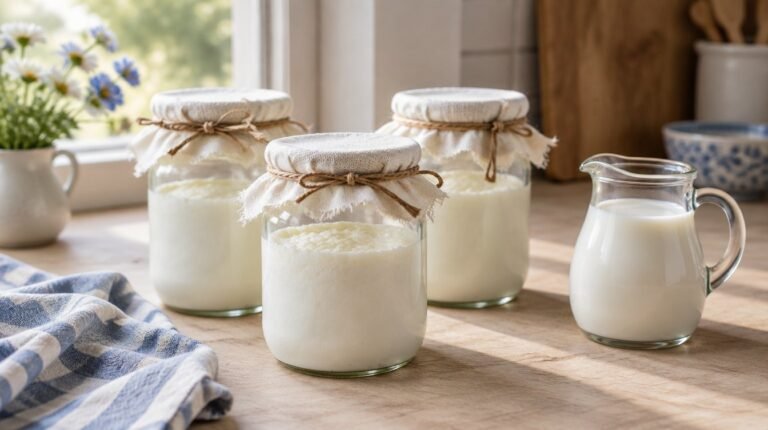
- Fill the jars to the rim and close them tightly.
- Incubate at 100 to 105°F for 24 hours without moving the jars. Check one jar at 16 hours; if it has set and smells pleasantly tangy, you can stop early.
- Chill straight away at 40°F or below for at least 6 hours.
- Eat within 14 days for food safety (University of Illinois Extension). In one lab study, B. longum and other bifidobacteria tolerated cold storage less well than an L. acidophilus strain (Hughes and Hoover, 1995), so sooner is better if live bacteria are the point.
Yogurt Temperature explains what each temperature band does to texture and tang, and why a few degrees matter with slow cultures.
How to tell it worked
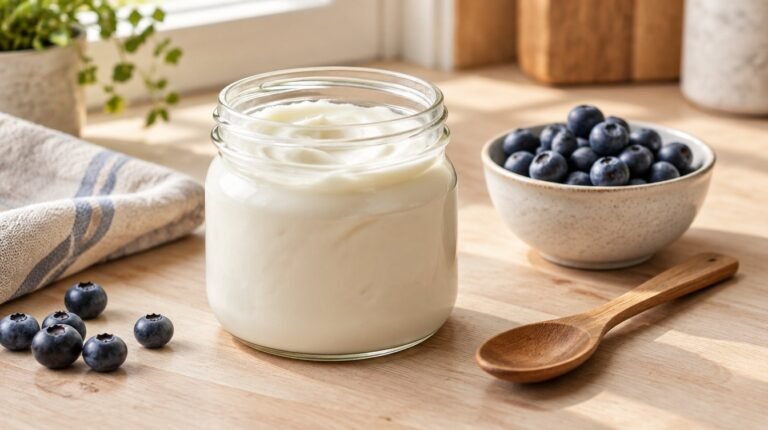
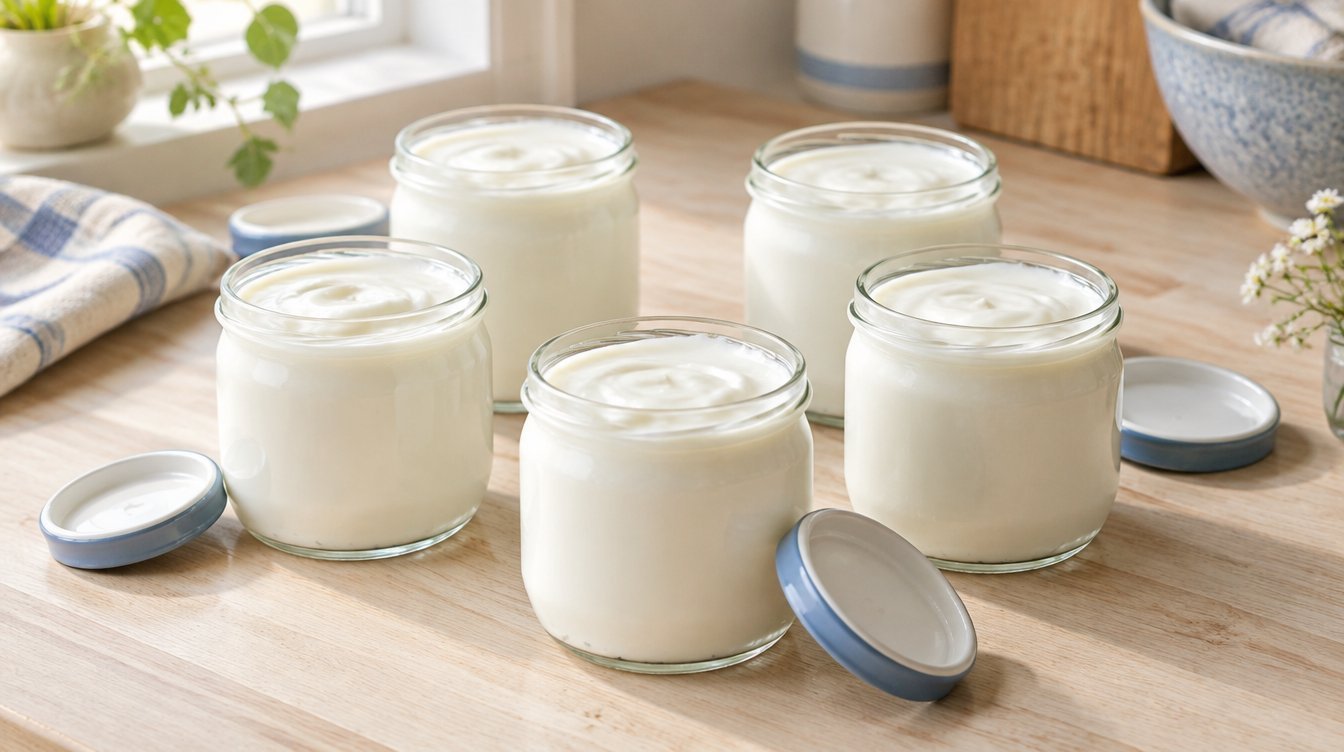
- Texture: a soft spoonable set or a thick, drinkable yogurt. Single-strain bifidobacterium batches are often looser than ordinary yogurt.
- Smell and taste: clean and tangy, sometimes with a faint vinegar note. Bifidobacteria make acetic acid as well as lactic acid; in milk ferments by several strains, B. longum among them, the lactic-to-acetic ratio was about 0.7 (Salazar et al., 2009).
- Acidity (optional): pH strips should show a clear drop from fresh milk’s 6.7. In a lab study of other probiotic strains in milk at 37°C, pH fell to 3.9 to 4.4 within 24 hours (Østlie et al., 2003); a slow B. longum batch may stop higher.
- No change at all after 24 hours means the culture did not grow.
At home you cannot confirm that B. longum itself grew or count how many are alive. That takes selective lab media (Shah, 2000). If you added a helper culture, assume the helper did much of the thickening.
Failure modes and fixes
| Problem | Likely cause | Fix |
|---|---|---|
| Still liquid, smells like milk | Weak or dead starter, or milk too hot when it went in | Use a fresh starter, add it at 102°F, and check the incubator with a thermometer |
| Slightly thick but barely sour | Slow growth, which is common for B. longum in plain milk | Keep the dry milk and inulin, fill jars to the rim, or add a mild helper culture |
| Sharp, vinegary and split | Fermented too long or too warm | Stop at 16 to 20 hours and keep the temperature near 100°F |
| Fizzy, yeasty or cheesy smell | Contamination | Discard, wash jars and tools in hot soapy water, and start again |
| Fuzzy spots, or pink, orange or dark patches | Mold or spoilage | Throw out the whole batch |
The USDA advises discarding yogurt with mold, because moist foods can be contaminated below the surface and bacteria may grow along with the mold (USDA FSIS). If a batch only weeps a little clear whey but smells clean, it is usually fine; see Whey from Yogurt.
Can you reuse a batch as starter?
It is better not to count on it. B. longum is sensitive to acid and air, so each reused batch is likely to carry fewer of them while hardier bacteria, including any helper, take over. If you try, use 2 tablespoons from a fresh, clean batch within a few days, and go back to a new capsule as soon as the set or tang fades. Heirloom Starter Weakened Over Time describes the same pattern.
Why ferment B. longum for 24 hours instead of 8?
It grows slowly in milk at body temperature, so it needs far longer than ordinary yogurt bacteria, which incubate at 108 to 115°F for 6 to 10 hours.
Is B. longum the same as B. infantis?
B. infantis is now classified as a subspecies of B. longum, B. longum subsp. infantis, but the two behave differently (Mattarelli et al., 2008).
Can I use a multi-strain capsule?
Yes, but the faster bacteria in the blend will likely dominate, so you will not know how much of the result came from B. longum.
Related topics
- Bifidobacterium breve: a close relative with a similar 24-hour protocol.
- Bifidobacterium infantis: the infant-adapted subspecies of B. longum.
- Bifidobacterium animalis subsp. lactis: the bifidobacterium that copes best with milk.
- Yogurt Starter: how to choose and handle starter cultures.
- How Long to Incubate Yogurt: how time changes tang and texture.
- Best Yogurt for Probiotics: store-bought yogurts that list bifidobacteria.
Sources
- Schell MA, et al. The genome sequence of Bifidobacterium longum reflects its adaptation to the human gastrointestinal tract (Proceedings of the National Academy of Sciences, 2002)
- Bifidobacterium longum subsp. longum DSM 20219 (type strain) (DSMZ German Collection of Microorganisms and Cell Cultures)
- Yonezawa S, et al. Improved growth of bifidobacteria by cocultivation with Lactococcus lactis subspecies lactis (Journal of Dairy Science, 2010)
- Making Yogurt at Home (University of Illinois Extension)
- Species: Bifidobacterium longum (LPSN, Leibniz Institute DSMZ)
- Mattarelli P, et al. Proposal to reclassify the three biotypes of Bifidobacterium longum as three subspecies (International Journal of Systematic and Evolutionary Microbiology, 2008)
- Oren A, Garrity GM. Valid publication of the names of forty-two phyla of prokaryotes (International Journal of Systematic and Evolutionary Microbiology, 2021)
- Xiao JZ, et al. Probiotics in the treatment of Japanese cedar pollinosis: a double-blind placebo-controlled trial (Clinical and Experimental Allergy, 2006)
- Allen AP, et al. Bifidobacterium longum 1714 as a translational psychobiotic: modulation of stress, electrophysiology and neurocognition in healthy volunteers (Translational Psychiatry, 2016)
- Pinto-Sanchez MI, et al. Probiotic Bifidobacterium longum NCC3001 reduces depression scores and alters brain activity: a pilot study in patients with irritable bowel syndrome (Gastroenterology, 2017)
- Jiang T, et al. Improvement of lactose digestion in humans by ingestion of unfermented milk containing Bifidobacterium longum (Journal of Dairy Science, 1996)
- Shah NP. Probiotic bacteria: selective enumeration and survival in dairy foods (Journal of Dairy Science, 2000)
- Dave RI, Shah NP. Ingredient supplementation effects on viability of probiotic bacteria in yogurt (Journal of Dairy Science, 1998)
- Odamaki T, et al. Improved viability of bifidobacteria in fermented milk by cocultivation with Lactococcus lactis subspecies lactis (Journal of Dairy Science, 2011)
- Xiao M, et al. Stimulation of Bifidobacterium longum viability and fermented milk quality by co-culture with Lactobacillus paracasei and inulin (Food Research International, 2025)
- Xie Z, et al. Effects of 2′-fucosyllactose on the viability of starter cultures and Bifidobacterium strains of human origin in yogurt during refrigerated storage (Journal of Food Science, 2024)
- Probiotics: Fact Sheet for Consumers (NIH Office of Dietary Supplements)
- Probiotics: Usefulness and Safety (National Center for Complementary and Integrative Health)
- Dietary Supplements (U.S. Food and Drug Administration)
- Preserve It Fresh, Preserve It Safe: 2019, No. 1 (University of Missouri Extension)
- Hughes DB, Hoover DG. Viability and enzymatic activity of bifidobacteria in milk (Journal of Dairy Science, 1995)
- Salazar N, et al. Production of exopolysaccharides by Lactobacillus and Bifidobacterium strains of human origin, and metabolic activity of the producing bacteria in milk (Journal of Dairy Science, 2009)
- Østlie HM, et al. Growth and metabolism of selected strains of probiotic bacteria in milk (International Journal of Food Microbiology, 2003)
- Molds on Food: Are They Dangerous? (USDA Food Safety and Inspection Service)