Gut Health Gummies: What You Need to Know
What gut health gummies are
Gut health gummies are chewable supplements that carry live bacteria (probiotic gummies), fermentable fiber (prebiotic gummies), or both. A few also add postbiotics, which are bacteria that have been inactivated, usually by heat. The format is popular because it is easy to take, but a gummy is also a candy matrix with sugar or sweeteners, so the label matters more than the front of the bottle.
Ultimate Gut is published by Ultimate Health Solutions, which sells a yogurt maker, probiotic capsules and an inulin fiber supplement. None of the products reviewed here are ours, and these brands don’t pay us.
Like other supplements, gummies reach shelves without FDA review. The FDA is not authorized to approve dietary supplements for safety and effectiveness before they are marketed.
Why most probiotic gummies use Bacillus
Gummies are made by mixing ingredients into a hot syrup and letting the candy set. Researchers note that the food industry is turning to spore-forming bacteria to get probiotics through this kind of processing. Spores are a dormant, tough form that some bacteria make under stress. That helps explain why every probiotic gummy in the table below lists Bacillus coagulans or Bacillus subtilis rather than the lactobacilli found in yogurt. Newer papers call B. coagulans by its updated name, Heyndrickxia coagulans; labels still use the old one.
One study shows what this looks like in practice. In a single-arm trial of 24 healthy adults, a gummy carrying at least 1 billion CFU of H. coagulans SNZ1969 lost very little viability over 24 months at room temperature, and live bacteria were recovered from every participant’s stool during two weeks of daily use. The trial had no control group, did not measure any health outcome, and was funded by the candy maker, so it shows survival, not benefit.
What the research on these strains shows
Health research is strain-specific. The most-used gummy strain, B. coagulans MTCC 5856 (sold as LactoSpore), was studied in a double-blind pilot trial of 36 adults with diarrhea-predominant IBS. Those taking 2 billion CFU a day in tablet form for 90 days, alongside standard treatment, reported larger drops in bloating, diarrhea and abdominal pain than the placebo group. It was small, used tablets rather than gummies, and was run by researchers from the ingredient’s maker. Two gummies below provide 500 million or 1 billion CFU per serving, less than that trial used.
What the labels say
This table compares what six widely sold gummies list on their own product pages and Supplement Facts panels. It is not a ranking of effectiveness, and no gummy here has been compared with another in a published trial. Labels checked October 2026.
| Gummy (brand page) | Serving | Strain(s) as labeled | CFU per serving | Fiber or prebiotic | Sugar per serving |
|---|---|---|---|---|---|
| OLLY Probiotic + Prebiotic | 1 gummy | LactoSpore Bacillus coagulans MTCC 5856 | 500 million (timing not stated) | 1.1 g FOS and inulin blend | Less than 1 g; also contains xylitol |
| OLLY Extra Strength Probiotic | 2 gummies | B. coagulans MTCC 5856, B. subtilis DE111 | 6 billion (timing not stated) | None listed | 2 g (all added) |
| Align DualBiotic Prebiotic + Probiotic | 2 gummies | Bacillus coagulans (LactoSpore) | 1 billion until at least the best-by date | 2.5 g inulin | 1 g (all added) |
| Culturelle Probiotic + Prebiotic Gummies | 2 gummies | Proprietary blend of B. coagulans and B. subtilis (no strain IDs listed) | 2 billion, measured at expiration per the brand | 2 g inulin | 1 g (all added) |
| Goli Pre+Post+Probiotic | 3 gummies (suggested use) | Bacillus subtilis DE111, 10 mg; postbiotic L. paracasei MCC1849 (heat-treated) | No CFU listed on the page | 50 mg XOS | 5 g total sugars |
| Vitafusion Fiber Well Sugar Free | 2 or 3 gummies | None (fiber only) | Not applicable | 5 g or 7.5 g polydextrose | No sugar listed; 1 to 2 g sugar alcohol (sorbitol), plus sucralose |
Two things stand out. Only Align and Culturelle say their CFU count holds to the end of shelf life. And only the two OLLY products and Goli give a strain designation (such as MTCC 5856 or DE111) that you can look up in research. For more on single brands, see our reviews of Goli Pre Post Probiotic and Konsyl gut health gummies.
How to read a gummy label
- Find the strain, not just the species. A name like Bacillus coagulans MTCC 5856 points to specific studies. A species name alone does not tell you which research applies.
- Check when the CFU count applies. CFU counts can fall over time, and some products list the count at manufacture rather than at expiration. NIH’s Office of Dietary Supplements suggests choosing products that list CFUs through the expiration date.
- Count the sugar. Probiotic gummies in the table add 1 to 5 g of sugar per serving. The Dietary Guidelines for Americans, 2025-2030 say no amount of added sugar is recommended and that one meal should have no more than 10 g. On the ingredient list, look for words with “sugar” or “syrup” or ending in “-ose.”
- Watch sugar alcohols and fiber. Sugar-free gummies often use sorbitol or xylitol. Federal rules require foods that could supply 50 g of sorbitol a day to warn that excess consumption may have a laxative effect. Fiber added too fast can cause gas, bloating and cramping, so increase it slowly over a few weeks.
- Compare the dose with the research. If the studied amount was 2 billion CFU a day and your gummy gives 500 million, the study does not tell you what the smaller dose does.
- Know what postbiotic means. Postbiotic or heat-treated bacteria are not alive. They are a different ingredient from a live probiotic and have their own, separate research.
Are there probiotic gummies made for women?
Some gummies are sold as women’s formulas. The label tells you who the product is marketed to, not whether its strain was tested in women. Check the strain name and look for trials in women with the concern you have. Our guide to the best probiotic for women covers which strains have that research.
Who should be careful
- People who are seriously ill or immunocompromised: the risk of harmful effects from probiotics is greater with severe illness or a weakened immune system (NCCIH), and some reported serious infections involved hospital patients with a central venous catheter (NIH ODS). Ask a doctor first.
- Pregnant or breastfeeding: check with your doctor or midwife before starting any supplement.
- Children: gummies look and taste like candy. Store them where children cannot reach them, as the Vitafusion label also advises, and use only products labeled for a child’s age.
- People managing blood sugar: count gummy sugar toward your daily total, or choose a lower-sugar option.
- People sensitive to fiber or sugar alcohols: inulin, FOS, polydextrose and sorbitol can cause gas or loose stools. Start with one serving and see how you feel.
This article is general information, not medical advice.
Food first

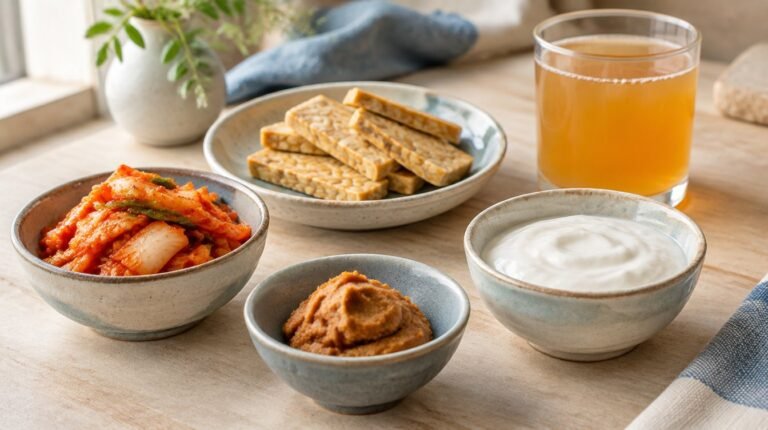
Gummies are optional. The Dietary Guidelines point to vegetables, fruits, high-fiber foods and fermented foods such as sauerkraut, kimchi, kefir and miso to support a diverse microbiome. Yogurt and kefir with live cultures give you bacteria without added candy sugar if you choose plain versions. See our guides to fermented foods for gut health and fiber supplements.
Related topics
- Best Probiotic: strain-by-strain evidence for common goals.
- Goli Pre Post Probiotic: a closer look at one popular gummy.
- Konsyl Gut Health Prebiotic-probiotic Fiber Gummies: a fiber-plus-probiotic gummy, label by label.
- Probiotic Strawberry Yoggies: another chewable probiotic format.
- Fiber Supplement: fiber types and doses used in research.
Sources
- Perotti S, et al. Human in vivo assessment of the survival and germination of Heyndrickxia coagulans SNZ1969 spores delivered via gummy candies (Current Research in Food Science, 2024)
- Majeed M, et al. Bacillus coagulans MTCC 5856 supplementation in the management of diarrhea predominant Irritable Bowel Syndrome: a double blind randomized placebo controlled pilot clinical study (Nutrition Journal, 2016)
- Probiotic + Prebiotic product page and Supplement Facts (OLLY, checked October 2026)
- Extra Strength Probiotics product page and Supplement Facts (OLLY, checked October 2026)
- Align DualBiotic Prebiotic + Probiotic Gummies product page and Supplement Facts (Align, checked October 2026)
- Probiotic + Prebiotic Gummies for Adults product page and Supplement Facts (Culturelle, checked October 2026)
- Probiotic+ Gummies product page and Supplement Facts (Goli Nutrition, checked October 2026)
- Fiber Well Sugar Free Gummy product page and Supplement Facts (Vitafusion, checked October 2026)
- Probiotics: Fact Sheet for Consumers (NIH Office of Dietary Supplements)
- Probiotics: Fact Sheet for Health Professionals (NIH Office of Dietary Supplements)
- Probiotics: Usefulness and Safety (National Center for Complementary and Integrative Health)
- Information for Consumers on Using Dietary Supplements (U.S. Food and Drug Administration)
- Dietary Guidelines for Americans, 2025-2030 (U.S. Department of Agriculture and U.S. Department of Health and Human Services)
- 21 CFR 184.1835 Sorbitol (Electronic Code of Federal Regulations)
- Dietary fiber: Essential for a healthy diet (Mayo Clinic)
This article is for general information and is not medical advice. Talk to your doctor or a registered dietitian before changing your diet, supplements or medication, especially if you have a health condition.