Probiotic Strawberry Yoggies: A Buyer’s Guide
What Probiotic Strawberry Yoggies are
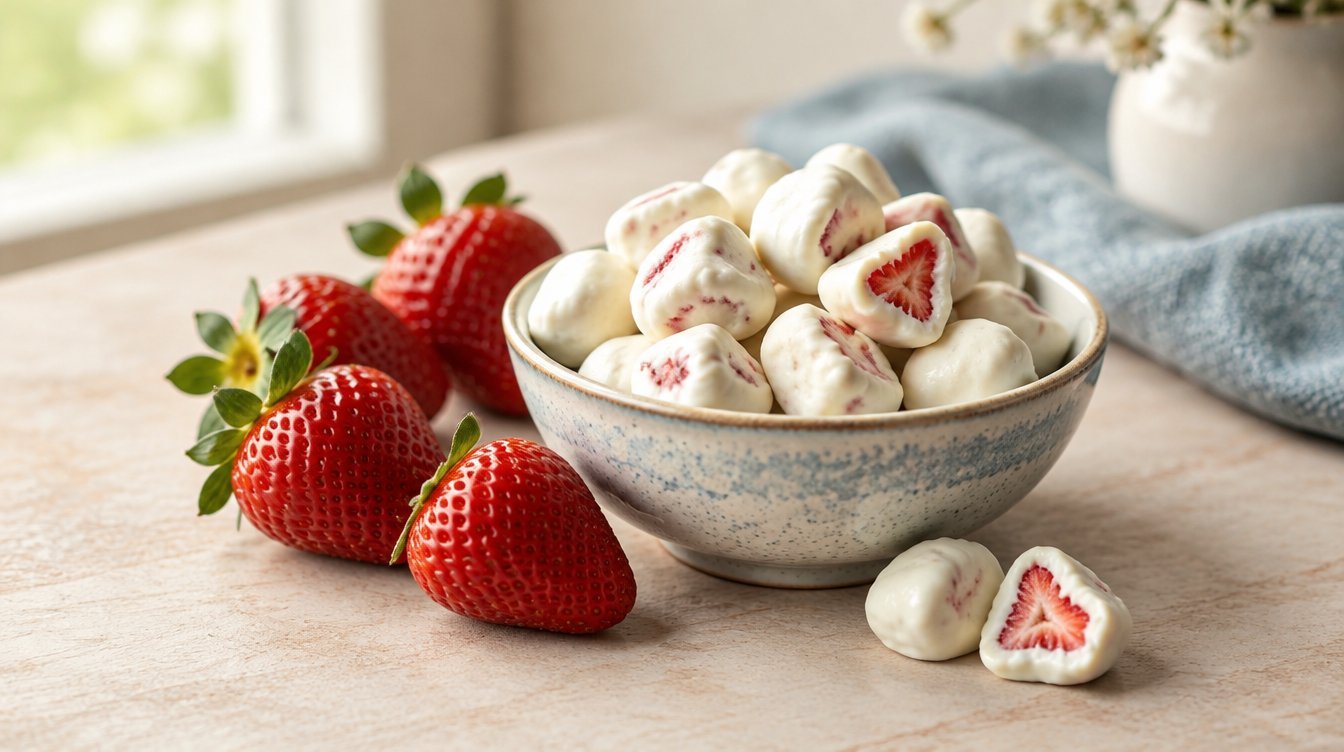
Probiotic Strawberry Yoggies are made by Nature’s Garden. According to the brand’s product page and product blog, they are bite-size snacks with a chewy apple and strawberry fruit center inside a yogurt coating, with an added probiotic, Lactobacillus rhamnosus GG (LGG). They come in 0.7 oz (20 g) snack packs, and the brand pitches them as a snack for the whole family.
Despite the name, they are not freeze-dried yogurt. Freeze-dried yogurt “melts” sold for babies and toddlers are a different type of product from other brands. Nature’s Garden’s page gives no age guidance for Yoggies.
Ultimate Gut is published by Ultimate Health Solutions, which sells a yogurt maker, probiotic capsules and an inulin fiber supplement. None of the products reviewed here are ours, and these brands don’t pay us.
What the label says
The figures below come from the ingredient list and Nutrition Facts on the Nature’s Garden Probiotic Strawberry Yoggies page, plus allergen and storage notes from the brand’s blog post; labels checked October 2026.
| Item | What Nature’s Garden publishes |
|---|---|
| Serving size | 13 pieces (20 g), one 0.7 oz pack |
| Calories | 80 |
| Fat | 2.5 g total, all saturated |
| Carbohydrate and fiber | 15 g carbohydrate, 3 g fiber |
| Sugars | 11 g total sugars, including 7 g added sugars |
| Protein and sodium | 0 g protein, 10 mg sodium |
| Probiotic | Lactobacillus rhamnosus GG, “2 billion probiotics per serving,” microencapsulated; no statement on whether the count holds to the end of shelf life |
| Main ingredients | Apple and strawberry fruit cubes (apple puree concentrate, strawberry puree, apple juice concentrate, soluble corn fiber, palm fat, citrus pectin, citrus fiber and more); yogurt coating (sugar, palm kernel oil, nonfat dry milk, yogurt powder, Greek yogurt powder, soy lecithin and more) |
| Allergens | Contains milk and soy; made in a facility that also packages peanuts, tree nuts, egg, wheat and sesame |
| Shelf life | 12 months from production; store cool and dry, since the coating can melt |
| Price | $20.99 for 30 packs, about $0.70 per pack |
One point to read carefully: the product description says Yoggies are sweetened only with fruit juice, which fits the fruit center. The yogurt coating, though, lists sugar as its first ingredient, and the Nutrition Facts show 7 g of added sugars per pack.
Why it matters for gut health
The probiotic: LGG
LGG is one of the most studied probiotic strains. A meta-analysis of 12 trials found it lowered the risk of antibiotic-associated diarrhea, with a significant effect in children (5 trials, 445 children), though the evidence quality was moderate to low (Szajewska 2015).
LGG doesn’t help with everything. In a large U.S. trial, 971 children aged 3 months to 4 years with stomach flu took 10 billion CFU of LGG twice a day for 5 days. They did no better than children given a placebo (Schnadower 2018). A pack of Yoggies lists 2 billion, a tenth of a single dose in that trial, and no trial of Yoggies themselves has been published.
Do dried and coated yogurt snacks keep live cultures?
Sometimes, but drying is hard on bacteria. A review of drying methods found that freeze-drying and spray-drying lower the number of live cells, and that survival during storage is best with low moisture and cool temperatures (Broeckx 2016). Microencapsulation, which coats the bacteria in a protective layer, can improve survival through processing and storage (Dianawati 2016).
Nature’s Garden says its microencapsulation keeps the LGG alive through the 12-month shelf life, but it doesn’t publish a count at the end of shelf life. The NIH Office of Dietary Supplements suggests looking for counts stated through the expiration date. The label also doesn’t say whether the yogurt powders in the coating contain live cultures, so count on the added LGG only. The same check applies to freeze-dried yogurt melts: if the bag doesn’t name live cultures, don’t assume they are there.
For more on which yogurt products carry live cultures, see does all yogurt have probiotics.
Fiber
Each pack has 3 g of fiber, mostly from added soluble corn fiber, citrus fiber and pectin. The brand’s blog notes that eating too much fiber may cause digestive discomfort.
Sugar and young children
The Dietary Guidelines for Americans, 2025-2030 advise avoiding added sugars during infancy and early childhood, which they define as birth to 4 years. For ages 5 to 10, they say no amount of added sugars is recommended. For snacks, they point to FDA “Healthy” limits, such as no more than 2.5 g of added sugars in a 2/3-cup serving of a dairy snack like yogurt.
By those standards, a pack of Yoggies, with 7 g of added sugars, is a treat for older kids and adults rather than an everyday gut-health food, and it doesn’t fit the guidelines for children under 5.
Safety notes for toddlers and young children
- Choking: the CDC lists chewy fruit snacks and gummy candies among choking hazards for infants and toddlers, along with uncut berries. It advises cutting food into small pieces, having children sit upright, and watching them closely while they eat.
- Probiotic supplements: check with a pediatrician before giving any probiotic supplement to a young child. The Office of Dietary Supplements advises against giving children supplements unless a health care provider recommends them.
- Higher-risk children: NCCIH notes the FDA has warned that probiotics can cause severe infections in premature infants, and that risks are higher for anyone who is seriously ill or has a weakened immune system.
- Allergies: Yoggies contain milk and soy.
How to choose and use a probiotic yogurt snack
- Check added sugars first. Compare grams per serving with the guideline limits above.
- Look for a named strain and count. Yoggies list LGG and 2 billion per serving; many yogurt snacks list no cultures at all.
- Look for counts through the end of shelf life. Few snack labels give them, so treat probiotic claims on shelf-stable snacks with caution.
- Store as directed. Heat can melt the coating, and warm storage can lower live cell counts.
- Think of it as a snack, not a supplement. For live cultures every day, plain yogurt or kefir does more for less sugar. See our Greek yogurt snack ideas.
A homemade alternative: plain yogurt with strawberries
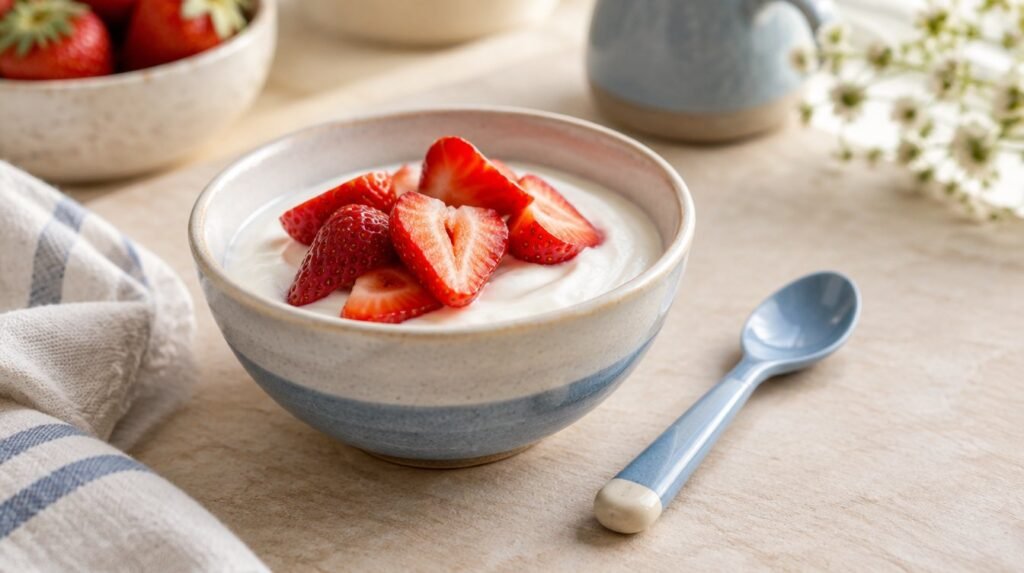
The simplest swap is a bowl of plain yogurt with fresh strawberries. You control the sugar, and plain yogurt with live cultures is a food, not a supplement. The Dietary Guidelines list full-fat yogurt among the foods to introduce to infants at around 6 months, without added sugars. For toddlers, mash the berries or cut them small, since uncut berries are a choking hazard.
If you want to make the yogurt yourself, the University of Alaska Fairbanks Cooperative Extension’s Making Yogurt at Home guide gives these steps:
- Heat the milk to 185°F and hold it there for 10 minutes (up to 20 for thicker yogurt), without boiling.
- Cool the milk to 112°F to 115°F.
- Mix the starter with a cup of the warm milk, then stir it back in: about 1/4 cup of starter yogurt per quart of milk.
- Incubate at about 110°F for 4 to 7 hours, until set.
- Chill quickly and keep it at 40°F or below. It keeps about 10 to 21 days in the fridge.
A steady incubation temperature is the hardest part to get right at home. Our guides to making yogurt at home and yogurt temperature cover the details, and how long homemade yogurt lasts covers storage.
Related topics
- Does All Yogurt Have Probiotics?: how to tell which yogurt products carry live cultures.
- How to Make Yogurt at Home: the full method, step by step.
- Plain Yogurt: what to look for in a plain yogurt.
- Frozen Yogurt Bark Recipes: a homemade yogurt-and-fruit snack.
- Gut Health Gummies: how chewable probiotic products compare.
Sources
- Probiotic Strawberry Yoggies product page, ingredients and Nutrition Facts (Nature’s Garden, checked October 2026)
- Yoggies: Real Fruit, Creamy Yogurt, and Gut Support (Nature’s Garden, checked October 2026)
- Szajewska H, et al. Systematic review with meta-analysis: Lactobacillus rhamnosus GG in the prevention of antibiotic-associated diarrhoea in children and adults (Alimentary Pharmacology & Therapeutics, 2015)
- Schnadower D, et al. Lactobacillus rhamnosus GG versus Placebo for Acute Gastroenteritis in Children (New England Journal of Medicine, 2018)
- Broeckx G, et al. Drying techniques of probiotic bacteria as an important step towards the development of novel pharmabiotics (International Journal of Pharmaceutics, 2016)
- Dianawati D, et al. Survival of Microencapsulated Probiotic Bacteria after Processing and during Storage: A Review (Critical Reviews in Food Science and Nutrition, 2016)
- Dietary Guidelines for Americans, 2025-2030 (U.S. Department of Agriculture and U.S. Department of Health and Human Services)
- Choking Hazards (Centers for Disease Control and Prevention)
- Dietary Supplements: What You Need to Know (NIH Office of Dietary Supplements)
- Probiotics: Usefulness and Safety (National Center for Complementary and Integrative Health)
- Probiotics: Fact Sheet for Health Professionals (NIH Office of Dietary Supplements)
- Making Yogurt at Home (University of Alaska Fairbanks Cooperative Extension Service)
This article is for general information and is not medical advice. Talk to your doctor or a registered dietitian before changing your diet, supplements or medication, especially if you have a health condition.