Best Fruits for Gut Health: Compared (2026)
Best Fruits for Gut Health: Our Picks
The fruits with the best case for gut health are the ones that pair plenty of fiber with at least some human research. Fiber feeds the microbes in your colon and helps keep stools soft, and most adults fall short of it. Here is how common fruits compare, based on USDA nutrient data and published studies.
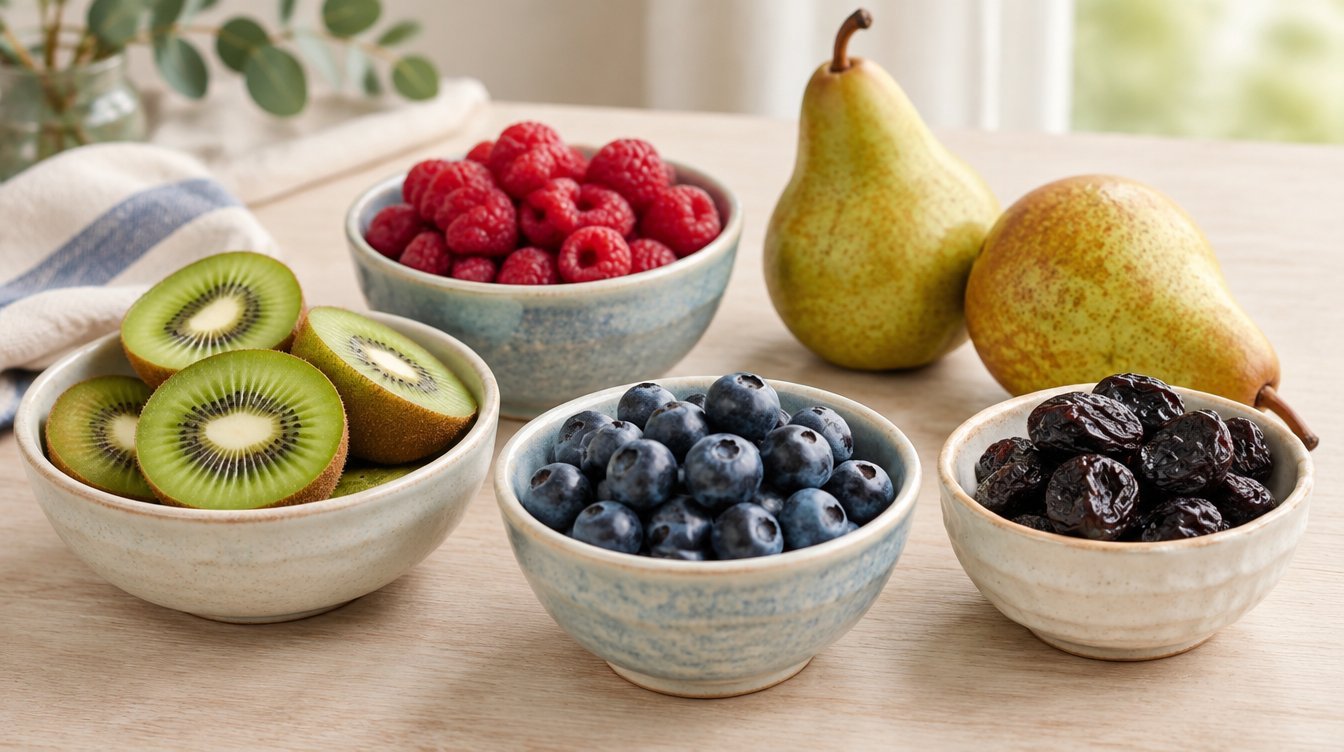
- Best overall for regularity: green kiwifruit, which has the most trial evidence for constipation and was well tolerated.
- Best classic constipation fruit: prunes, backed by several small trials.
- Most fiber per serving: raspberries, at about 8 grams per cup.
- Best everyday fiber fruits: pears and apples with the skin on.
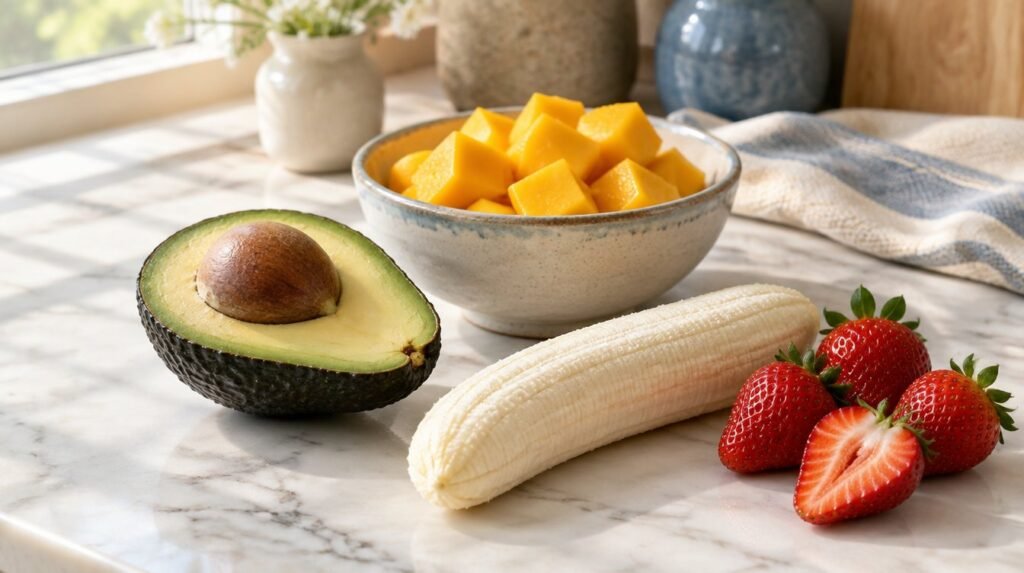
- Best studied for gut bacteria: avocado, in a 12-week trial of 163 adults.
- Best polyphenol-rich pick: blueberries, with early evidence on gut bacteria.
- Easiest everyday option: bananas, which also carry some prebiotic fiber.
- Promising but early: mango, in one small pilot study.
- Gentler choices for sensitive stomachs: oranges and strawberries, which are not on the NIDDK’s list of high-FODMAP fruits.
This article is general information, not medical advice. If you have a digestive condition, ask your doctor or a dietitian which fruits suit you.
Fruits for gut health compared
Fiber values come from USDA FoodData Central, converted from per-100-gram figures using USDA serving weights. For context, the NIDDK says adults need 22 to 34 grams of fiber a day, and Harvard’s Nutrition Source estimates most Americans get only about 15.
| Fruit | Serving | Fiber | Human gut research | Watch out for |
|---|---|---|---|---|
| Green kiwifruit (USDA) | 2 fruits (138 g) | About 4.1 g | Several constipation trials | Little |
| Prunes (USDA) | 5 prunes (48 g) | About 3.4 g | Several small trials | Gas; dried fruit is a FODMAP |
| Raspberries (USDA) | 1 cup (123 g) | About 8.0 g | Fiber only | Little |
| Pear (USDA) | 1 medium (178 g) | About 5.5 g | Fiber only | High FODMAP; gas |
| Apple with skin (USDA) | 1 medium (182 g) | About 4.4 g | Fiber only | High FODMAP; gas |
| Avocado (USDA) | Half (100 g) | About 6.7 g | One 12-week trial | Calories |
| Blueberries (USDA) | 1 cup (148 g) | About 3.6 g | Small powder-drink study | Little |
| Banana (USDA) | 1 medium (118 g) | About 3.1 g | Prebiotic source; no fruit trials here | Little |
| Mango (USDA) | 1 cup (165 g) | About 2.6 g | One small pilot | High FODMAP |
| Orange (USDA) | 1 medium (131 g) | About 3.1 g | Fiber only | Little |
| Strawberries (USDA) | 1 cup halves (152 g) | About 3.0 g | Fiber only | Little |
The FODMAP notes follow the NIDDK’s list of fruits that contain FODMAPs, carbohydrates that are hard to digest and can trigger symptoms in some people with irritable bowel syndrome (IBS). That list includes apples, apricots, blackberries, cherries, mango, nectarines, pears, plums and watermelon, plus dried fruit and large amounts of juice.
How each fruit stacks up
Green kiwifruit
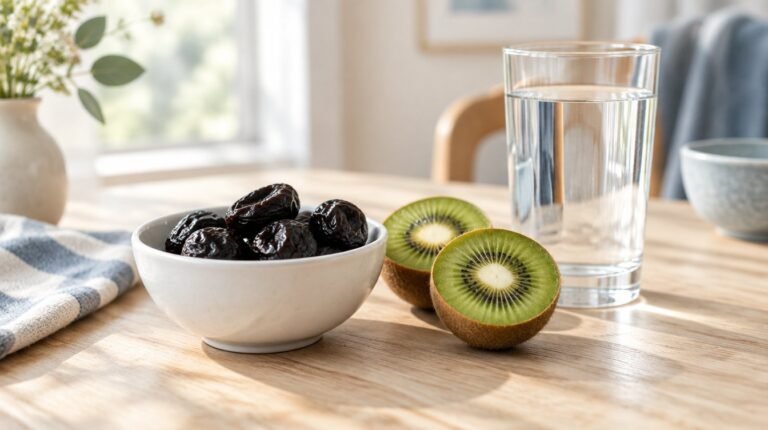
Kiwifruit has the strongest research of any fruit here. In a US comparative trial of 79 adults with chronic constipation, two green kiwifruit a day worked about as well as prunes or psyllium fiber over four weeks. All three increased complete bowel movements; kiwifruit also improved bloating, caused the fewest side effects, and left the fewest people dissatisfied. The trial was only partly randomized and 87 percent of participants were women.
A 2024 meta-analysis found that fruits, kiwifruit in particular, led to slightly more bowel movements per week than psyllium, and the British Dietetic Association’s 2025 constipation guidelines include recommendation statements on kiwifruit. Two kiwis give you about 4 grams of fiber.
Prunes
Prunes are the traditional choice, and the evidence is reasonable but limited. In a randomized trial of 120 healthy adults who ate little fiber, 80 or 120 grams of prunes a day for four weeks increased stool weight, and the 80-gram group had more frequent stools than the control group. Flatulence was also more common. An earlier systematic review found only four trials, but in one with constipated adults, 100 grams of prunes a day beat psyllium for stool frequency and consistency. The 2024 meta-analysis, though, found no clear difference between prunes and psyllium.
Five prunes have about 3.4 grams of fiber and about 18 grams of sugar, per USDA. Because dried fruit is on the NIDDK’s FODMAP list, people with IBS may want to start with one or two.
Raspberries
Raspberries lead on fiber: a cup has about 8 grams, roughly double most other fruits on this list. There are no good human trials on raspberries and gut health specifically, so their place here rests on fiber. The NIDDK names berries among good fiber sources for people with constipation. Frozen raspberries work just as well in oatmeal or a gut health smoothie.
Pears and apples
A medium pear has about 5.5 grams of fiber and a medium apple with skin about 4.4 grams, and the NIDDK lists both, apples with the skin on, as good fiber sources. Their catch is that both are high in FODMAPs, and the NIDDK names apples, peaches and pears among fruits that can cause extra gas. If they bother you, smaller portions or cooked fruit may sit better; see our guide to stewed apples for gut health.
Avocado
Avocado is not sweet, but it is a fruit, and it has one of the better microbiome studies. In a 12-week randomized trial of 163 adults with overweight or obesity, eating one avocado-containing meal a day raised gut bacterial diversity and increased several fiber-fermenting bacteria compared with a similar meal without avocado. It also changed fecal fats and bile acids. These are changes in markers, not proven health outcomes. Half an avocado has about 6.7 grams of fiber, along with a fair number of calories.
Blueberries
Blueberries are rich in polyphenols, plant compounds that gut bacteria break down. In a small six-week crossover study, a drink made from wild blueberry powder increased Bifidobacterium in volunteers’ guts compared with a placebo drink. That used a concentrated powder, not a bowl of fresh berries, so treat it as an early hint. A cup of fresh blueberries has about 3.6 grams of fiber.
Bananas
Bananas are cheap, easy and gentle for many people. Harvard’s Nutrition Source lists them among foods with naturally high levels of prebiotic fibers, while ISAPP notes that the prebiotic content of foods like bananas is usually low. A medium banana has about 3.1 grams of fiber. Bananas are not on the NIDDK’s list of high-FODMAP fruits.
Mango
Mango had a promising pilot study: adults with chronic constipation who ate 300 grams of mango a day for four weeks saw better stool frequency and consistency than those given an equivalent amount of fiber. It was small, and larger studies are needed. Mango is lower in fiber than most fruits here, about 2.6 grams per cup, and it is on the NIDDK’s FODMAP list.
Oranges and strawberries
Neither has gut-specific trials, but both give about 3 grams of fiber per serving and are not on the NIDDK’s high-FODMAP list, which can make them easier choices for sensitive stomachs. The NIDDK lists oranges among good fiber sources for constipation. Eat the orange rather than drinking it: Harvard’s Nutrition Source advises choosing whole fruit over juice to get the fiber.
How to eat more fruit for your gut
- Go slowly. The NIDDK suggests adding fiber by 2 to 3 grams a day to help avoid gas and bloating.
- Drink enough. The NIDDK says water and other liquids help fiber work and keep stools soft.
- Mix it up. In the American Gut Project, a citizen-science study with samples from more than 10,000 people, those who reported eating more than 30 types of plants a week had different gut microbes, including more likely fiber fermenters, than those eating 10 or fewer. It is observational, so it can’t prove cause.
- Choose whole fruit over juice. Harvard advises whole fruit for its fiber, and the NIDDK lists large amounts of fruit juice as a FODMAP source.
- Pair fruit with live cultures. Berries on plain yogurt or kefir combine fiber with probiotic foods. Try our yogurt bowl ideas, or read prebiotic vs probiotic for how the two work together.
- Use what is easy to keep on hand. The NHS counts fresh, dried, or canned-in-natural-juice fruit as ways to add fiber, so frozen berries and canned pears in juice can fill gaps.
- Watch dried fruit portions. The NHS also suggests eating dried fruit with meals rather than as a snack, because it is sticky and can raise the risk of tooth decay.
When to see a doctor
More fruit is a sensible step for occasional constipation, but it is not a fix for every gut problem. The NIDDK advises seeing a doctor if constipation doesn’t improve with self-care or you have a family history of colon or rectal cancer, and seeing one right away if constipation comes with:
- bleeding from the rectum or blood in your stool
- constant abdominal pain, inability to pass gas, or vomiting
- fever or lower back pain
- weight loss without trying
Also talk with a doctor if gas symptoms change suddenly or come with pain, diarrhea or weight loss, as the NIDDK recommends. For more food ideas, see our guide to constipation relief.
How We Compared
- Fiber per typical serving, calculated from USDA FoodData Central values and serving weights.
- The quality of human research on the fruit itself, ranking randomized trials above small or pilot studies, and noting where a study used a powder or extract.
- Tolerance, using the NIDDK’s lists of FODMAP and gas-producing foods.
- How easy the fruit is to buy and eat regularly in the United States.
What this comparison can’t tell you: USDA figures are averages, and fiber varies with variety, ripeness and whether you eat the skin. Most gut studies on single fruits are small and short, several measured changes in bacteria rather than health outcomes, and none shows that a fruit treats or prevents a disease. Your own tolerance matters more than any ranking.
Frequently asked questions
Which fruit is best for constipation?
Green kiwifruit and prunes have the most trial evidence. In one US trial, two kiwis a day worked about as well as prunes or psyllium and caused the fewest side effects (Chey et al.).
Which fruits are easiest on a sensitive stomach?
Fruits that are not on the NIDDK list of FODMAP foods, such as oranges, strawberries, blueberries, kiwifruit and bananas, may be easier for some people with IBS (NIDDK). Tolerance varies, so a dietitian can help you test your own.
Is fruit juice as good as whole fruit for your gut?
Not for fiber. Harvard’s Nutrition Source advises eating whole fruits instead of drinking juice (Harvard).
How much fiber should I aim for?
Adults need 22 to 34 grams of fiber a day depending on age and sex, from fruit, vegetables, whole grains, beans and nuts (NIDDK).
Related topics
- Best Foods for Gut Health: fiber, fermented foods and more beyond fruit.
- Best Juice for Gut Health: how juices compare with whole fruit.
- Foods That Help with Bloating: gentler choices when you feel puffy.
- Dairy and Gut Health: how yogurt and kefir fit alongside fruit.
- Gut Health Diet Plan: putting these foods into a weekly routine.
Sources
- Eating, Diet, & Nutrition for Constipation (NIDDK)
- Symptoms & Causes of Constipation (NIDDK)
- Eating, Diet, & Nutrition for Irritable Bowel Syndrome (NIDDK)
- Eating, Diet, & Nutrition for Gas in the Digestive Tract (NIDDK)
- Symptoms & Causes of Gas in the Digestive Tract (NIDDK)
- Fiber (Harvard T.H. Chan School of Public Health, The Nutrition Source)
- The Microbiome (Harvard T.H. Chan School of Public Health, The Nutrition Source)
- Prebiotics (International Scientific Association for Probiotics and Prebiotics)
- How to get more fibre into your diet (NHS)
- Kiwifruit, green, raw; Plums, dried (prunes), uncooked; Raspberries, raw; Pears, raw; Apples, raw, with skin; Avocados, raw, all commercial varieties (USDA FoodData Central)
- Blueberries, raw; Bananas, raw; Mangos, raw; Oranges, raw, all commercial varieties; Strawberries, raw (USDA FoodData Central)
- Chey SW, et al. Exploratory comparative effectiveness trial of green kiwifruit, psyllium, or prunes in US patients with chronic constipation (American Journal of Gastroenterology, 2021)
- van der Schoot A, et al. Systematic review and meta-analysis: Foods, drinks and diets and their effect on chronic constipation in adults (Alimentary Pharmacology & Therapeutics, 2024)
- Dimidi E, et al. British Dietetic Association guidelines for the dietary management of chronic constipation in adults (Journal of Human Nutrition and Dietetics, 2025)
- Lever E, et al. The effect of prunes on stool output, gut transit time and gastrointestinal microbiota: a randomised controlled trial (Clinical Nutrition, 2019)
- Lever E, et al. Systematic review: the effect of prunes on gastrointestinal function (Alimentary Pharmacology & Therapeutics, 2014)
- Thompson SV, et al. Avocado consumption alters gastrointestinal bacteria abundance and microbial metabolite concentrations among adults with overweight or obesity (Journal of Nutrition, 2021)
- Vendrame S, et al. Six-week consumption of a wild blueberry powder drink increases bifidobacteria in the human gut (Journal of Agricultural and Food Chemistry, 2011)
- Venancio VP, et al. Polyphenol-rich mango ameliorate functional constipation symptoms in humans beyond equivalent amount of fiber (Molecular Nutrition & Food Research, 2018)
- McDonald D, et al. American Gut: an open platform for citizen science microbiome research (mSystems, 2018)
This article is for general information and is not medical advice. Talk to your doctor or a registered dietitian before changing your diet, supplements or medication, especially if you have a health condition.