What Is Prebiotic Soda? A Clear Answer
What is prebiotic soda?
Prebiotic soda is a fizzy drink with added plant fibers, such as inulin from chicory or agave, that gut bacteria can ferment. The two best-known brands list 3 to 9 grams of fiber and about 5 grams of sugar per can, far less sugar than regular soda. It contains no live bacteria, so it is not a probiotic.
Ultimate Gut is published by Ultimate Health Solutions, which sells a yogurt maker, probiotic capsules and an inulin fiber supplement. None of the products reviewed here are ours, and these brands don’t pay us. The brand figures below come from each brand’s own product page, with labels checked in October 2026.
What “prebiotic” means
An expert panel from the International Scientific Association for Probiotics and Prebiotics defines a prebiotic as a substrate that is selectively used by microorganisms in the body and gives a health benefit (Gibson et al., 2017). The National Center for Complementary and Integrative Health puts it more simply: prebiotics are nondigestible food components that selectively feed helpful microbes. Probiotics, by contrast, are live microorganisms.
The best-studied prebiotics are inulin-type fructans and galacto-oligosaccharides, according to a 2017 review from King’s College London. Inulin is the fiber you will see most often on soda labels.
One label wrinkle: the FDA has not yet formally added inulin to its definition of dietary fiber. Until it finishes that rulemaking, the agency allows manufacturers to count inulin in the fiber line on the Nutrition Facts panel.
What is in a can
Two of the best-known brands show how much the category varies. Here is what their product pages list, next to a regular cola from USDA data.
| Per 12 oz can | Olipop Vintage Cola (9 g fiber line) | Poppi Strawberry Lemon | Regular cola |
|---|---|---|---|
| Calories | 50 | 30 | about 155 |
| Dietary fiber | 9 g | 3 g | 0 g |
| Total sugars | 5 g | 5 g | about 37 g |
| Added sugars | 2 g | 4 g | not listed in the USDA entry |
| Fiber ingredients | Cassava root fiber, chicory root inulin, Jerusalem artichoke inulin (OLISMART blend, with botanical extracts) | Cassava root fiber, organic agave inulin | None |
| Other notable ingredients | Cassava root syrup, apple juice concentrate, stevia, green tea caffeine | Organic cane sugar, organic apple cider vinegar, stevia | Varies by brand |
| Source | Olipop product page | Poppi product page | USDA FDC 174852 |
Olipop sells several fiber levels; its home page lists 9-gram, 6-gram and 3-gram lines and cites 35 to 45 calories per can, although the Vintage Cola panel lists 50. Poppi has fewer calories and less fiber. Both are a large step down in sugar from regular cola, which USDA lists at about 10 grams of sugar per 100 grams.
What the research on these fibers shows
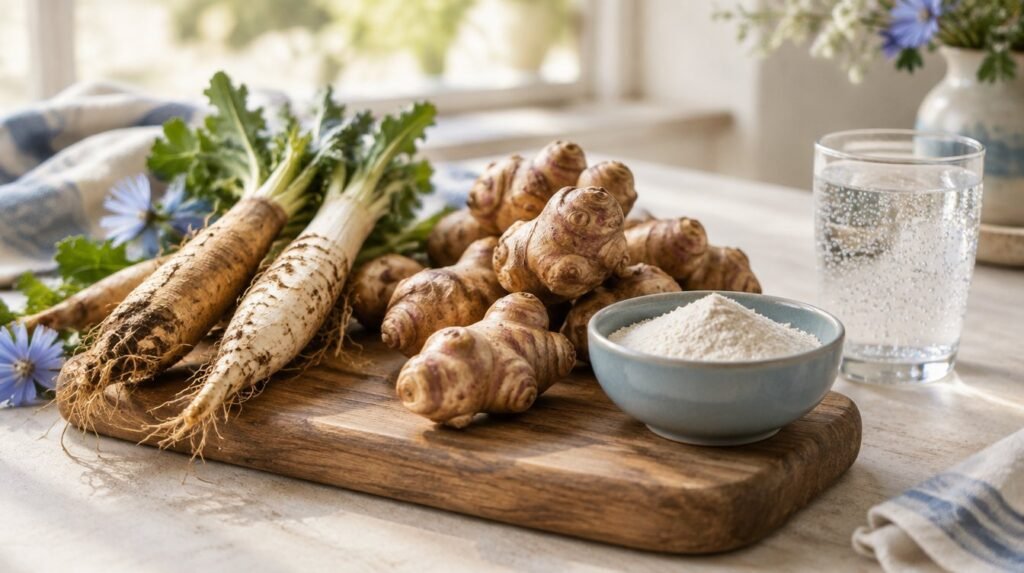
A PubMed search in October 2026 turned up no published human trials of prebiotic sodas themselves. The evidence comes from studies of the fibers they contain, mostly chicory inulin, often at higher doses than one can provides.
- Gut bacteria: a 2023 meta-analysis of 50 trials with 2,525 participants found that chicory inulin-type fructans at 3 to 20 grams a day increased Bifidobacterium and improved bowel function measures in healthy people. The bacterial effect was not significant in people with gastrointestinal disorders.
- Regularity: in a four-week randomized trial of 44 adults with constipation, 12 grams a day of chicory inulin raised median stool frequency from 3 to 4 a week compared with placebo.
- Tolerance: in a small crossover study of 26 healthy adults, up to 10 grams of native inulin was well tolerated, though gas and bloating were the most common complaints.
- IBS: low doses of prebiotics showed some promise for IBS symptoms, but larger doses may have neutral or negative effects, and the low FODMAP diet used for IBS restricts these fibers (Wilson and Whelan).
So a can with 9 grams of inulin-type fiber is in the range studied. A can with 2 or 3 grams is a small contribution toward the 28-gram Daily Value for fiber. Neither has been shown to treat any gut condition.
Poppi also contains apple cider vinegar. Our guide to apple cider vinegar benefits covers what that research does and does not show.
How to fit prebiotic soda into your diet
- Think of it as a soda swap: the clearest benefit is trading a 37-gram sugar drink for one with about 5 grams.
- Check added sugars: the Daily Value for added sugars is 50 grams, and labels range from about 2 to 4 grams per can in the two brands above.
- Start with one can: if you are new to inulin, more than one can a day may cause gas. Read the fiber line before you stack cans with other fiber-added foods.
- Go easy with IBS: NIDDK notes that too much fiber at once can cause gas that may trigger IBS symptoms. Ask your doctor or dietitian if you follow a low FODMAP plan.
- Do not rely on it for fiber: Mayo Clinic lists oats, beans, apples, citrus, carrots and barley among good sources of soluble fiber. Whole foods also bring vitamins and other compounds a can does not.
- Want live microbes too? Kefir, kombucha and yogurt with live cultures are the fermented options; see probiotic drinks and fermented drinks.
Frequently asked questions
Is prebiotic soda the same as probiotic soda?
No. Prebiotic soda adds fiber that feeds gut microbes, while probiotics are live microorganisms; most prebiotic sodas contain no live cultures.
Is prebiotic soda good for your gut?
It may help a little, mainly through its fiber, but no published human trials have tested the sodas themselves. Its clearest benefit is having far less sugar than regular soda.
How many prebiotic sodas can I drink a day?
There is no official limit. One can is a sensible start, because inulin can cause gas and bloating in some people as intake rises.
Does prebiotic soda have caffeine?
Some flavors do. Olipop Vintage Cola lists green tea caffeine on its ingredient list, so check the label of the flavor you buy.
Related topics
- Gut Health Drinks: the wider range of drinks marketed for digestion.
- Fiber Supplement: another way to add inulin and other fibers.
- Prebiotic Fibers for Culturing: inulin, GOS, FOS and resistant starch explained.
- Best Kombucha for Gut Health: a fizzy drink that is fermented.
- Probiotic vs Yogurt: how live-culture foods compare with capsules.
Sources
- Vintage Cola (9g Fiber) product page and Nutrition Facts (Olipop, checked October 2026)
- Olipop home page (Olipop, checked October 2026)
- Strawberry Lemon product page and Nutrition Facts (Poppi, checked October 2026)
- Beverages, carbonated, cola, regular (FDC 174852) (USDA FoodData Central)
- Daily Value on the Nutrition and Supplement Facts Labels (U.S. Food and Drug Administration)
- Questions and Answers on Dietary Fiber (U.S. Food and Drug Administration)
- Probiotics: Usefulness and Safety (NCCIH)
- Dietary fiber: Essential for a healthy diet (Mayo Clinic)
- Eating, Diet, & Nutrition for Irritable Bowel Syndrome (NIDDK)
- Gibson GR, et al. Expert consensus document: The International Scientific Association for Probiotics and Prebiotics (ISAPP) consensus statement on the definition and scope of prebiotics (Nature Reviews Gastroenterology & Hepatology, 2017)
- Wilson B, Whelan K. Prebiotic inulin-type fructans and galacto-oligosaccharides: definition, specificity, function, and application in gastrointestinal disorders (Journal of Gastroenterology and Hepatology, 2017)
- Nagy DU, et al. Effect of chicory-derived inulin-type fructans on abundance of Bifidobacterium and on bowel function: a systematic review with meta-analyses (Critical Reviews in Food Science and Nutrition, 2023)
- Micka A, et al. Effect of consumption of chicory inulin on bowel function in healthy subjects with constipation: a randomized, double-blind, placebo-controlled trial (International Journal of Food Sciences and Nutrition, 2017)
- Bonnema AL, et al. Gastrointestinal tolerance of chicory inulin products (Journal of the American Dietetic Association, 2010)