Your Skin Before and After a Gut Health Diet: A Practical Guide
What “Before and After” Means for Skin on a Gut Health Diet
Many people switch to a gut health diet, with more fiber, more plants and some fermented foods, and hope to see clearer or calmer skin in the mirror. Before-and-after photos online make it look fast and certain. The research tells a slower, more modest story: your gut bacteria can shift within days, but skin changes, if they come, usually take weeks to months.
This guide covers what the evidence supports, a realistic timeline and how to track your own before and after fairly. It is general information, not medical advice, and no diet is a substitute for treatment of a skin condition.
Why Gut Health May Matter for Skin
Researchers use the term “gut-skin axis” for the idea that gut bacteria influence the skin through the immune system and the compounds they produce. A 2018 review in Frontiers in Microbiology describes how gut microbes may affect skin cell turnover and immune responses in skin conditions. Much of that work comes from lab and animal studies, so it explains a possible link rather than proving one.
What is well established is that diet changes the gut quickly. In a study of 10 American volunteers who ate an all-plant or nearly all-animal diet for five days, the makeup of their gut bacteria shifted rapidly. In a 17-week Stanford trial of 36 healthy adults, a diet high in fermented foods increased gut microbiome diversity and lowered several inflammatory markers in the blood. Neither study measured skin.
What the Evidence Says About Diet and Skin
Most of the research on food and skin is about acne. The findings are real but mixed, and none show that a diet clears skin on its own.
- Lower glycemic load: in a 12-week randomized trial of 43 young men with acne, a diet higher in protein and low-glycemic carbohydrates cut lesion counts more than a standard diet. The diet group also lost more weight, so the researchers could not separate the two effects.
- Dairy: a 2018 meta-analysis of 14 observational studies linked milk, cheese and yogurt with higher odds of acne in people aged 7 to 30, but the authors urged caution because of bias and differences between studies. The American Academy of Dermatology says cow’s milk may be linked to more breakouts but that no studies have found yogurt or cheese lead to more breakouts.
- Probiotic supplements: a 2025 meta-analysis of three double-blind trials with 231 people found a modest drop in inflammatory acne lesions, with low to moderate certainty. NCCIH says the evidence on probiotics for acne is not strong enough to justify recommendations.
- Eczema: NCCIH reports that reviews in children did not find consistent benefit from probiotics for atopic dermatitis, while a review of adult studies found preliminary evidence that some strains might help.
The AAD also stresses that keeping skin clear requires more than a diet change. Skin care and, when needed, medicine are still the core of acne treatment. If you are curious about the gut side of specific conditions, our articles on gut health and acne and eczema and gut health go deeper.
A Realistic Before-and-After Timeline
There is no study that tracks skin week by week on a “gut health diet,” so this timeline borrows from the closest evidence. Treat it as a rough guide, not a promise.
| Timeframe | What may happen | Where this comes from |
|---|---|---|
| Days 1 to 7 | Gut bacteria begin to shift; you may notice more gas as fiber and fermented foods increase | Short-term diet study in 10 adults (David, 2014) |
| Weeks 4 to 6 | Earliest point to expect any visible skin change | AAD advice on how long acne treatments take to show improvement |
| Week 12 | A fair point to judge your before and after | Length of the low-glycemic acne trial (Smith, 2007) |
| Months 2 to 3 and beyond | Clearing, if it happens, can take this long or longer | AAD guidance on acne clearing |
The AAD advises giving any acne treatment at least 4 weeks, with some improvement expected in 4 to 6 weeks if it is working and two to three months or longer for clearing. Diet changes are unlikely to work faster than that.
How to Track Your Own Before and After
Photos are easy to fool with lighting, angle and makeup. A fair comparison takes a little planning:
- Take baseline photos. Shoot your face (or the area you care about) in the same spot, same daylight and same time of day, without makeup or filters.
- Write down a starting point. Note roughly how many spots, dry patches or red areas you see, and how your skin feels.
- Change the diet, not the skin care. Keep your cleanser, moisturizer and any medicine the same, so the diet is the only thing that changes.
- Change one or two things at a time. For example, add a daily fermented food and swap white bread for whole grains, rather than overhauling everything at once.
- Keep a simple food and skin diary. The AAD suggests tracking breakouts and checking whether avoiding a suspected trigger for a day, a week or a month makes a difference.
- Repeat photos every 4 weeks. Compare at weeks 4, 8 and 12 using the same setup.
- Account for other factors. Hormonal cycles, stress, sleep, season and new products all affect skin, so note them in your diary.
If you have rosacea, be careful with spicy fermented foods such as kimchi. The AAD lists spicy foods and alcohol, especially red wine, among common rosacea triggers and suggests keeping a diary for at least two weeks to spot your own.
What to Eat on a Skin-Friendly Gut Health Diet
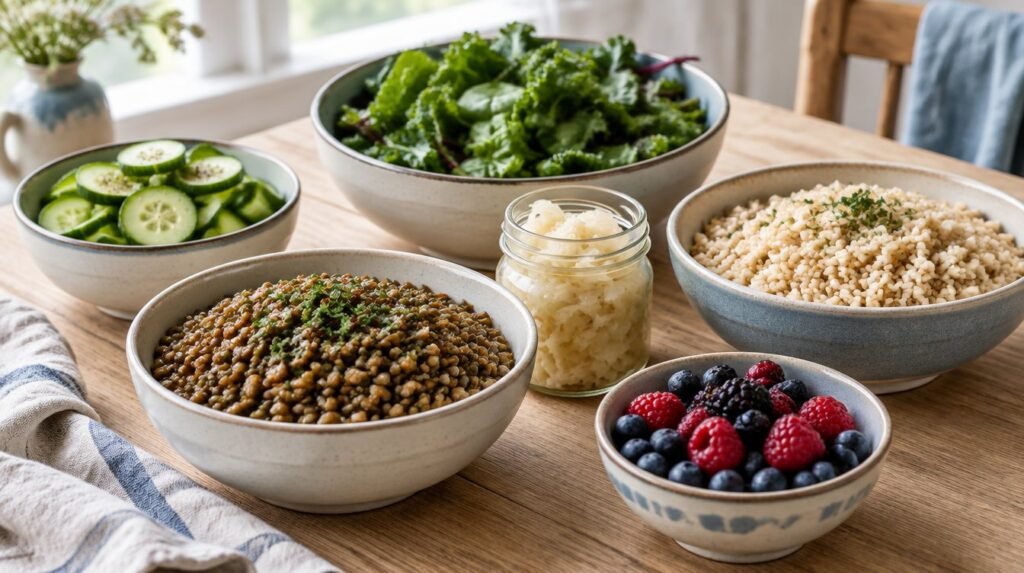
A gut health diet that also suits the acne research looks a lot like ordinary healthy eating. Our gut health diet plan lays out a full week, but the core is simple:
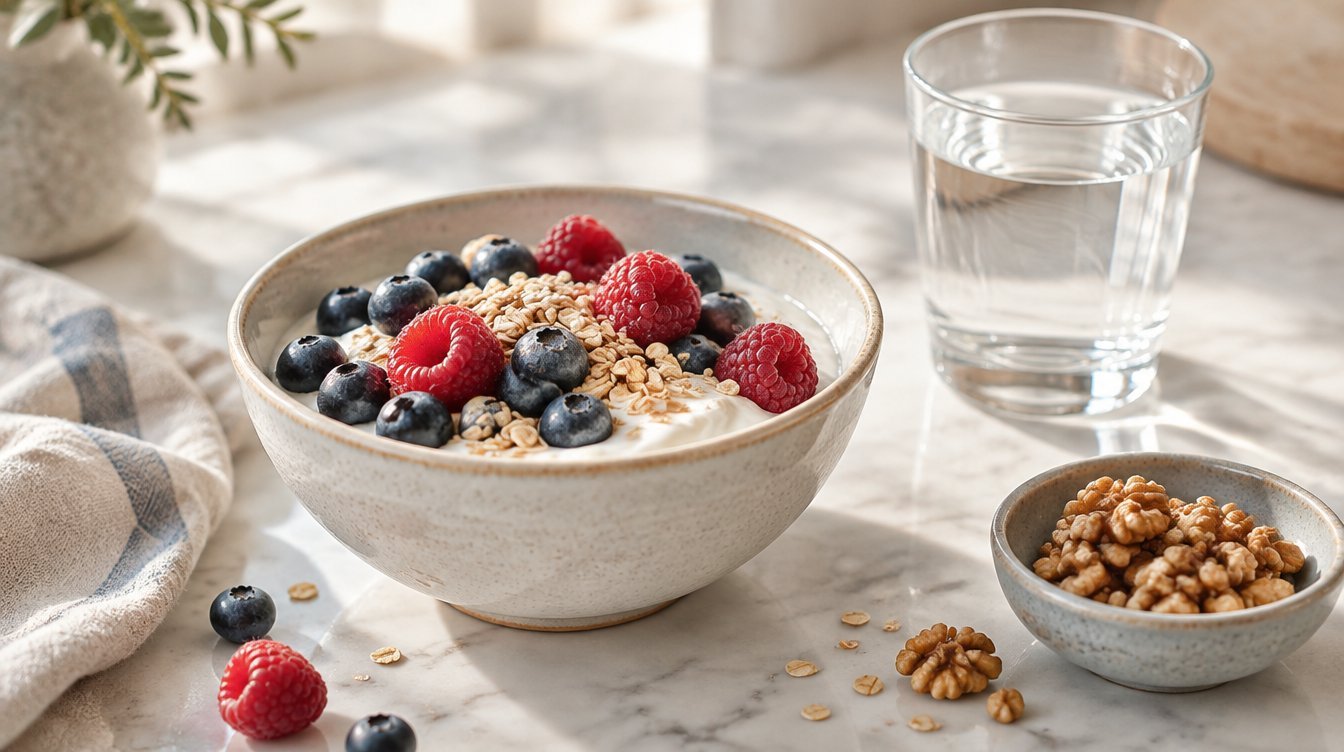
- Plenty of fiber-rich plants: vegetables, fruit, beans, lentils, oats and whole grains feed gut bacteria.
- Lower-glycemic carbohydrates: choose whole grains and legumes over white bread, fries and sugary drinks, in line with the low-glycemic trial and the AAD.
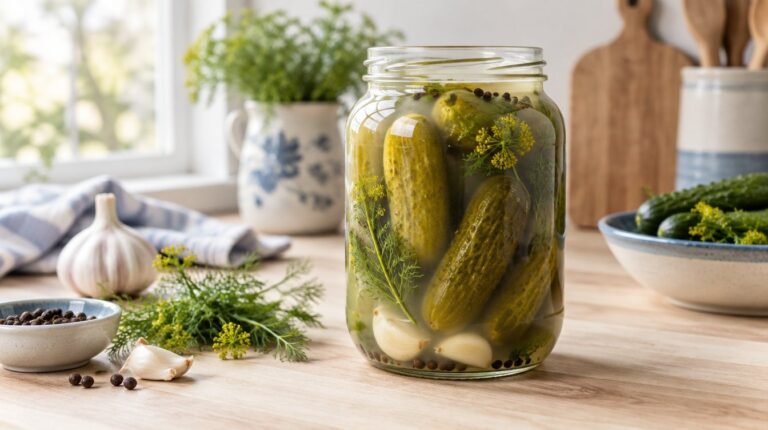
- A daily fermented food: plain yogurt, kefir, sauerkraut or kimchi, as in the Stanford trial. See our guide to fermented foods for gut health for options.
- Watch your own response to milk: if you suspect dairy, try cutting back on cow’s milk for a few weeks and compare your photos, rather than dropping all dairy at once.
Probiotic supplements are optional, not required. NCCIH notes that many probiotics are sold as supplements that do not need FDA approval before they are marketed, and that the risk of harmful effects is greater in people with severe illnesses or weakened immune systems. Talk to your doctor first if that applies to you or if you have a serious health condition.
When to See a Dermatologist
Diet experiments are fine for mild, occasional breakouts. The AAD recommends seeing a dermatologist when:
- You have deep, painful cysts or nodules, which can scar.
- Acne has not cleared with treatment you can buy without a prescription.
- Your skin makes you feel uncomfortable or self-conscious and you want help clearing it.
If a new rash or skin change worries you, or comes with feeling unwell, see a doctor rather than waiting to see whether a diet helps.
Related Topics
- Gut Health and Acne: What You Need to Know: the research on the gut-acne link in more detail.
- Best Probiotic for Acne: which strains have been studied, and how strong the evidence is.
- Eczema Gut Health: What You Need to Know: what is known about eczema and the gut.
- Signs Your Gut Is Healing: gut-side changes to watch for alongside your skin.
- Gut Health Diet Plan: a practical week of meals to start from.
Sources
- Salem I, et al. The gut microbiome as a major regulator of the gut-skin axis (Frontiers in Microbiology, 2018)
- David LA, et al. Diet rapidly and reproducibly alters the human gut microbiome (Nature, 2014)
- Wastyk HC, et al. Gut-microbiota-targeted diets modulate human immune status (Cell, 2021)
- Smith RN, et al. A low-glycemic-load diet improves symptoms in acne vulgaris patients: a randomized controlled trial (American Journal of Clinical Nutrition, 2007)
- Juhl CR, et al. Dairy intake and acne vulgaris: a systematic review and meta-analysis of 78,529 children, adolescents, and young adults (Nutrients, 2018)
- Tjiu JW, et al. Oral probiotics in acne vulgaris: a systematic review and meta-analysis of double-blind randomized clinical trials (Medicina, 2025)
- Probiotics: What You Need To Know (National Center for Complementary and Integrative Health)
- Can the right diet get rid of acne? (American Academy of Dermatology)
- 9 things to try when acne won’t clear (American Academy of Dermatology)
- Triggers could be causing your rosacea flare-ups (American Academy of Dermatology)