Lactobacillus casei: How to Culture It at Home (98-104°F / 24h)
What Lactobacillus casei is
Lactobacillus casei is a lactic acid bacterium whose name means “of cheese” in Latin (LPSN), a nod to the dairy foods it has long been found in. It belongs to the “casei group” with two close relatives, L. paracasei and L. rhamnosus, and the three are among the most researched probiotic lactobacilli. They are so alike that telling them apart has needed ever more refined lab methods, and strains have been classified and reclassified many times (Hill et al., 2018).
Since 2020 the official name is Lacticaseibacillus casei, after taxonomists split the old Lactobacillus genus into 25 genera (Zheng et al., 2020). Labels and most articles still say Lactobacillus casei, and this guide uses both.
For a home cook, L. casei is a body-temperature culture. It is grown at about 98.6°F (37°C) in the lab, and it sours milk slowly. A lactobacillus casei yogurt is made at 98 to 104°F (37 to 40°C) for about 24 hours, compared with 108 to 115°F for 6 to 10 hours for standard yogurt (University of Illinois Extension). Strictly speaking, U.S. rules reserve the word yogurt for milk cultured with L. bulgaricus and S. thermophilus (21 CFR 131.200), so a pure L. casei batch is a fermented milk.
Taxonomy at a glance
| Domain | Phylum | Genus | Species | Strain |
|---|---|---|---|---|
| Bacteria | Bacillota (formerly Firmicutes) | Lacticaseibacillus (formerly Lactobacillus) | L. casei | Type strain ATCC 393; product strains vary |
The List of Prokaryotic names with Standing in Nomenclature (LPSN) lists Lacticaseibacillus casei in the family Lactobacillaceae, as a correct, validly published name in risk group 1, the lowest-risk category, with ATCC 393 as its type strain. Firmicutes is now a synonym of the phylum name Bacillota (LPSN).
Many famous “casei” strains are now L. paracasei
This is the most useful thing to know before reading any study. In 2008 the type strain of L. casei was confirmed as ATCC 393, and a strain once proposed in its place (ATCC 334) was assigned to L. paracasei instead (Hill et al., 2018). Strains studied for decades under the casei name have since moved. Researchers at the company that sells the Shirota strain now call it Lacticaseibacillus paracasei, “formerly known as Lactobacillus casei” (Kato et al., 2024). The strain sold as L. casei DN-114 001 is now L. paracasei CNCM I-1518 (Poon et al., 2020).
So a capsule that says L. casei may contain a true L. casei or an older-named paracasei, and the research below often concerns paracasei strains. Check the strain code on your label, and see our Lactobacillus paracasei guide for that species.
What the research shows
Most human trials of “L. casei” used fermented milk drinks made in factories, with one named strain, often alongside standard yogurt bacteria. Results are mixed, several trials were funded by the companies that make the products, and none tested a homemade ferment.
Constipation (strain Shirota)
In a German double-blind trial, 70 adults with chronic constipation drank 65 mL a day of a drink with the Shirota strain or a look-alike placebo for four weeks. The probiotic group reported less severe constipation and better stool consistency from the second week, while gas and bloating did not change (Koebnick et al., 2003). It was small and short, and the strain is now classed as L. paracasei.
Diarrhea with antibiotics (a casei plus yogurt culture drink)
In a London trial, 135 hospital patients with an average age of 74 drank a probiotic drink with L. casei, L. bulgaricus and S. thermophilus twice a day during their antibiotics and for a week after. Antibiotic-associated diarrhea occurred in 12% of the probiotic group and 34% of the placebo group (Hickson et al., 2007). Some authors had received conference funding from a probiotic dairy company, and the trial excluded people who were severely ill or immunosuppressed.
Common infections (strain DN-114 001 / CNCM I-1518)
In a trial of 1,000 healthy shift workers, a daily fermented dairy product with DN-114 001 did not change the main outcome, the total number of common infections, though some secondary and post hoc measures favored it (Guillemard et al., 2010). A company-funded meta-analysis of nine trials of the same drink found modestly lower odds of having at least one common infection, with no effect on how long or how severe infections were (Poon et al., 2020).
The independent view
A systematic review by public health researchers compared advertising claims for two widely sold probiotic drinks with the published trials and concluded there was insufficient evidence for the claims, especially for the product with L. casei (Meléndez-Illanes et al., 2016). That is a fair summary of where the field stands: interesting, strain-specific, and short of firm conclusions.
Can L. casei make yogurt on its own?
Slowly. A dairy research group described L. casei as having “a slow growth rate in milk”: in plain milk at 37°C, their strain took about 90 hours to reach its final acidity, though adding pre-digested milk protein cut that to 42 hours (Ma et al., 2025). That suggests the strain was held back by a shortage of the small protein fragments it feeds on.
For a home batch, that means a soft, sour, drinkable result after 24 hours is normal, and a firm set is unlikely from L. casei alone. Several of the products in the trials above combined a casei-type strain with the two standard yogurt bacteria, which sour milk quickly. Adding a spoonful of plain yogurt with live cultures copies that approach, at the cost of making a mixed culture rather than a single-strain one. You can read about those partners in our guides to Streptococcus thermophilus and Lactobacillus bulgaricus.
Before you start: a short safety note
Probiotics are generally considered safe for healthy people, but the risk of harm is greater in people with severe illness or a weakened immune system, and severe infections have been reported in premature infants given probiotics (NCCIH). People who are seriously ill or immunocompromised may be at higher risk of bacterial infection from live microbes (NIH Office of Dietary Supplements). If that applies to you, or you are pregnant, have a central line, or are feeding a premature baby, ask your health care provider first. Most probiotic capsules are sold as dietary supplements, which the FDA does not approve before sale; their makers are responsible for safety and labeling (FDA). This article is general information, not medical advice.
Home protocol: L. casei yogurt at 98-104°F for 24 hours
This makes 1 quart. Active time is about 30 minutes, plus 24 hours of incubation and at least 6 hours of chilling.
Equipment
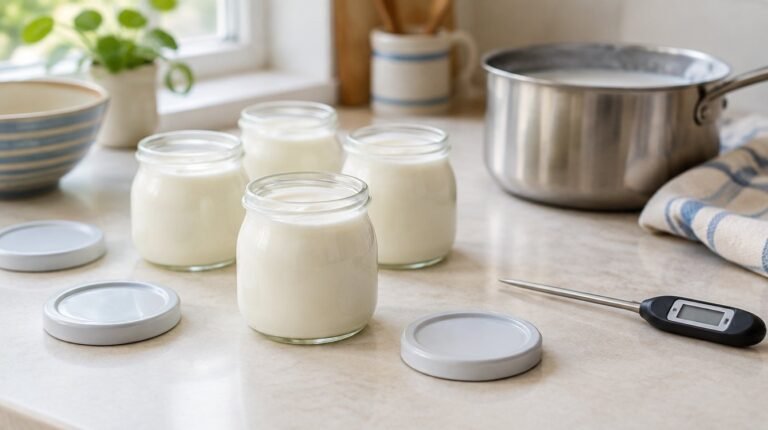
- An incubator that holds 98 to 104°F for a full day: a yogurt maker with adjustable temperature, a multicooker with a low yogurt setting, or a proofing box. See How to Incubate Yogurt for options.
- A probe thermometer: test your incubator with a jar of water before the first batch, since some units run warm.
- Clean glass jars with lids, a saucepan and a whisk.
Ingredients
- 1 quart (946 mL) milk: whole milk gives the best body. Ultra-pasteurized milk works too; see using ultra-pasteurized milk.
- L. casei starter: a capsule or powder that lists L. casei (or Lacticaseibacillus casei) with a strain code if possible. Use the label serving to start; see how much starter to use for scaling.
- 1/4 cup nonfat dry milk (optional): more milk protein for a thicker result.
- 1 tablespoon plain yogurt with live cultures (optional helper): speeds souring and firms the set.
Steps
- Whisk the dry milk into the cold milk, if using. Heat slowly to 180 to 185°F (82 to 85°C), stirring so it does not scorch. Heating to 180°F kills competing bacteria and changes the whey proteins so the result sets better (University of Missouri Extension).
- Cool to 100°F (38°C). A sink of cold water speeds this up. Do not add the culture above 104°F.
- Whisk the capsule contents (and helper yogurt, if using) into half a cup of the warm milk until smooth, then stir it back into the rest.
- Pour into jars, fill them close to the top, and put the lids on.
- Incubate at 98 to 104°F, aiming for 100°F, for 24 hours without stirring. With the helper yogurt, check at 10 to 12 hours; if it is set and tangy, you can stop early.
- If a pure L. casei batch is still thin but smells clean and sour at 24 hours, that is normal. Chill it as a drinkable ferment, or give it up to 12 more hours if you want more tang.
- Refrigerate at 40°F or below for at least 6 hours, then eat within 14 days (University of Illinois Extension). Our guide to how long homemade yogurt lasts has more on storage.
For why cooler, longer ferments behave differently, see Yogurt Temperature. Our L. reuteri guide uses a similar body-temperature method.
How to tell it worked
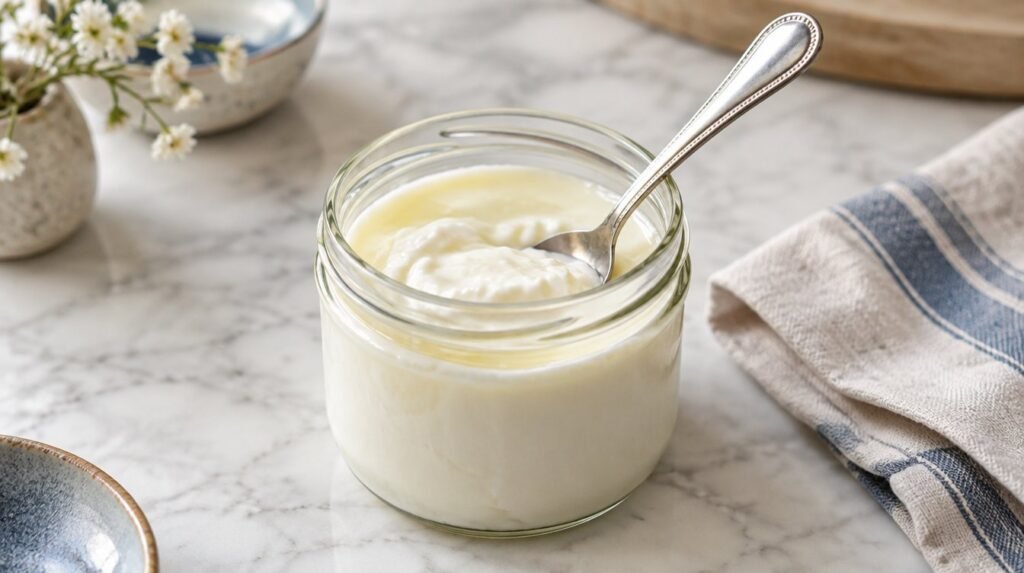
- Texture: a soft gel or a thick, pourable fermented milk that moves as one mass when you tilt the jar. Pure L. casei batches are usually thinner than yogurt.
- Smell and taste: clean, sour and slightly cheesy-sweet. Long ferments are much tangier than store yogurt.
- Acidity (optional): with pH strips, aim for 4.6 or lower, the benchmark U.S. rules set for finished yogurt (21 CFR 131.200).
- Whey: a thin layer of clear liquid on top is normal after 24 hours. Stir it back in or pour it off.
A good set and sour smell show that lactic acid bacteria grew. They cannot tell you whether L. casei did, or how many are alive, especially if you used the helper yogurt, since those bacteria grow faster. Counting a specific species takes lab tests.
Failure modes and fixes
| Problem | Likely cause | Fix |
|---|---|---|
| Still smells like milk after 24 hours | Dead or weak culture, or milk too hot when culture went in | Use a fresh capsule, add it at 100°F, and check your incubator temperature |
| Sour but thin and drinkable | Normal for L. casei, which grows slowly in milk | Add dry milk, use the helper yogurt, or extend to 36 hours |
| Grainy curds and a lot of whey | Too long or too warm with a helper culture | Stop when set; with helper yogurt, check from 10 hours |
| Fizzy, yeasty or bitter | Contamination from jars, spoons or a reused batch | Discard, wash everything in hot soapy water, and start fresh |
| Pink, orange, black or fuzzy spots; rotten smell | Mold or spoilage | Throw out the whole batch; do not scoop around it |
The USDA advises discarding yogurt with mold, because foods with high moisture can be contaminated below the surface (USDA FSIS). For batches that are weepy but smell fine, see Whey from Yogurt.
Can you use a batch to start the next one?
You can try saving 2 tablespoons of a good batch for the next quart, but expect drift. If you used helper yogurt, the faster yogurt bacteria will gradually take over, and single strains from capsules are not chosen for keeping going over many generations. When tang or texture fades after two or three rounds, go back to a fresh capsule. Our article on why an heirloom starter weakens over time explains the pattern.
Is Lactobacillus casei the same as Lacticaseibacillus casei?
Yes. The species moved to the new genus Lacticaseibacillus in 2020, though most labels still print the old name (Zheng et al., 2020).
Is the Shirota strain L. casei?
It was sold under that name for decades, but researchers at the company that markets it now classify it as Lacticaseibacillus paracasei (Kato et al., 2024).
Why is my L. casei yogurt so thin?
L. casei grows slowly in plain milk and does little to thicken it, so a soft, drinkable set is normal; dry milk or a spoonful of live yogurt helps.
Will homemade L. casei yogurt match the studies?
No one knows. The trials used specific strains in factory-made drinks at measured doses, and a home ferment gives no way to count live bacteria.
Related topics
- Lactobacillus paracasei: the species many “casei” strains now belong to.
- Lactobacillus rhamnosus GG: the third member of the casei group.
- Lactobacillus acidophilus: another probiotic culture made at warm temperatures.
- Yogurt Starter: how starters differ and how to pick one.
- Probiotic Drinks: if you would rather buy a fermented milk drink.
Sources
- Hill D, et al. The Lactobacillus casei group: history and health related applications (Frontiers in Microbiology, 2018)
- Zheng J, et al. A taxonomic note on the genus Lactobacillus: description of 23 novel genera, emended description of the genus Lactobacillus Beijerinck 1901, and union of Lactobacillaceae and Leuconostocaceae (International Journal of Systematic and Evolutionary Microbiology, 2020)
- Species: Lacticaseibacillus casei (LPSN, Leibniz Institute DSMZ)
- Phylum: Bacillota (LPSN, Leibniz Institute DSMZ)
- Kato K, et al. Cell wall polysaccharide enhances Lacticaseibacillus paracasei strain Shirota growth in milk and contributes to acid and bile tolerance (International Journal of Food Microbiology, 2024)
- Poon T, et al. Effects of a fermented dairy drink containing Lacticaseibacillus paracasei subsp. paracasei CNCM I-1518 (Lactobacillus casei CNCM I-1518) and the standard yogurt cultures on the incidence, duration, and severity of common infectious diseases: a systematic review and meta-analysis of randomized controlled trials (Nutrients, 2020)
- Koebnick C, et al. Probiotic beverage containing Lactobacillus casei Shirota improves gastrointestinal symptoms in patients with chronic constipation (Canadian Journal of Gastroenterology, 2003)
- Hickson M, et al. Use of probiotic Lactobacillus preparation to prevent diarrhoea associated with antibiotics: randomised double blind placebo controlled trial (BMJ, 2007)
- Guillemard E, et al. Effects of consumption of a fermented dairy product containing the probiotic Lactobacillus casei DN-114 001 on common respiratory and gastrointestinal infections in shift workers in a randomized controlled trial (Journal of the American College of Nutrition, 2010)
- Meléndez-Illanes L, et al. Does the scientific evidence support the advertising claims made for products containing Lactobacillus casei and Bifidobacterium lactis? A systematic review (Journal of Public Health, 2016)
- Ma C, et al. Stimulatory effect of milk protein peptides on the growth and propagation of Lacticaseibacillus casei (Food Science of Animal Resources, 2025)
- 21 CFR 131.200: Yogurt (Electronic Code of Federal Regulations)
- Probiotics: Usefulness and Safety (National Center for Complementary and Integrative Health)
- Probiotics: Fact Sheet for Consumers (NIH Office of Dietary Supplements)
- Dietary Supplements (U.S. Food and Drug Administration)
- Making Yogurt at Home (University of Illinois Extension)
- Preserve It Fresh, Preserve It Safe: 2019, No. 1 (University of Missouri Extension)
- Molds on Food: Are They Dangerous? (USDA Food Safety and Inspection Service)