Can You Make Yogurt with Pasteurized Milk? What the Evidence Says
The verdict: yes, and it is the usual choice
Yes. Pasteurized milk from the grocery store is what nearly every home yogurt guide is written for, and the federal standard for store yogurt requires its dairy ingredients to be pasteurized or ultra-pasteurized before the culture goes in. Most recipes still have you heat the milk again, to around 180°F. That second heating is about texture, not safety: skip it and you usually get softer, runnier yogurt.
What the research shows
Pasteurization removes pathogens, not nutrition
Pasteurization kills harmful germs by heating milk to a set temperature for a set time, the FDA explains. Raw milk can carry Salmonella, E. coli, Listeria, Campylobacter and other germs. The common commercial method is high-temperature short-time pasteurization at 72°C (about 161°F) for 15 seconds, with a slower option at 63°C (145°F) for 30 minutes.
The FDA’s review of raw milk claims says pasteurization kills raw milk pathogens without any significant impact on nutritional quality. It found no meaningful change in protein digestibility or calcium availability. Vitamin C was the main loss. So yogurt made from pasteurized milk starts with essentially the same protein, calcium and fat as raw milk would give you.
Home guides are built around store milk
The University of Kentucky extension guide says yogurt may be made from commercially pasteurized milk from grocery stores. The University of Guam extension guide lists whole, reduced-fat or nonfat pasteurized milk, or UHT milk. It adds that you could skip the heating step because commercial pasteurized milk is free of vegetative pathogens and spoilage bacteria, though the yogurt will be soft.
Heating it again is about texture
Milk for yogurt is heated hard to change its whey proteins. In a 2015 lab study from the University of Wisconsin, researchers heated skim milk to 85°C (185°F) for 30 minutes, then cultured it. Milk heated at its natural acidity gave the firmest yogurt gel. The authors credit the right balance between heat-changed whey proteins attached to the casein network and those left floating free.
That matches what home guides report. University of Illinois Extension lists milk that was not heated enough as a cause of yogurt that separates or is not firm. Whey pooling on top, which dairy scientists call wheying-off, is a known yogurt defect whose causes are still being studied, as one review of milk protein gels notes.
The cultures work the same way
The bacteria that make yogurt do not care whether the milk was pasteurized at the dairy. What matters is that the finished yogurt is not heated again. In a small 1984 trial of nine lactase-deficient adults, pasteurizing yogurt after fermentation cut its live bacteria a hundredfold and removed its usual advantage for lactose digestion. Pasteurizing the milk first, before the culture goes in, does not have that effect.
Caveats to keep in mind
- Pasteurized is not sterile. Pasteurized milk still spoils, and the FDA warns that pasteurization does not make it safe to leave milk out of the fridge for long, especially after opening. Illinois Extension links milk that is not fresh to off flavors and thin yogurt. See our piece on sour milk for more.
- Ultra-pasteurized works too. UHT and ultra-pasteurized milk are both listed in the Guam guide. Our article on ultra-pasteurized milk for yogurt covers the differences.
- Raw milk is a separate case. The FDA says raw milk germs are especially dangerous for children, older adults, pregnant women and people with weakened immune systems. Our guide to raw milk yogurt covers the risks.
- Heating targets vary. Kentucky calls for 160°F held for one minute, Illinois for 180 to 185°F, and Guam for 185°F for 30 minutes or 203°F for 10 to 20 minutes. All are used successfully; the Illinois range is an easy middle ground.
- The evidence is mostly food science. The texture research uses controlled lab milk, not home kitchens, so treat the exact numbers as a guide.
How to make yogurt with pasteurized milk

These steps follow the Illinois Extension method, with the Guam guide’s longer hold as an option for thicker yogurt.
- Pick fresh pasteurized milk well inside its date, in whatever fat level you like.
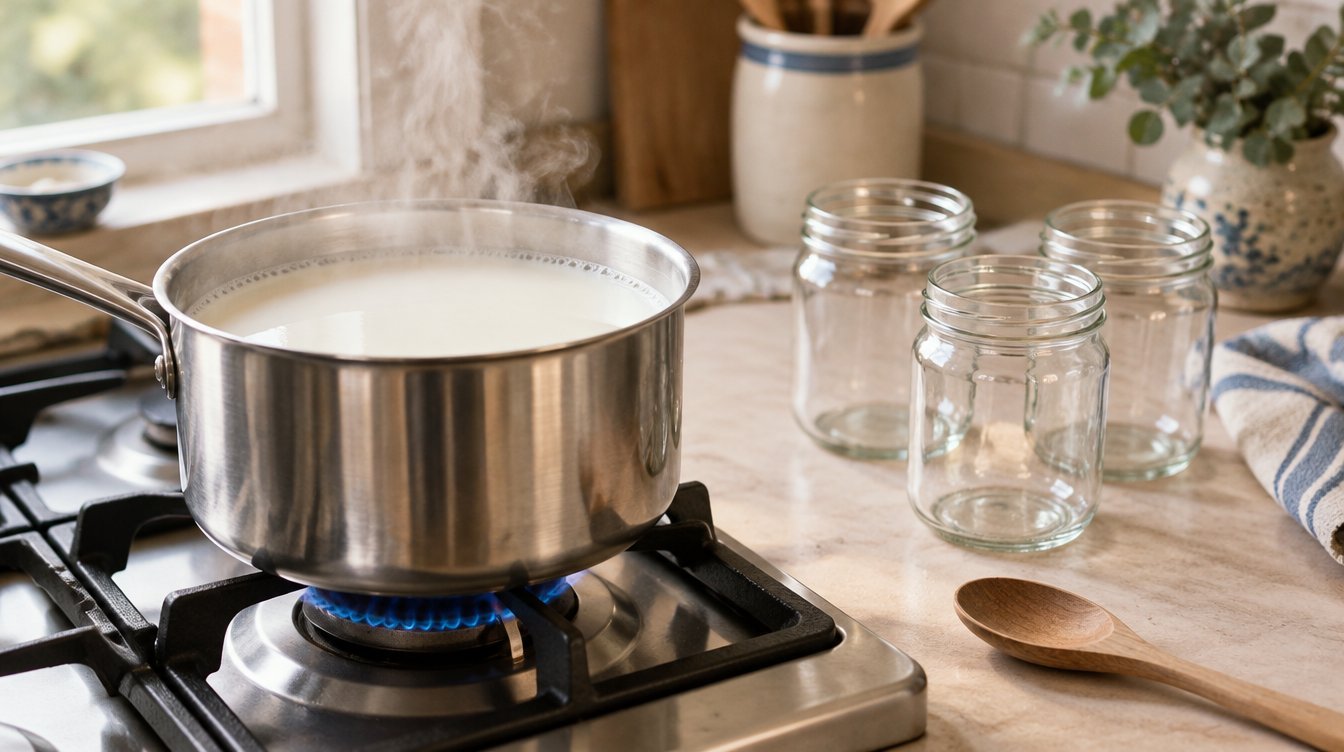
- Heat the milk slowly to 180 to 185°F, stirring so it does not scorch. For a firmer set, hold it at about 185°F for up to 30 minutes.
- Cool the milk to 108 to 115°F.
- Stir in your starter, either a few spoonfuls of plain yogurt with live cultures or a powdered yogurt starter.
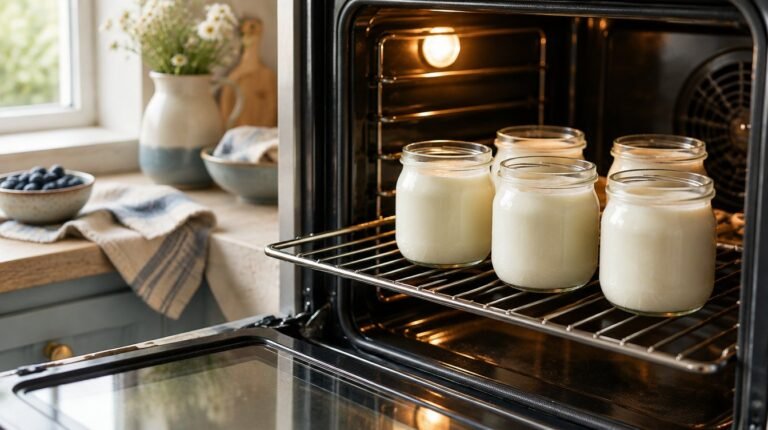
- Incubate at 108 to 115°F for 6 to 10 hours without moving it. Our guide to incubating yogurt covers ovens, coolers and machines.
- Refrigerate at 40°F or lower once it has set, and eat it within 14 days.
Do I have to heat pasteurized milk before making yogurt?
Not for safety, since store milk is already pasteurized, but heating to about 180°F gives a thicker set; skipping it usually means softer yogurt (University of Guam).
Can I use ultra-pasteurized or UHT milk?
Yes. The University of Guam guide lists UHT milk alongside regular pasteurized milk (University of Guam).
Does pasteurization make yogurt less nutritious?
No meaningful loss: the FDA says pasteurization has no significant impact on milk’s nutritional quality, with vitamin C the main exception (FDA).
Will yogurt made from pasteurized milk have live cultures?
Yes. The cultures are added after the milk cools, so they stay alive as long as you do not heat the finished yogurt.
Related topics
- How to Make Yogurt at Home: the full step-by-step method.
- Yogurt Temperature: heating, cooling and incubation targets in one place.
- Homemade Yogurt Nutrition: What You Need to Know: what your batch contains.
- Best Milk for Gut Health: choosing between milk types.
- How Long does Homemade Yogurt Last? The Complete Answer: fridge life and spoilage signs.
Sources
- 21 CFR 131.200 Yogurt (Electronic Code of Federal Regulations)
- The Dangers of Raw Milk: Unpasteurized Milk Can Pose a Serious Health Risk (U.S. Food and Drug Administration)
- Raw Milk Misconceptions and the Danger of Raw Milk Consumption (U.S. Food and Drug Administration)
- Ozcan T, et al. Yogurt made from milk heated at different pH values (Journal of Dairy Science, 2015)
- Lucey JA. Formation and physical properties of milk protein gels (Journal of Dairy Science, 2002)
- Savaiano DA, et al. Lactose malabsorption from yogurt, pasteurized yogurt, sweet acidophilus milk, and cultured milk in lactase-deficient individuals (American Journal of Clinical Nutrition, 1984)
- Making Yogurt at Home (IP-36) (University of Kentucky Cooperative Extension Service)
- Making Yogurt at Home (University of Illinois Extension, 2024)
- Making Yogurt at Home (FP-01) (University of Guam Cooperative Extension, 2016)