Can You Make Yogurt with Sour Milk? What the Evidence Says
The verdict: use fresh milk, not milk that has turned
Not if “sour” means milk that has started to spoil. Sour-smelling milk has already been taken over by spoilage bacteria and their enzymes, and it is more acidic than fresh milk, which both work against a firm, clean-tasting yogurt. The USDA says food with an off odor, flavor or texture should not be eaten. Milk that is past its date but still smells and tastes fresh is a different story and can usually be used.
What people mean by sour milk
- Spoiled store milk: pasteurized milk that smells sour or tastes off, sometimes with lumps. This is the case this article is mostly about.
- Raw milk left to sour on its own: sometimes called clabber. It thickens because of whatever bacteria happen to be in the milk, not a known yogurt culture.
- “Soured milk” in baking recipes: fresh milk with a little lemon juice or vinegar stirred in. It is acidified, not fermented, and is meant for batters, not yogurt.
- Yogurt that tastes too sour: a different question about tartness. See how to make sour yogurt if you want more tang on purpose.
What the research shows
Sour milk is already full of the wrong bacteria
A 2017 review in Frontiers in Microbiology describes how pasteurized milk spoils. Its shelf life is mainly limited by heat-resistant, spore-forming bacteria that survive pasteurization and grow slowly in the cold, with the Bacillus cereus group among the most important. Bacteria such as Pseudomonas can also get in after pasteurization. The result is souring, texture changes and off flavors such as bitter, rancid or soapy notes.
Many of the enzymes these bacteria make are heat resistant and keep part of their activity after heating, the review notes. So reheating sour milk to 180°F does not wipe the slate clean. The flavors and protein damage already done tend to carry through into the yogurt.
Extra acid makes a weaker set
Yogurt depends on heated milk proteins forming a gel as the culture lowers the pH. In a 2015 University of Wisconsin study, skim milk heated at a slightly acidic pH of 6.2 made the weakest yogurt gel, while milk heated at its natural pH of about 6.7 made the firmest. The researchers adjusted the acidity with chemicals rather than spoilage, so it is not a direct test of sour milk, but the direction is the same: milk that is already acidic when heated sets less well.
Home guides report the same thing in plain terms. University of Illinois Extension lists milk that was not fresh as a cause of off flavors and of thin yogurt.
Home methods assume fresh milk
The University of Guam extension guide explains that commercial pasteurized milk is free of vegetative pathogens and spoilage bacteria, which is why the yogurt culture can take over cleanly. Once milk has soured, that is no longer true, and the starter has to compete with an established population of other microbes.
Naturally soured raw milk is not a safe shortcut
Raw milk that thickens on the counter may look like yogurt, but the FDA notes there is no visual or sensory indicator that tells you whether pathogens are present. Raw milk can carry Salmonella, E. coli, Listeria and Campylobacter, and the FDA warns these are especially risky for children, older adults, pregnant women and people with weakened immune systems.
Caveats to keep in mind
- A date is not a safety line. The USDA says dates on most foods are about quality, not safety, and that food past its date should still be safe if handled properly. Milk a few days past the date that smells normal is fine for yogurt.
- Spoilage bacteria are not usually what makes people sick. USDA separates spoilage bacteria, which ruin quality, from pathogens, which cause illness. Sour milk is mainly a quality problem, but you cannot tell by smell which kind you have.
- The evidence is indirect. No published trials test yogurt made from spoiled milk. The case rests on dairy science, extension guidance and food safety advice, which all point the same way.
- When in doubt, throw it out. If milk smells sour, tastes off or has lumps before heating, it is not worth the batch.
How to choose and use milk for yogurt
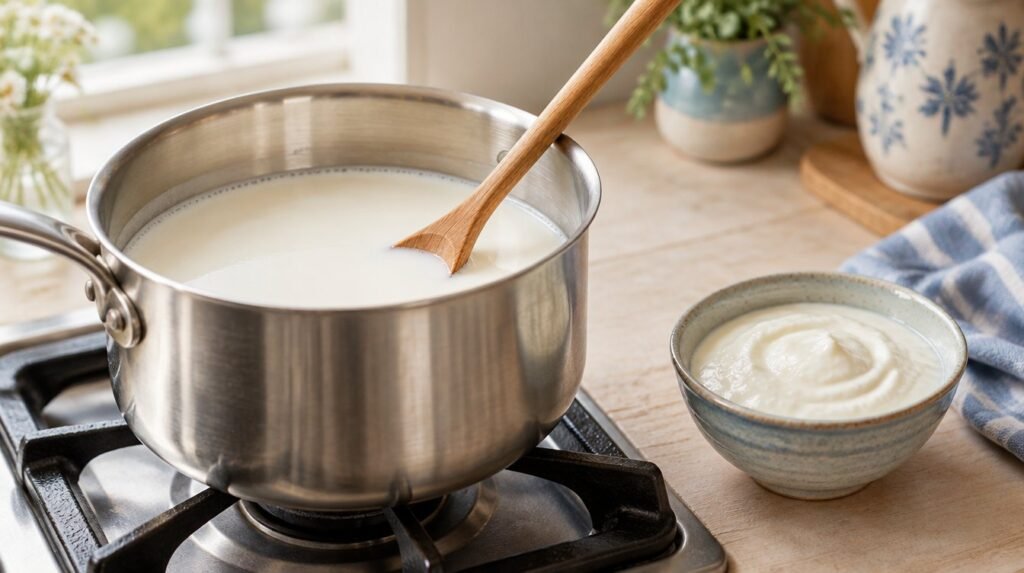
- Smell and taste a little of the milk before heating. It should be sweet and clean. If it is, it works, even near its date. Our guide to making yogurt with pasteurized milk covers the rest.
- If a carton is close to its date and still fresh, turn it into yogurt now. Fermented yogurt keeps 2 to 3 weeks in the fridge, according to the Kentucky and Guam extension guides.
- Use a fresh starter. Illinois Extension says fresher starter has more active bacteria, and the Kentucky guide says fresh starter helps prevent an overly sharp flavor. See our yogurt starter guide.
- Heat to 180 to 185°F, cool to 108 to 115°F, and incubate 6 to 10 hours, following the Illinois method. Our yogurt temperature guide has the details.
- Pour milk that has already turned down the drain rather than into the pot.
Can I make yogurt with milk past its expiration date?
Yes, if it still smells and tastes fresh; USDA says dates on most foods are about quality, not safety (USDA FSIS).
Will heating sour milk to 180°F fix it?
No. Heat kills many bacteria, but some spoilage enzymes are heat resistant, so off flavors and weak texture usually carry into the yogurt.
Is clabbered raw milk the same as yogurt?
No. It sets from whatever bacteria are in the milk rather than yogurt cultures, and raw milk can carry pathogens you cannot see or smell.
What can I do with milk that has gone sour?
If it smells or tastes spoiled, throw it out. USDA advises that food with an off odor, flavor or texture should not be eaten.
Related topics
- How to Make Yogurt at Home: the full method with fresh milk.
- Can you Use Ultra Pasteurized Milk to Make Yogurt? What the Evidence Says: a longer-lasting milk option.
- Raw Milk Yogurt: the risks and how people handle them.
- How Long does Homemade Yogurt Last? The Complete Answer: spotting a batch that has turned.
- Homemade Yogurt Nutrition: What You Need to Know: what fresh milk gives your yogurt.
Sources
- Food Product Dating (USDA Food Safety and Inspection Service)
- Machado SG, et al. The biodiversity of the microbiota producing heat-resistant enzymes responsible for spoilage in processed bovine milk and dairy products (Frontiers in Microbiology, 2017)
- Ozcan T, et al. Yogurt made from milk heated at different pH values (Journal of Dairy Science, 2015)
- Raw Milk Misconceptions and the Danger of Raw Milk Consumption (U.S. Food and Drug Administration)
- The Dangers of Raw Milk: Unpasteurized Milk Can Pose a Serious Health Risk (U.S. Food and Drug Administration)
- Making Yogurt at Home (University of Illinois Extension, 2024)
- Making Yogurt at Home (FP-01) (University of Guam Cooperative Extension, 2016)
- Making Yogurt at Home (IP-36) (University of Kentucky Cooperative Extension Service)