Natural Stool Softener: What You Need to Know
What a natural stool softener is
A natural stool softener is a food, drink or fiber that helps keep more water in your stool, so it comes out softer and easier to pass. The best-studied options are psyllium fiber, prunes, green kiwifruit and mineral-rich water, used along with enough fluids. They work more slowly than drugstore products and suit mild, everyday constipation rather than sudden or severe symptoms.
The term borrows from over-the-counter “stool softeners,” which usually means docusate. MedlinePlus explains that these products soften stools to make them easier to pass, usually take one to three days to work, and shouldn’t be used for more than a week unless a doctor says so. The NIDDK lists stool softeners alongside fiber supplements and osmotic laxatives as over-the-counter options for constipation.
This article is general information about food and fiber, not medical advice. It doesn’t replace advice from your own doctor or pharmacist, especially if you take medicines or have a health condition.
Why stool consistency is worth tracking
Stool form is one of the simplest gut measurements you can make at home. In a 1997 study of 66 volunteers, researchers in Bristol, England, found that a 7-point stool form scale tracked changes in how fast food moved through the gut better than how often people went. That scale, now called the Bristol Stool Form Scale, runs from hard separate lumps (type 1) to watery stool (type 7).
Hard, dry or lumpy stools that are tough to pass are classic signs of constipation, along with having fewer than three bowel movements a week, according to NIDDK. If you try a natural stool softener, noting your stool type and frequency for a couple of weeks shows whether it is helping. For lab-based gut testing, see our guide to stool tests for gut health.
Natural stool softeners and what the research shows
Here is how the main options compare, based on randomized trials and recent reviews. Most trials were small and short, so treat the results as a guide, not a guarantee.
| Option | Amount used in studies | What the evidence shows |
|---|---|---|
| Psyllium | About 10 to 12 g a day | Softened stool more than docusate in one trial; best-supported fiber supplement |
| Prunes | 80 to 120 g a day (about 8 to 13 prunes) | More stool weight and frequency in two small trials |
| Green kiwifruit | 2 kiwis a day | Similar results to prunes and psyllium, fewer side effects |
| High-mineral water | Varies by brand | Better response than low-mineral water in a pooled analysis |
| Magnesium | Stay at or under 350 mg a day from supplements | Used in some laxatives; too much causes diarrhea |
Psyllium
Psyllium is a soluble fiber that forms a gel and holds water. In a double-blind trial of 170 adults with chronic constipation, psyllium (5.1 grams twice a day) raised stool water content and total stool output more than docusate (100 mg twice a day) over two weeks. A 2022 review of 16 trials with 1,251 people found fiber supplements helped constipation overall, with psyllium, doses above 10 grams a day and at least four weeks of use giving the best results. Gas was more common with fiber, and the authors noted the studies varied a lot. Our fiber supplement guide compares types.
Prunes and prune juice
Prunes supply fiber plus sorbitol, a sugar alcohol that draws water into the gut. One analysis found 11.2 to 15.5 grams of sorbitol per 100 grams of prunes. USDA FoodData Central lists 7.1 grams of fiber per 100 grams, or about 0.7 grams in a single pitted prune. In a 4-week trial of 120 adults with low fiber intakes, 80 or 120 grams of prunes a day increased stool weight and frequency compared with water alone, though gas was more common. In a smaller crossover trial of 40 people with constipation, 50 grams of prunes twice a day beat psyllium for weekly bowel movements and stool consistency.
Green kiwifruit
Kiwifruit has fiber that holds a lot of water. In a US trial of 79 adults with chronic constipation, two green kiwifruit a day, 100 grams of prunes or 12 grams of psyllium all increased complete bowel movements over four weeks. Kiwifruit improved stool consistency and straining, had the fewest side effects and the fewest dissatisfied patients. One green kiwi of about 69 grams has roughly 2 grams of fiber, according to USDA FoodData Central.
Water, mineral water and fiber-rich meals
NIDDK advises adults to get 22 to 34 grams of fiber a day, add it a little at a time, and drink water and other liquids so fiber can soften stool. A 2024 review of 23 food studies found high-mineral water led to more people responding than low-mineral water, and rye bread beat white bread for stool frequency. The British Dietetic Association’s 2025 guidelines include recommendations on fiber supplements, kiwifruit, prunes, rye bread and high-mineral water, though most rest on low-certainty evidence. For everyday meal ideas, see best foods for gut health and stewed apples.
Magnesium
Magnesium pulls water into the bowel, which is why it appears in some laxatives. The NIH Office of Dietary Supplements warns that high intakes from supplements and medicines can cause diarrhea, nausea and cramping, and sets the adult upper limit for supplemental magnesium at 350 mg a day unless a health care provider advises otherwise. A 2023 joint guideline from two US gastroenterology societies gave fiber and magnesium oxide conditional recommendations for chronic constipation, meaning the evidence was weaker than for some prescription and over-the-counter drugs.
How to use natural stool softeners
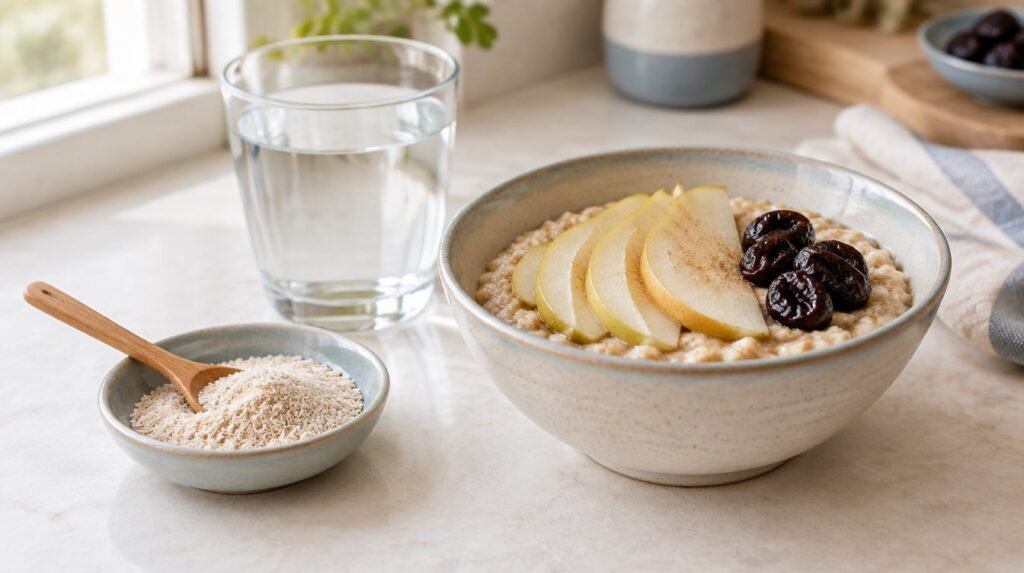
- Start small: add one change at a time, such as two kiwis or a few prunes a day, so you can see what works.
- Raise fiber slowly: NIDDK advises adding fiber a little at a time, since a sudden jump can cause gas and bloating.
- Drink with it: NIDDK advises drinking plenty of water and other liquids when you eat more fiber or take a fiber supplement.
- Give it time: most trials ran three to four weeks, and the fiber review found the best results after at least four weeks.
- Track the results: note your stool type and frequency so you can tell whether the change is working.
For children, take a different approach. The NHS advises seeing a doctor if you think a child is constipated, and laxatives for children should only be given on medical advice. Our guide to signs of poor gut health in toddlers covers the warning signs.
When to see a doctor
Natural stool softeners are for mild constipation. According to NIDDK, see a doctor right away if constipation comes with:
- Bleeding from the rectum or blood in the stool
- Constant pain in the abdomen
- Being unable to pass gas
- Vomiting or fever
- Lower back pain
- Losing weight without trying
Also see a doctor if your symptoms don’t improve with self-care, or if you have a family history of colon or rectal cancer. If you rely on laxatives to go, NIDDK says to talk with your doctor about how to slowly stop using them.
Related topics
- Constipation Relief: more food and lifestyle steps for getting things moving.
- Fiber Supplement: psyllium, inulin and other fiber types compared.
- Stool Test for Gut Health: what lab stool tests can and can’t tell you.
- Signs of a Healthy Gut: what normal bowel habits look like.
- What to Drink After a Meal to Help Digestion: drinks that support digestion.
Sources
- Treatment for Constipation (NIDDK)
- Eating, Diet, & Nutrition for Constipation (NIDDK)
- Symptoms & Causes of Constipation (NIDDK)
- Stool Softeners: MedlinePlus Drug Information (National Library of Medicine)
- Magnesium: Fact Sheet for Consumers (NIH Office of Dietary Supplements)
- Constipation in children (NHS)
- Plums, dried (prunes), uncooked (USDA FoodData Central)
- Kiwifruit, green, raw (USDA FoodData Central)
- McRorie JW, et al. Psyllium is superior to docusate sodium for treatment of chronic constipation (Aliment Pharmacol Ther, 1998)
- van der Schoot A, et al. The Effect of Fiber Supplementation on Chronic Constipation in Adults: An Updated Systematic Review and Meta-Analysis (Am J Clin Nutr, 2022)
- Lever E, et al. The effect of prunes on stool output, gut transit time and gastrointestinal microbiota: A randomised controlled trial (Clin Nutr, 2019)
- Attaluri A, et al. Randomised clinical trial: dried plums (prunes) vs. psyllium for constipation (Aliment Pharmacol Ther, 2011)
- Gill SK, et al. Nutrient, fibre, sorbitol and chlorogenic acid content of prunes (Prunus domestica) (Int J Food Sci Nutr, 2019)
- Chey SW, et al. Exploratory Comparative Effectiveness Trial of Green Kiwifruit, Psyllium, or Prunes in US Patients With Chronic Constipation (Am J Gastroenterol, 2021)
- van der Schoot A, et al. Systematic review and meta-analysis: Foods, drinks and diets and their effect on chronic constipation in adults (Aliment Pharmacol Ther, 2024)
- Dimidi E, et al. British Dietetic Association Guidelines for the Dietary Management of Chronic Constipation in Adults (J Hum Nutr Diet, 2025)
- Chang L, et al. American Gastroenterological Association-American College of Gastroenterology Clinical Practice Guideline: Pharmacological Management of Chronic Idiopathic Constipation (Am J Gastroenterol, 2023)
- Lewis SJ, Heaton KW. Stool form scale as a useful guide to intestinal transit time (Scand J Gastroenterol, 1997)
This article is for general information and is not medical advice. Talk to your doctor or a registered dietitian before changing your diet, supplements or medication, especially if you have a health condition.