Slow Digesting Carbs: What You Need to Know
What slow-digesting carbs are
Slow-digesting carbs are carbohydrate foods your body breaks down and absorbs gradually, so blood sugar rises gently instead of spiking. Most are whole, minimally processed foods with fiber still in them: beans, lentils, oats, barley, whole grains, and most whole fruits. The usual yardstick is the glycemic index, which Harvard’s Nutrition Source describes as a 0 to 100 scale of how quickly and how much a carbohydrate raises blood sugar.
On that scale, foods at 55 or below count as low-glycemic, 56 to 69 as medium, and 70 or above as high. Mayo Clinic lists green vegetables, most fruits, raw carrots, kidney beans, chickpeas and lentils as low; white rice, white bread and potatoes as high.
The index has limits. Mayo notes it ignores how much of a food you actually eat, and the same food can have a range of values depending on how it is grown, cooked and processed. That is why Harvard also uses glycemic load, which multiplies the index by the carbohydrate in a serving. A load of 10 or under is low and 20 or more is high.
Why some carbs digest slowly
A carb’s speed depends less on whether it is “simple” or “complex” and more on how easy it is for your enzymes to reach the starch and sugar. A few things slow the process down:
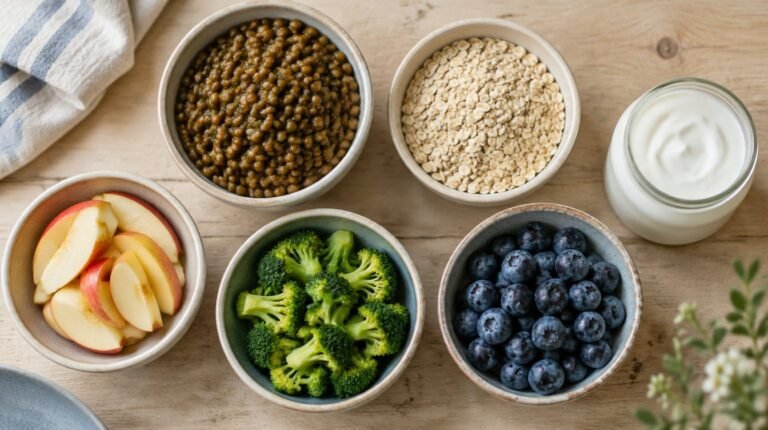
- Soluble fiber. It dissolves in water and forms a gel that slows digestion, according to Mayo Clinic. Oats, beans, peas, apples, citrus, carrots and barley are good sources.
- Intact structure. Harvard notes that milled, refined grains have a higher glycemic index, and finely ground grain is digested faster than coarsely ground grain. Steel-cut oats and whole barley kernels hold together longer than instant oats or white flour.
- Fat and acid in the meal. Harvard says meals that contain fat or acid are converted to sugar more slowly. Adding olive oil, nuts, yogurt or a vinegar dressing changes how a meal behaves.
- Ripeness. Riper fruit tends to have a higher glycemic index than less ripe fruit, per Harvard.
- Cooking and cooling. When cooked starch cools, some of it rearranges into resistant starch, a form your small intestine cannot fully digest. More on this below.
Why slow-digesting carbs matter for gut health
The gut connection is fiber. Your own enzymes cannot break down most plant fibers, so they travel to the large intestine, where gut microbes ferment them into short-chain fatty acids such as acetate, propionate and butyrate. A 2017 review in Gut Microbes describes these compounds as a main way fiber shapes the gut community and its activity. Refined carbs like white bread and sugary drinks are mostly absorbed in the small intestine and leave little for those microbes.
Small human studies show what this looks like in practice. In a 2016 randomized crossover study of 21 healthy adults, eating bread made from barley kernels for four days lowered blood sugar after a standard breakfast the next morning, compared with white wheat bread. It also raised breath hydrogen, a sign that gut bacteria were fermenting more carbohydrate. The study was short and small, so treat it as a sign of how these foods work rather than proof of lasting health effects.
The bigger picture comes from fiber research overall. A 2019 series of reviews in The Lancet, covering 185 long-term observational studies and 58 clinical trials, found that people who ate the most fiber had 15 to 30% lower rates of heart disease, type 2 diabetes and colorectal cancer than those who ate the least, with the strongest links at 25 to 29 grams a day. Those are associations, not proof of cause, but they line up with the trial data on body weight, blood pressure and cholesterol.
Resistant starch: the cook-and-cool trick
Cooling cooked starch increases its resistant starch. In a 2015 study from Indonesia, white rice cooked, chilled for 24 hours at 39°F (4°C) and reheated had 1.65 grams of resistant starch per 100 grams, compared with 0.64 grams in freshly cooked rice. In 15 healthy adults, the chilled and reheated rice produced a smaller blood sugar rise. The same idea applies to potato salad, cold pasta salad and leftover rice, though the change is modest. If you use leftovers this way, refrigerate cooked rice promptly. For a supplement version, see our guide to resistant starch supplements.
Slow-digesting carbs to try
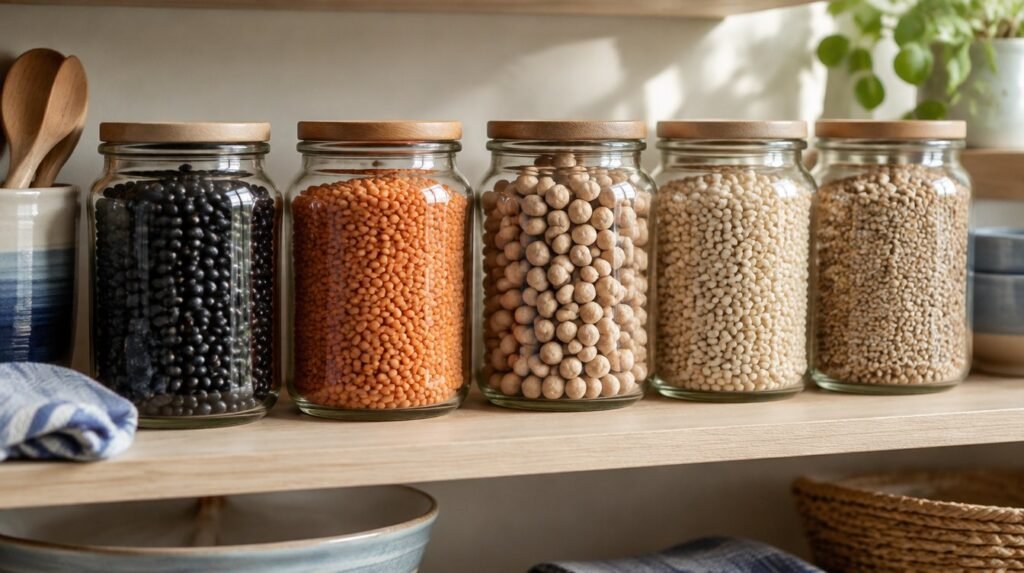
The fiber numbers below come from USDA FoodData Central and are per 100 grams of the food as eaten. Glycemic categories follow the Mayo Clinic and Harvard lists cited above.
| Food | Fiber per 100 g (USDA) | Notes |
|---|---|---|
| Lentils, boiled | 7.9 g | About 15.6 g per cup (198 g). Low glycemic per Mayo. |
| Black beans, boiled | 8.7 g | About 15 g per cup (172 g). Low glycemic load per Harvard. |
| Chickpeas, boiled | 7.6 g | Low glycemic per Mayo. Try roasted or in hummus. |
| Rolled oats, dry | 10.1 g | Cooked with water, oatmeal has 1.7 g per 100 g because it is mostly water. |
| Whole-wheat bread | 6.0 g | Compare white bread at 2.7 g. Mayo still rates whole-grain bread as medium. |
| Apple, with skin | 2.4 g | Low glycemic load per Harvard. Eat the skin. |
| Pear, raw | 3.1 g | Whole fruit, not juice, keeps the fiber. |
Oats deserve a closer look because people often ask whether they are good or bad for the gut. Our articles on fiber in overnight oats and whether oatmeal is bad for your gut go into detail.
How to eat more slow-digesting carbs
- Swap, don’t subtract. Trade white rice for barley, farro or a rice and lentil mix, and white bread for a dense whole-grain or rye loaf.
- Add beans to what you already cook. A half cup of lentils or black beans stretches soups, chili, tacos and salads.
- Pick less-processed forms. Steel-cut or rolled oats instead of instant packets; whole fruit instead of juice.
- Build a mixed plate. Pair carbs with protein, fat or something acidic, such as yogurt with oats, olive oil on beans, or a vinegar dressing on grain salads.
- Cook ahead and chill. Leftover rice, potatoes or pasta eaten cold or reheated carry a bit more resistant starch.
- Go slowly. Mayo Clinic advises adding fiber over a few weeks and drinking plenty of water, because too much too fast can cause gas, bloating and cramping. Adults generally need 21 to 38 grams a day depending on age and sex.
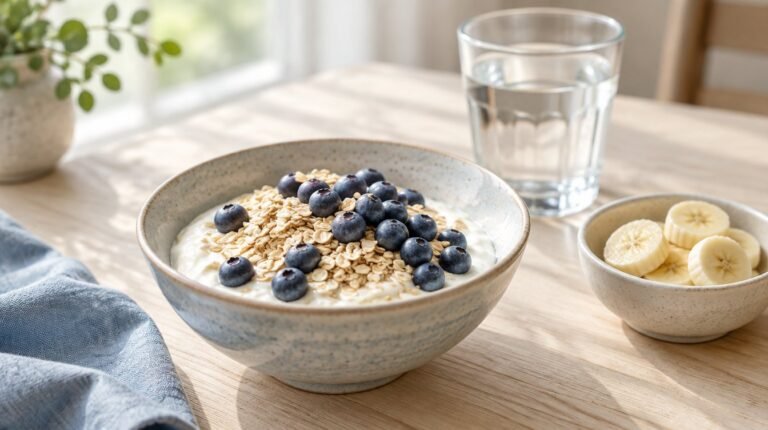
A simple slow-carb breakfast is a bowl of rolled oats with plain yogurt, berries and a spoon of nuts. For more ideas, see our gut health diet plan and the list of best foods for gut health.
Who should be careful
Slow-digesting carbs are not the right fit for every gut. Many of them, including beans, lentils, apples, pears and wheat, are high in FODMAPs, fermentable carbs that can trigger gas, bloating and pain in people with irritable bowel syndrome. The NIDDK says a doctor may suggest a low-FODMAP diet for a few weeks, then reintroduce foods slowly. Starting with small portions can help you find your limit. If gas is your main problem, our guide on what to eat when your stomach hurts from gas can help.
People with gastroparesis, a condition in which the stomach empties too slowly, are often told the opposite. The NIDDK says doctors may recommend low-fiber, low-fat foods and five or six small meals a day for them. If you have diabetes and take insulin or other glucose-lowering medicine, talk with your care team before making big changes to how you eat carbs.
This article is general information, not medical advice. If you have ongoing belly pain, unexplained weight loss, blood in your stool or a lasting change in bowel habits, see a doctor rather than adjusting your diet on your own.
Related topics
- Foods That Slow Digestion: what makes a meal stay with you longer.
- Resistant Starch Supplement: when a powder might make sense.
- Do Overnight Oats Have Fiber?: the numbers behind a slow-carb breakfast.
- Foods That Are Hard to Digest: why some high-fiber foods cause trouble.
- Fiber Supplement: options if food alone falls short.
Sources
- Carbohydrates and Blood Sugar (The Nutrition Source, Harvard T.H. Chan School of Public Health)
- Low-glycemic index diet: What’s behind the claims? (Mayo Clinic)
- Dietary fiber: Essential for a healthy diet (Mayo Clinic)
- Holscher HD. Dietary fiber and prebiotics and the gastrointestinal microbiota (Gut Microbes, 2017)
- Nilsson A, et al. Gut microbiota mediated benefits of barley kernel products on metabolism, gut hormones, and inflammatory markers as affected by co-ingestion of commercially available probiotics (Clinical Nutrition ESPEN, 2016)
- Reynolds A, et al. Carbohydrate quality and human health: a series of systematic reviews and meta-analyses (The Lancet, 2019)
- Sonia S, et al. Effect of cooling of cooked white rice on resistant starch content and glycemic response (Asia Pacific Journal of Clinical Nutrition, 2015)
- Eating, Diet, & Nutrition for Irritable Bowel Syndrome (NIDDK)
- Eating, Diet, & Nutrition for Gastroparesis (NIDDK)
- Lentils, mature seeds, cooked, boiled, without salt (USDA FoodData Central)
- Beans, black, mature seeds, cooked, boiled, without salt (USDA FoodData Central)
- Chickpeas, mature seeds, cooked, boiled, without salt (USDA FoodData Central)
- Cereals, oats, regular and quick, not fortified, dry and cooked with water (USDA FoodData Central)
- Bread, whole-wheat, commercially prepared and Bread, white, commercially prepared (USDA FoodData Central)
- Apples, raw, with skin and Pears, raw (USDA FoodData Central)