Aloe Vera Juice: What You Need to Know
What aloe vera juice is
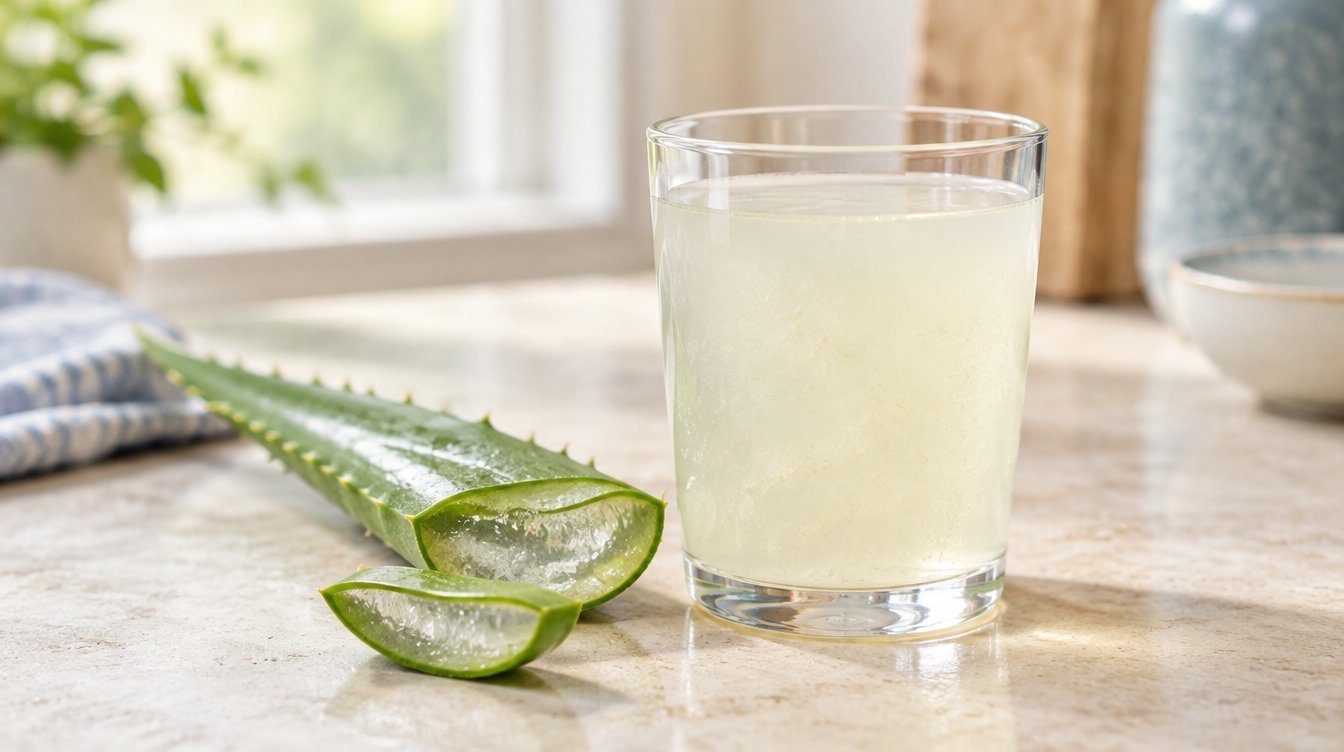
Aloe vera juice is a drink made from the leaves of the aloe plant, the same spiky succulent many people keep for sunburns. Products range from plain juice to sweetened drinks with added fruit juice, so the ingredient list matters. What matters most for safety, though, is which part of the leaf the juice comes from.
The National Center for Complementary and Integrative Health (NCCIH) describes three parts used in aloe products:
- Gel: the clear, jelly-like inner leaf. Food-grade aloe drinks are generally made from this or from decolorized whole leaf, according to a 2023 review.
- Latex: from the outer layer of the leaf. It contains compounds called anthraquinones, including aloin, and has a laxative effect.
- Whole leaf: crushed leaf containing both gel and latex. If it has not been filtered through activated carbon to remove the anthraquinones, it is called non-decolorized.
So “inner leaf” or “decolorized” juice and non-decolorized whole-leaf juice are very different products, even though both may simply say “aloe vera juice” on the front.
What is in a glass
Aloe juice is mostly water. USDA FoodData Central lists a vitamin C-fortified aloe vera juice drink (FDC 174131) at 96% water. One 8-ounce (240 ml) cup provides about 36 calories, 9 g of carbohydrate, all of it sugar, and 9 mg of vitamin C. Brands vary widely, so check the Nutrition Facts panel, especially for added sugar.
The interest in aloe for the gut comes from compounds in the gel, including complex sugars called polysaccharides (described in the Guo and Mei review), and from the laxative effect of the latex. Those are two separate things, and only the gel is meant to be in everyday drinks.
What research says about aloe vera juice and digestion
The human research is small and mixed. NCCIH’s summary says there isn’t enough reliable information to say whether aloe helps irritable bowel syndrome (IBS) or ulcerative colitis. Here is what the main trials found:
| Use | What studies found | How strong |
|---|---|---|
| IBS symptoms | A 2018 meta-analysis of 3 trials (151 people) found aloe beat placebo; a 2026 meta-analysis of 3 aloe trials found no significant difference | Weak and conflicting |
| Heartburn and reflux | One 4-week pilot trial in 79 people compared aloe syrup with two acid-reducing drugs; all groups reported fewer symptoms | Very early; no placebo group |
| Ulcerative colitis | One 4-week trial in 44 people found more clinical responses with aloe gel than placebo | Small, single trial |
| Constipation | Aloe latex has a laxative effect, but FDA required it to be removed from over-the-counter laxatives in 2002 for lack of safety data | Real effect; not advised for regular use |
Irritable bowel syndrome
A 2018 meta-analysis in the Journal of Neurogastroenterology and Motility by Hong and colleagues pooled 3 randomized trials with 151 people with IBS. Aloe improved symptom scores more than placebo over the short term, with no aloe-related side effects reported. But a larger 2026 review of plant-based IBS treatments in Phytotherapy Research (Meyer and colleagues) found aloe’s effect across 3 studies was not statistically significant, while peppermint oil was. The authors called the quality of many studies limited.
Reflux and heartburn
In a 2015 pilot trial (Panahi and colleagues), 79 people with reflux took 10 ml a day of an aloe syrup, omeprazole or ranitidine for 4 weeks. The aloe group reported fewer reflux symptoms and no side effects serious enough to stop. With no placebo group and a short timeframe, this is a starting point, not proof. Our GERD diet guide covers food changes with better support.
Ulcerative colitis
A 2004 double-blind trial in Alimentary Pharmacology and Therapeutics (Langmead and colleagues) gave 30 people with mild to moderate ulcerative colitis 100 ml of aloe gel twice a day and 14 people a placebo for 4 weeks. Clinical response was 47% with aloe and 14% with placebo, but other measures, including the scope exam, showed no difference. The authors said more study was needed, and NCCIH still rates the evidence for ulcerative colitis as insufficient.
Safety: what to know before you drink it
Short-term use of the gel looks reasonably safe. NCCIH says studies suggest oral aloe gel is safe for up to 42 days. The concerns come mainly from latex and non-decolorized whole-leaf products, and from long-term use.
- Cramps and diarrhea: oral aloe latex can cause abdominal pain, cramps and diarrhea (NCCIH). A review by FDA scientists Guo and Mei links aloe preparations to diarrhea, low potassium and kidney problems.
- Liver injury: NCCIH notes cases of acute hepatitis in people who took aloe leaf extracts for anywhere from 3 weeks to 5 years.
- Cancer in animal studies: in a 2-year U.S. government study, non-decolorized whole-leaf extract in drinking water caused large-intestine tumors in rats at the two higher doses. The International Agency for Research on Cancer classes this form as a possible human carcinogen, and California has listed it under Proposition 65 since 2015.
- Decolorized products: a 2023 review (Kim and colleagues) concluded that drinkable aloe products with no more than 10 parts per million of aloin were not genotoxic. Several authors work for Ashland, an ingredients company, and NCCIH notes some lab research suggests even decolorized extract might damage DNA.
- Pregnancy and breastfeeding: NCCIH says aloe taken by mouth may be unsafe during both.
- Medicines: overuse of latex may raise the risk of side effects from heart drugs such as digoxin, and aloe may lower blood sugar. NCCIH advises talking with your health care provider first if you take any medicine.
Many aloe products are sold as dietary supplements, which NCCIH notes are not approved by the FDA before they are sold. The label is the main clue to what you are getting.
How to choose and use aloe vera juice

- Look for “inner leaf” or “decolorized” on the label, and skip non-decolorized whole-leaf juice.
- Check for an aloin figure. If the label lists one, look for 10 ppm or less, the level covered by the 2023 safety review. With no figure, you cannot tell.
- Read the sugar line. Many aloe drinks are sweetened. Unsweetened versions or a splash mixed into water keep sugar down.
- Keep it short-term. The trials above lasted 4 weeks, and NCCIH’s safety note covers gel use up to 42 days. Do not use aloe as a daily laxative.
- Stop if your gut reacts. Cramping or loose stools suggest latex or too much juice.
- Skip it if you are pregnant or breastfeeding, and ask your doctor first if you take any medicine.
If you want a drink for regularity, fiber and fluids have stronger support. Our guides to constipation relief and the best juice for gut health compare options.
When to see a doctor
Diarrhea and stomach pain can have many causes, aloe among them. The National Institute of Diabetes and Digestive and Kidney Diseases (NIDDK) advises talking with a doctor right away if you have:
- Diarrhea lasting more than 2 days, or six or more loose stools a day
- Severe pain in the abdomen or rectum
- Stools that are black and tarry or contain blood or pus
- High fever or frequent vomiting
- Signs of dehydration, such as extreme thirst, dizziness, dark urine or urinating less than usual
Ongoing reflux, IBS or colitis symptoms also deserve a proper diagnosis rather than self-treatment with aloe. This article is general information, not medical advice.
Related topics
- Herbs for Gut Health: other plants studied for digestion, with the evidence for each.
- Gut Health Drinks: kefir, kombucha and other options compared.
- Gut Health Shots: what small daily drinks can and cannot do.
- Juice Cleanse: why cleanses promise more than the evidence shows.
- Upset Stomach Remedies: gentle steps for a sour stomach.
Sources
- Aloe Vera: Usefulness and Safety (National Center for Complementary and Integrative Health)
- Hong SW, et al. Aloe vera Is Effective and Safe in Short-term Treatment of Irritable Bowel Syndrome: A Systematic Review and Meta-analysis (Journal of Neurogastroenterology and Motility, 2018)
- Meyer A, et al. Systematic Review and Meta-Analysis: Plant-Based Therapy for Irritable Bowel Syndrome (Phytotherapy Research, 2026)
- Panahi Y, et al. Efficacy and safety of Aloe vera syrup for the treatment of gastroesophageal reflux disease: a pilot randomized positive-controlled trial (Journal of Traditional Chinese Medicine, 2015)
- Langmead L, et al. Randomized, double-blind, placebo-controlled trial of oral aloe vera gel for active ulcerative colitis (Alimentary Pharmacology and Therapeutics, 2004)
- Boudreau MD, et al. Clear evidence of carcinogenic activity by a whole-leaf extract of Aloe barbadensis miller (aloe vera) in F344/N rats (Toxicological Sciences, 2013)
- Guo X, Mei N. Aloe vera: A review of toxicity and adverse clinical effects (Journal of Environmental Science and Health, Part C, 2016)
- Kim ST, et al. The absence of genotoxicity of Aloe vera beverages: A review of the literature (Food and Chemical Toxicology, 2023)
- Aloe vera, non-decolorized whole leaf extract (California Office of Environmental Health Hazard Assessment, Proposition 65 list)
- Beverages, aloe vera juice drink, fortified with Vitamin C (FDC ID 174131) (USDA FoodData Central)
- Symptoms and Causes of Diarrhea (National Institute of Diabetes and Digestive and Kidney Diseases)