How to Thicken Yogurt: A Step-by-Step Guide
What you will end up with
There are two ways to thicken yogurt. You can build thickness in while the yogurt forms, by adding milk solids, heating the milk longer and holding the incubation steady. Or you can take water out after it sets, by straining off the whey. Most people get the best results by combining a little of both.
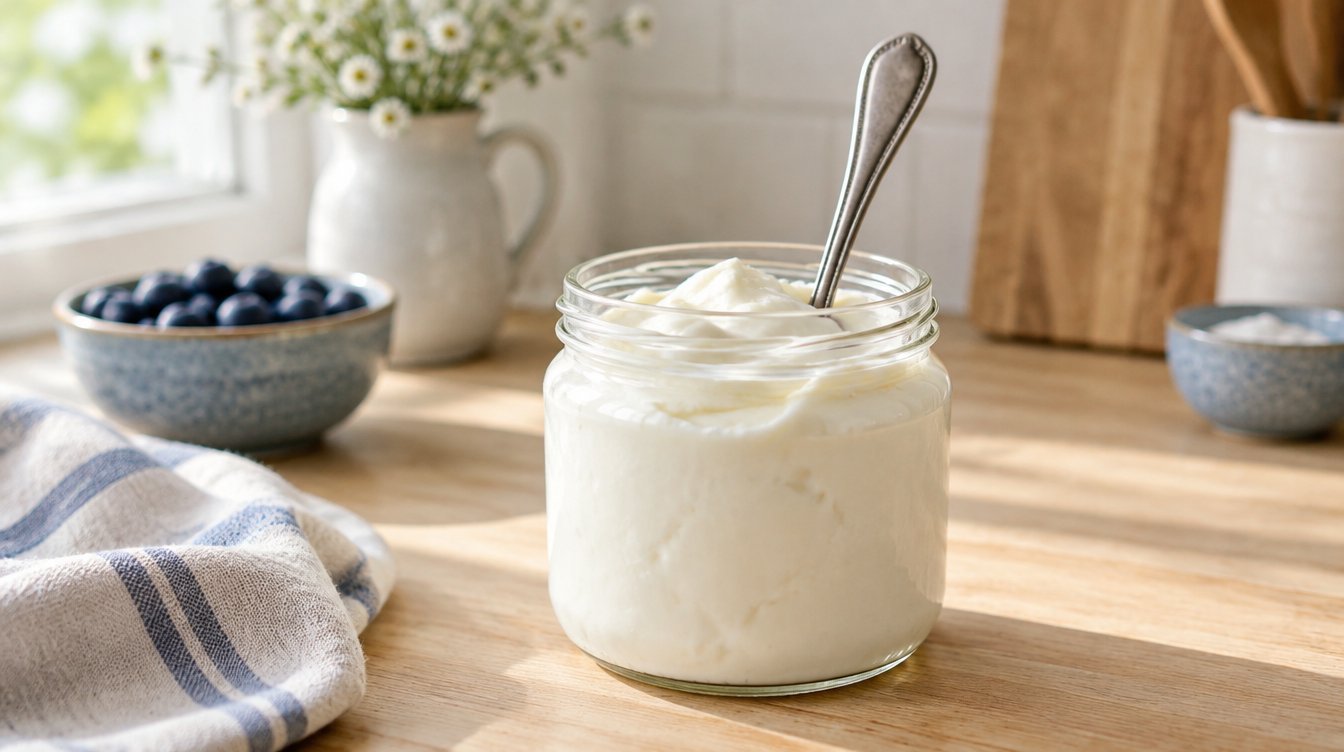
Follow the steps below and you will end up with about a quart of plain yogurt that holds a spoon upright, or a smaller amount of Greek-style yogurt if you strain it. Plan on about 45 minutes of hands-on time, 6 to 10 hours of incubation, at least 6 hours of chilling, and 2 to 4 more hours if you strain.
Why yogurt turns out thin
Yogurt sets because the culture turns lactose into lactic acid. As the milk sours, its proteins pull together into a soft gel that traps water (University of Illinois Extension). Anything that weakens that protein network, or gives it less protein to work with, gives you a thinner yogurt.
The most common causes listed in extension troubleshooting guides are milk that was not heated enough before the starter went in, a starter that was old or had few live bacteria, and an incubation temperature that ran too hot or too cold. Jostling the jars or chilling them late can also weaken the texture (Illinois; University of Kentucky Cooperative Extension).
Food scientists see the same pattern in the lab. A review of yogurt texture research found that adding milk proteins, using the right heat treatment (85°C for 30 minutes or 95°C for 5 minutes), incubating around 40°C, and cooling carefully all reduced whey separation (Arab et al., Journal of Food Science and Technology, 2023).
Equipment
- Heavy saucepan (2-quart or larger), so the milk heats evenly and is less likely to scorch.
- Food or candy thermometer, because both heating and incubation depend on hitting a temperature range.
- Clean jars or a 1.5-quart container with lids.
- A way to hold 108 to 112°F for several hours: a yogurt maker, an oven with the light on, or an insulated cooler with warm water.
- For straining: a fine-mesh strainer or a colander lined with a double layer of cheesecloth, set over a bowl.
Ingredients
- 1 quart milk. Whole milk gives the creamiest result. Skim and low-fat milk work too, but the University of Kentucky notes that lower-fat yogurts may not be as smooth (UK Extension).
- ¼ to ¾ cup instant nonfat dry milk. Illinois suggests ¼ cup per quart when using skim milk. Kentucky’s recipe uses 1½ cups per half gallon, which works out to ¾ cup per quart, and recommends about 5% added dry milk to prevent whey separation (Illinois; Kentucky).
- 2 tablespoons plain yogurt with live and active cultures, or a packet of freeze-dried starter used according to its directions. Use a starter before its date, or a homemade batch within 5 to 7 days (Illinois).
- Optional stabilizer: unflavored gelatin, pectin, agar or tapioca starch, all listed as yogurt texture improvers by the University of Guam.
Adding milk solids is not a home trick. The federal standard for yogurt sets a minimum of 8.25% milk solids not fat and allows other milk-derived ingredients to raise it, along with stabilizers (21 CFR 131.200). For more on how different milks behave, see our milk type vs yogurt texture matrix.
Step-by-step: how to thicken yogurt as you make it
- Whisk in the milk powder while the milk is cold. Add the nonfat dry milk to the cold milk and whisk until no lumps remain. Illinois lists powder that was not added to cold milk as one cause of thin yogurt, so do this before heating.
- Heat the milk to 180 to 185°F. Warm it slowly over medium-low heat, stirring often so it does not scorch. Illinois and Missouri both use about 180°F (Illinois; University of Missouri Extension). The heat changes the whey proteins so they join the gel instead of floating free.
- Hold the heat for a thicker set. For the firmest yogurt, keep the milk at 185°F (85°C) for 30 minutes, or at 203°F (95°C) for 10 to 20 minutes, as the University of Guam guide recommends. In a University of Wisconsin study, milk preheated at 85°C for 30 minutes made thicker, more mouth-coating stirred yogurt than milk heated to 75°C (Lee and Lucey, Journal of Dairy Science, 2006). Keep the heat low and stir often during the hold.
- Cool to 108 to 115°F. Set the pot in a sink of cold water to speed this up, stirring now and then. Skim off any skin that forms on top, because it can give the yogurt a lumpy texture (Missouri).
- Add the starter. Stir the starter into about 1 cup of the warm milk until smooth, then stir that back into the pot.
- Pour into jars and incubate at 108 to 112°F for 6 to 10 hours. Illinois gives 108 to 115°F for 6 to 10 hours; Guam uses 110°F for 6 to 12 hours. Do not move, stir or open the jars during this time. Wisconsin researchers found that gels formed at lower incubation temperatures within the normal range produced thicker stirred yogurt (Lee and Lucey, 2006), so aim for the lower end and keep it steady. See our guide to yogurt temperature for more detail.
- Check the set. Tilt a jar gently. When the yogurt pulls away from the side in one mass instead of flowing, it is done. A longer incubation makes a tangier yogurt and can firm it a bit more, but going far past the set point can cause whey separation (Illinois). Our article on how long to incubate yogurt covers timing by culture.
- Chill without stirring for at least 6 hours. Move the jars straight to the refrigerator at 40°F or below. The University of Kentucky notes the yogurt keeps firming as it cools, and that stirring breaks the gel and leaves a smoother, runnier texture. If you like it firm, do not stir until you serve it (UK Extension).
How to strain yogurt for Greek-style thickness
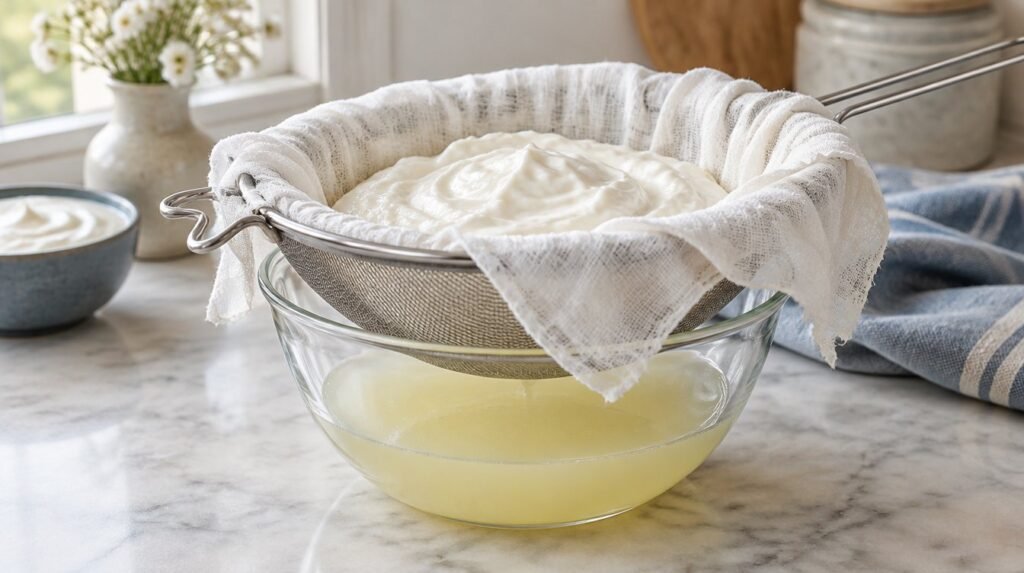
Straining is the most reliable way to thicken yogurt, and it works on homemade or store-bought plain yogurt. Removing the watery whey concentrates the protein. In USDA data, plain nonfat Greek yogurt has about 10.2 grams of protein per 100 grams (USDA FoodData Central), compared with about 5.3 grams in plain low-fat yogurt (USDA FoodData Central).
- Line a fine-mesh strainer or colander with a double layer of cheesecloth and set it over a bowl so the bottom sits above the whey that collects.
- Spoon in cold, set yogurt. Chilled yogurt holds together better than warm yogurt fresh from the incubator.
- Cover and refrigerate. Drain for 2 to 4 hours for Greek-style yogurt, or 8 to 24 hours for a thick, spreadable yogurt cheese (Illinois).
- Stir the strained yogurt with a spoon or whisk for a silky texture, and store it covered in the fridge.
The longer you strain, the thicker and smaller the batch. A Greek study of commercial-style production found that letting yogurt sit for 24 hours before removing whey gave about 8% more strained yogurt and 11% less whey than separating it right after incubation (Karastamatis et al., Foods, 2022). That study used a centrifuge, not cloth, but chilling first is an easy step at home too. Our full walkthrough is in How to Make Greek Yogurt, and you can put the leftover whey to use with these recipes using whey.
Other ways to thicken yogurt
| Method | How it works | Best for | Trade-off |
|---|---|---|---|
| More milk solids (dry milk powder) | Adds protein for a denser gel | Every batch, especially skim milk | Slightly sweeter, milky taste at high amounts |
| Longer heat hold (185°F for 30 min) | More whey protein joins the gel | Firm, spoonable set yogurt | Extra time at the stove |
| Straining | Removes whey | Greek-style yogurt or yogurt cheese | Smaller yield |
| Gelatin, pectin or agar | Binds water | Fruit yogurts, parfaits | Not plain yogurt any more; gelatin is not vegetarian |
| Starch (tapioca, cornstarch) | Thickens when cooked | Cooked sauces made with yogurt | Must be cooked to work |
| Thick-setting culture | Some strains make natural thickeners | Repeat batches | Results vary by starter |
Stabilizers. The University of Guam lists gelatin, pectin, agar, guar gum, tapioca starch and modified corn starch as ingredients that improve yogurt texture by helping the milk hold water (UOG). In the review of syneresis research, gelatin was the most effective stabilizer for reducing whey separation (Arab et al., 2023). At home, bloom unflavored gelatin in a little cold milk, then dissolve it in the hot milk before cooling, and use well under the amount you would use for a gelled dessert so the yogurt stays creamy.
The culture itself. Some strains of Streptococcus thermophilus produce exopolysaccharides, natural sugars that thicken yogurt. In one study, a starter built around a high-producing strain gave lower whey separation than one of the two commercial starters it was compared with (Han et al., BioMed Research International, 2016). If one starter always gives you thin yogurt, trying another is a fair experiment. Our yogurt starter guide explains the options.
How to rescue thin yogurt
- It set, but it is runny: strain it. This is the simplest fix and it works every time the yogurt has soured and gelled.
- It is barely set after the expected time: give it 2 more hours at incubation temperature and check again, as the Illinois guide suggests for drinkable yogurt (Illinois).
- It is grainy or full of whey: the incubation probably ran too hot, unevenly, or too long, or it cooled too slowly (UK Extension). Stir the whey back in or strain it out, and lower the temperature or shorten the time next batch.
- It never set and still smells like fresh milk: the culture did not work. Extension guides offer no safe rescue for milk that sat warm for hours without souring, so discard it and start again with a fresh starter.
Store finished yogurt covered at 40°F or below and eat it within 14 days (Illinois). Throw out any batch that grows mold; USDA advises discarding moldy yogurt because mold can reach below the surface (USDA FSIS).
Frequently asked questions
Does whole milk make thicker yogurt than skim milk?
Usually it tastes richer and creamier, and lower-fat yogurts may not be as smooth (University of Kentucky Extension). Adding nonfat dry milk is the bigger lever for thickness, especially with skim milk.
Can I thicken yogurt after it is made without straining?
Not much. Stirring in dissolved gelatin can add body, but nothing firms plain set yogurt as reliably as straining off some whey.
Why did my yogurt get thinner after I stirred it?
Stirring breaks the gel that formed during incubation, so the yogurt turns smoother and runnier (UK Extension). Leave it undisturbed until it is cold, and stir only right before serving.
How long should I strain yogurt?
About 2 to 4 hours in the fridge for Greek-style yogurt, and 8 to 24 hours for spreadable yogurt cheese (University of Illinois Extension).
Does ultra-pasteurized milk make thick yogurt?
Yes. The University of Guam lists UHT milk as a suitable milk for homemade yogurt, and adding nonfat dry milk still helps it set firmer.
Related topics
- How to Make Yogurt at Home: the basic method, start to finish.
- How to Make Greek Yogurt: straining in detail.
- Protein Content of Yogurt by Milk and Straining Method: how much protein straining adds.
- Can You Use Ultra-Pasteurized Milk to Make Yogurt?: what the extra heat does.
- Best Milk for Making Yogurt: which milks set best.
Sources
- Making Yogurt at Home (University of Illinois Extension, 2024)
- Making Yogurt at Home (University of Guam Cooperative Extension, 2016)
- Making Yogurt at Home, IP-36 (University of Kentucky Cooperative Extension Service)
- Preserve It Fresh, Preserve It Safe: Making Yogurt at Home (University of Missouri Extension, 2019)
- 21 CFR 131.200 Yogurt (Electronic Code of Federal Regulations)
- Yogurt, Greek, plain, nonfat (USDA FoodData Central, SR Legacy)
- Yogurt, plain, low fat (USDA FoodData Central, SR Legacy)
- Lee WJ, Lucey JA. Impact of gelation conditions and structural breakdown on the physical and sensory properties of stirred yogurts (Journal of Dairy Science, 2006)
- Arab M, et al. A comprehensive review on yogurt syneresis: effect of processing conditions and added additives (Journal of Food Science and Technology, 2023)
- Han X, et al. Improvement of the texture of yogurt by use of exopolysaccharide producing lactic acid bacteria (BioMed Research International, 2016)
- Molds on Food: Are They Dangerous? (USDA Food Safety and Inspection Service)
- Karastamatis S, et al. Effect of modified manufacturing conditions on the composition of Greek strained yogurt and the quantity and composition of generated acid whey (Foods, 2022)