Lactobacillus reuteri: How to Culture It at Home (99°F / 24h)
What Lactobacillus reuteri is
Lactobacillus reuteri is a lactic acid bacterium that lives in the guts of people and many animals. Home fermenters grow it in milk or half-and-half to make a thick, tart, yogurt-like food that most people call Lactobacillus reuteri yogurt, or L. reuteri yogurt for short. It needs a lower temperature and a much longer ferment than regular yogurt, so the method is different from a standard batch.
A 2018 review in Frontiers in Microbiology describes L. reuteri as a species found in the gastrointestinal tract, urinary tract, skin and breast milk, and as a heterofermentative organism that grows in low-oxygen conditions. Most strains of human and poultry origin can make reuterin, an antimicrobial compound produced from glycerol.
If you have made yogurt before, the basic steps will feel familiar. Our guide to making yogurt at home covers the standard process. This page focuses on what changes when the culture is L. reuteri.
The name change: Limosilactobacillus reuteri
In April 2020, a group of 15 microbiologists led by Jinshui Zheng split the old genus Lactobacillus into 25 genera in the International Journal of Systematic and Evolutionary Microbiology (Zheng et al., 2020). The emended Lactobacillus genus, Paralactobacillus and 23 new genera came out of that paper.
L. reuteri moved into one of the new genera, Limosilactobacillus. The official taxonomy database LPSN lists its current name as Limosilactobacillus reuteri (Kandler et al. 1982) Zheng et al. 2020, with Lactobacillus reuteri as the original name. The abbreviation L. reuteri still works, which is why labels and recipes use both names.
| Domain | Phylum | Genus | Species | Strain |
|---|---|---|---|---|
| Bacteria | Bacillota | Limosilactobacillus | L. reuteri | DSM 17938 |
| Bacteria | Bacillota | Limosilactobacillus | L. reuteri | ATCC PTA 6475 |
For completeness, LPSN places the genus in the class Bacilli, order Lactobacillales and family Lactobacillaceae. The strain code matters. Research on one strain does not carry over to another strain of the same species, or to a product that does not name its strain.
What published research on L. reuteri strains shows
Most human research on L. reuteri uses a few named strains given as drops, tablets or powders, not as homemade yogurt. Nobody has studied whether a home ferment delivers the same strain, dose or effect, so treat the findings below as background on the organism, not as a promise about your batch.
DSM 17938
DSM 17938 is the strain used in many trials in infants, mainly for colic, diarrhea and functional abdominal pain, according to the Frontiers review. Results have been mixed. One small, NIH-supported safety trial randomized 21 infants with colic to DSM 17938 or a placebo for 42 days, and 16 finished. It found no serious adverse events and no significant difference in colic symptoms between groups; the trial was designed to check safety, not to test whether the strain works.
ATCC PTA 6475
In a Swedish double-blind trial, 90 women aged 75 to 80 with low bone mineral density took ATCC PTA 6475 (10 billion CFU a day) or a placebo for 12 months, and 70 completed it. The probiotic group lost less bone at the shin than the placebo group, a difference of about 1 percentage point in the relative change in total volumetric bone density of the tibia (Nilsson et al., 2018). Secondary bone measures moved the same way but were not statistically significant, and the authors called for more research.
The University of Gothenburg described the result as about half the bone loss seen with placebo. It is one small trial in one group of older women, with one strain at one dose, so it does not show that L. reuteri yogurt protects bones.
Two ways people time the ferment
The long-ferment approach to L. reuteri yogurt was popularized by cardiologist William Davis. His first widely shared recipe, posted in January 2018, used a quart of organic half-and-half, a tablespoon of inulin and about 110°F for 36 hours. In a later post he wrote that L. reuteri grows best at around 100°F and recommended fermenting 30 to 36 hours, with 2 tablespoons of prebiotic fiber per quart.
This site recommends 24 hours at 99°F (37°C) when you use our L. reuteri capsules, which is the timing in our product guidance. Both are long ferments. Regular yogurt cultures usually set in 4 to 12 hours at around 110°F, so either L. reuteri schedule runs two to nine times longer than a standard batch.
| Regular yogurt | Davis method (later post) | This site, with our capsules | |
|---|---|---|---|
| Temperature | About 110°F (43°C) | About 100°F (38°C) | 99°F (37°C) |
| Time | 4 to 12 hours | 30 to 36 hours | 24 hours |
| Bacteria food | Milk sugar | Prebiotic fiber such as inulin | Chicory inulin, 2 tablespoons per quart |
The regular-yogurt column comes from the University of Alaska Fairbanks (4 to 7 hours) and University of Guam (6 to 12 hours) extension guides. For why temperature and time change texture and tartness, see yogurt temperature and how long to incubate yogurt.
Home protocol: 99°F for 24 hours
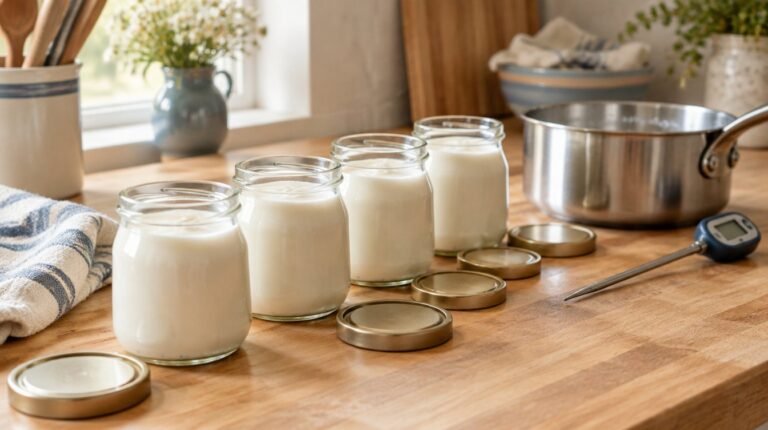
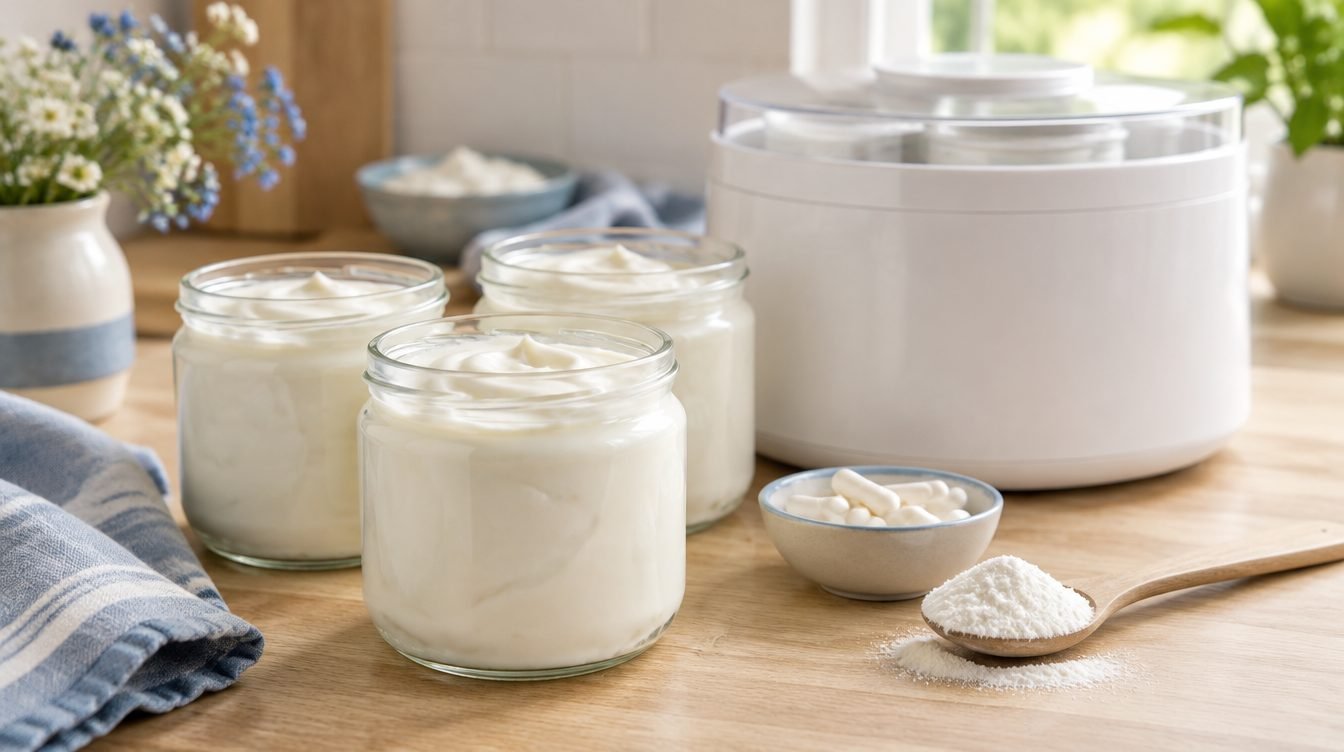
This makes 1 quart and follows the Ultimate Yogurt Guide that comes with our capsules. You need a yogurt maker that holds a steady 99°F for a full day and a clean 1-quart glass container, or a set of small jars.
- 1 capsule of L. reuteri
- 1 unopened quart of pasteurized half-and-half
- 2 tablespoons of chicory inulin
- Clean everything. Wash the container or jars, lids, spoon and mixing bowl in hot, soapy water and rinse well. Extension guides list unclean equipment as a cause of thin yogurt and off flavors.
- Make an inulin paste. Put the inulin in your clean container, add a splash (about 1 tablespoon) of boiling water and stir until smooth. A paste keeps lumps of inulin from settling at the bottom of the jar.
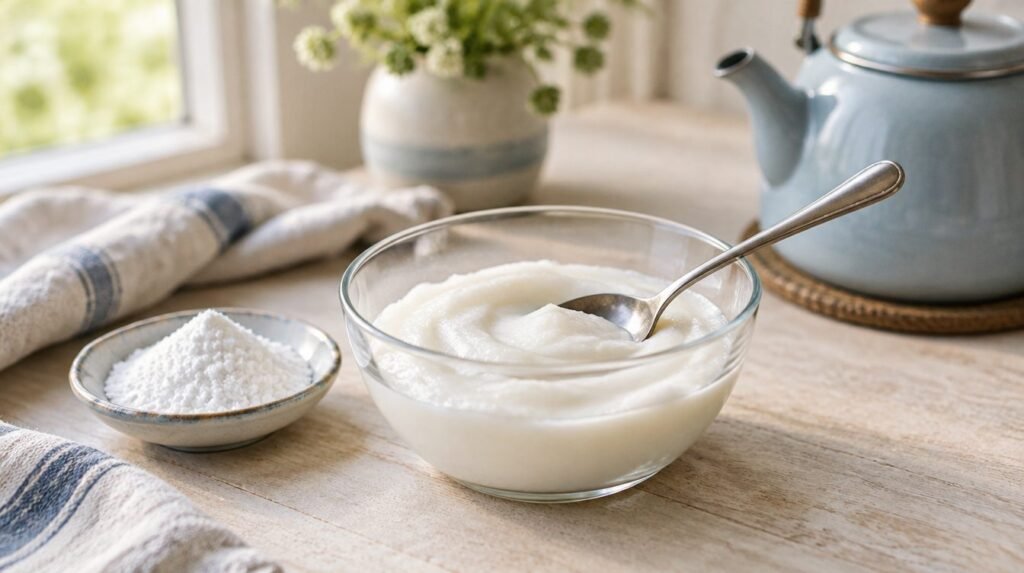
- Add the capsule. Wait about a minute for the paste to cool, then open 1 capsule, empty the powder into the paste and stir.
- Add the half-and-half. Fill the container with the half-and-half and stir thoroughly. Use a carton you open just for this batch; there is no heating step. Letting the half-and-half come to room temperature first helps it mix without lumps.
- Seal and load the yogurt maker. Put the lids on and set the containers in the yogurt maker. Add water to the machine up to about ½ inch from the top so the temperature stays even.

- Hold at 99°F (37°C) for 24 hours. Set the yogurt maker to 99°F and 24 hours and press Start. Do not stir or move the jars while they ferment.
- Chill. Refrigerate when it finishes, at 40°F or below. Cooling stops acid development, and the texture firms up more after several hours cold. Eat it within two weeks, which matches the 14 days Extension guides give for homemade yogurt; see how long homemade yogurt lasts.
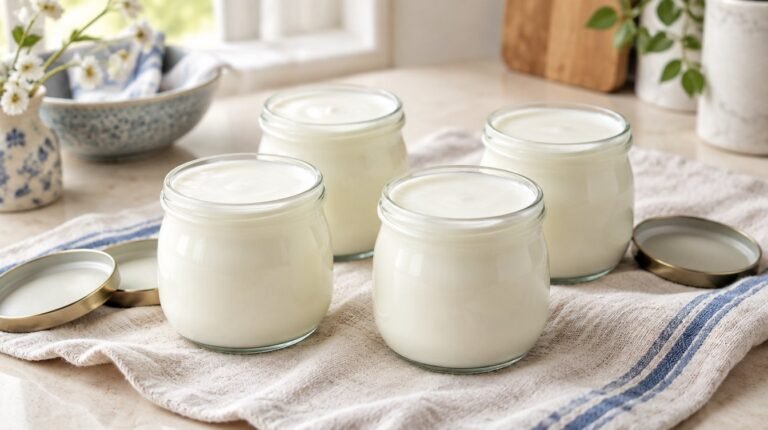
Using 6 oz jars? Mix up to 1½ quarts at a time in a large bowl or a measuring cup with a spout, using 1 capsule, 1½ tablespoons of inulin and 1½ quarts of half-and-half, then pour it into the jars.
For your next batch, you can use 1 oz (2 tablespoons) of yogurt or whey from this one in place of a new capsule. Keep it in its own clean, covered jar. Cultures for Health recommends re-culturing reusable starters at least every 7 days. If later batches get weaker, see heirloom starter weakened over time.
How to tell it worked
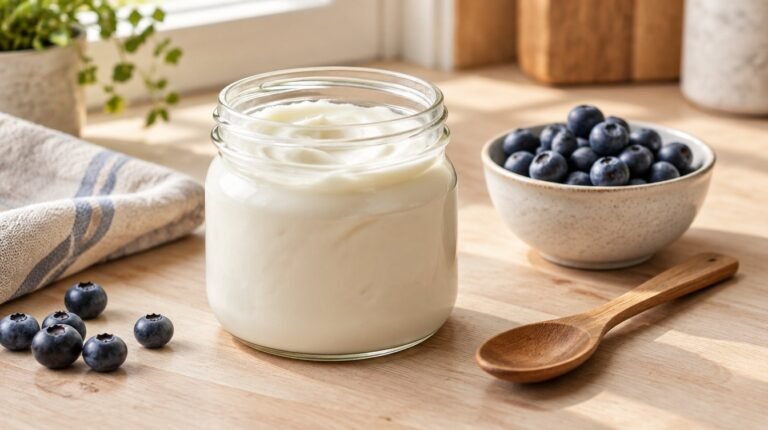
- Thick set: The yogurt holds together when you tilt the jar. Half-and-half makes a denser, almost spreadable texture; milk makes a softer set.
- Tart, clean sour smell: It should smell like sour cream or tangy yogurt, nothing else.
- Some whey: A layer of clear or yellowish liquid on top or along the sides is common after a long ferment. Extension guides say some whey is normal, and long incubation increases it. Stir it back in or pour it off.
- pH (optional): If you use pH strips, look for a reading below 4.6. Extension guides use pH 4.6 as the point where yogurt sets, and federal food rules define acid foods as those with a pH of 4.6 or below.
Failure modes and fixes
| Problem | Likely cause | Fix |
|---|---|---|
| Still liquid after 24 hours | Incubator ran too hot or too cold, or the starter was weak | Check the yogurt maker with a thermometer in a jar of water. Restart with fresh capsules. |
| Thin, slightly thickened | Low milk solids, too little food for the bacteria, or a weak saved starter | Use half-and-half or whole milk, add the inulin, and start from fresh capsules. |
| Lots of whey, grainy curds | Too warm or too long | Confirm the 99°F setting and stop at 24 hours. If it still separates, use 1 tablespoon of inulin instead of 2, and make sure the inulin paste has no lumps. Some separation is normal; heavy separation is not. |
| Bitter or flat flavor | Too much starter, or old milk | Use 1 capsule per quart and a fresh, unopened carton. |
Temperature too high
Heat is the most common cause of a failed L. reuteri batch. Extension guides warn that yogurt cultures can be killed above 130°F and do not grow well below 98°F, and Davis’s later post puts L. reuteri’s best growth at about 100°F. A setting that would be fine for regular yogurt can be too warm for this culture over a full day, so check your machine’s actual temperature.
Pasteurized vs. ultra-pasteurized milk
Regular pasteurized milk is the safer choice for a new culture. Cultures for Health advises against ultra-pasteurized milk for reusable starters, calling it too clean to give the culture enough nourishment. Some home fermenters still use ultra-pasteurized half-and-half without trouble. Our article on ultra-pasteurized milk for yogurt covers the tradeoffs.
Contamination: when to throw it out
A 24-hour ferment at body temperature gives other microbes time to grow if anything slipped in. Discard the whole batch, and do not save any as starter, if you see any of these:
- Pink, orange, red or other colored spots or streaks.
- Mold of any color. USDA says yogurt with mold should be discarded, because mold can reach below the surface and bacteria can grow along with it.
- A yeasty, beery or alcohol smell, foam or stringy texture, which Cultures for Health links to yeast contamination.
- Any smell other than a fresh, tart one. University of Alaska Fairbanks Extension says to discard yogurt with visible growth or an off odor.
Safety basics
Start with pasteurized milk, clean equipment and a reliable incubator, and refrigerate the yogurt as soon as it finishes. Do not taste a batch that looks or smells wrong. These are the same food-safety habits extension guides recommend for any homemade yogurt.
Live-culture foods are not risk-free for everyone. The National Center for Complementary and Integrative Health notes that the risk of serious side effects from probiotics may be greater in people with underlying health conditions. People who are immunocompromised, pregnant or seriously ill, and parents of infants, should talk with a doctor before eating or serving live-culture products. This article is general information, not medical advice.
Is Limosilactobacillus reuteri the same as Lactobacillus reuteri?
Yes. It is the same species under its current name, adopted in a 2020 reclassification (LPSN).
Why does L. reuteri yogurt ferment so much longer than regular yogurt?
It grows best at a lower temperature than standard yogurt cultures and needs more time to thicken the milk, so recipes run 24 to 36 hours instead of 4 to 12.
Can I use 100°F for 36 hours instead?
Many people use that longer Davis-style schedule. With our capsules we recommend 24 hours at 99°F (37°C); whichever you choose, keep the temperature steady.
Can I make it with plant milk?
Plant milks behave differently from dairy and Cultures for Health notes they need thickeners to reach a spoonable consistency (Cultures for Health), so expect a different result.
Related topics
- Yogurt Starter: how starters differ and how to choose one.
- How to Make Yogurt Starter: keeping a saved culture going.
- Heirloom Starter Weakened Over Time: what to do when each batch gets thinner.
- Probiotic Foods: other foods that contain live cultures.
- Fermented Foods for Gut Health: what research says about fermented foods in general.
Sources
- Zheng J, et al. A taxonomic note on the genus Lactobacillus: Description of 23 novel genera, emended description of the genus Lactobacillus Beijerinck 1901, and union of Lactobacillaceae and Leuconostocaceae (International Journal of Systematic and Evolutionary Microbiology, 2020)
- Limosilactobacillus reuteri (LPSN, List of Prokaryotic names with Standing in Nomenclature, DSMZ)
- Mu Q, et al. Role of Lactobacillus reuteri in Human Health and Diseases (Frontiers in Microbiology, 2018)
- Investigating the Safety of the Probiotic Lactobacillus reuteri in Infants With Colic (National Center for Complementary and Integrative Health, NIH)
- Nilsson AG, et al. Lactobacillus reuteri reduces bone loss in older women with low bone mineral density: a randomized, placebo-controlled, double-blind, clinical trial (Journal of Internal Medicine, 2018)
- Probiotics can protect the skeletons of older women (University of Gothenburg)
- Turn your yogurt into a SUPER PROBIOTIC (William Davis, Dr. Davis Infinite Health blog, 2018)
- Troubleshooting L. reuteri yogurt-making (William Davis, Dr. Davis Infinite Health blog, 2018)
- Making Yogurt at Home (University of Alaska Fairbanks Cooperative Extension Service)
- Making Yogurt at Home, FP-01 (University of Guam Cooperative Extension, 2016)
- Making Yogurt at Home (University of Illinois Extension)
- 21 CFR Part 114, Subpart A: Acidified Foods, General Provisions (eCFR)
- Molds on Food: Are They Dangerous? (USDA Food Safety and Inspection Service)
- Yogurt Starter FAQ (Cultures for Health)
- Yogurt Starter Troubleshooting FAQ (Cultures for Health)
- 5 Things To Know About Probiotics (National Center for Complementary and Integrative Health, NIH)