
Gut Health and Weight Loss: What You Need to Know
The short answer
Gut bacteria appear to play a part in how the body handles food and stores fat, and in animal studies they can shift weight on their own. In people, though, no gut-focused pill or test has been shown to produce meaningful weight loss. The gut-friendly habits with the best support, such as eating more fiber, help mainly because they make an overall healthy, lower-calorie diet easier to stick to (Miketinas and colleagues, 2019).
Weight is shaped by many things, including eating habits, activity, sleep, medicines, health conditions and genes (NIDDK). Your gut microbes are one more piece of that picture, not a shortcut around it. This article is general information, not medical advice.
How gut bacteria could affect weight
The trillions of microbes in your large intestine break down parts of food that you cannot digest on your own, especially fiber. Researchers have proposed a few ways this could matter for weight:
- Energy harvest: in mice, gut bacteria from obese animals pulled more energy out of food (Turnbaugh and colleagues, 2006).
- Fiber fermentation: bacteria ferment fiber into short-chain fatty acids, and soluble fiber slows digestion, which may help curb hunger and blood sugar spikes (Harvard Nutrition Source).
- Inflammation: fiber’s effects on gut bacteria may calm the low-grade inflammation tied to some chronic conditions (Harvard Nutrition Source).
Diet shapes these microbes quickly. When 10 volunteers switched to an all-plant or all-animal diet for 5 days, their gut bacteria changed noticeably within that short window (David and colleagues, 2014). That cuts both ways: your microbiome responds to better food choices, and it also drifts back when you stop.
What the research shows
In mice: microbes alone can change body fat
The idea took off after a 2006 study in which germ-free mice given gut bacteria from obese mice gained more body fat than mice given bacteria from lean mice (Turnbaugh and colleagues, 2006). In a 2013 follow-up, mice given stool bacteria from the heavier twin in a pair gained more body fat than mice given bacteria from the leaner twin. Housing the two groups together protected the mice carrying the heavier twin’s bacteria, but only on certain diets (Ridaura and colleagues, 2013).
In people: fecal transplants have not caused weight loss
If microbes drove weight on their own, transferring a lean person’s gut bacteria should help. Two small, placebo-controlled trials tested this with capsules from lean donors. In one with 24 adults with obesity, the transplant did not improve insulin sensitivity or body composition (Yu and colleagues, 2020). In another with 22 adults, gut bacteria shifted toward the donor’s, but BMI did not change at 12 weeks (Allegretti and colleagues, 2020).
Probiotic supplements: small, uncertain effects
A 2018 meta-analysis of 15 trials with 957 people with overweight or obesity found probiotics lowered body weight by about 0.6 kg (1.3 pounds) more than placebo over 3 to 12 weeks, an effect the authors described as small (Borgeraas and colleagues, 2018). A 2026 meta-analysis of 10 trials found no significant effect on body weight, and its small effects on BMI and body fat did not hold up when single studies were removed (Ko and colleagues, 2026). NIH’s Office of Dietary Supplements sums it up: it is unclear whether probiotic supplements have any effect on weight or body fat (NIH ODS).
One newer candidate is Akkermansia muciniphila, a gut bacterium found in lower amounts in people with obesity. In a pilot trial, 32 adults with overweight or obesity completed 3 months of a pasteurized form or placebo. Insulin sensitivity improved, but the drop in body weight, about 2.3 kg, was not statistically significant (Depommier and colleagues, 2019). That is too small and early to build a weight plan on. Our guide to the best probiotic for weight loss looks at specific strains.
Fiber: the most consistent link
In the POUNDS Lost trial, 345 adults followed calorie-reduced diets for 6 months and lost about 7 kg on average. Fiber intake was the strongest dietary predictor of how much weight people lost, and higher fiber was tied to sticking with the diet (Miketinas and colleagues, 2019). This was an analysis within a trial, so it shows a strong association rather than proof that fiber alone caused the loss.
What you can do

The steps with the best support are ordinary ones. They are good for your gut and for weight at the same time:
| Step | What the evidence says | Source |
|---|---|---|
| Eat more fiber | Most Americans get about 15 g a day; Harvard recommends at least 25 to 35 g. Fiber predicted weight loss in POUNDS Lost. | Harvard; Miketinas 2019 |
| Add fermented foods | In a 10-week trial of 36 adults, about six servings a day raised gut bacterial diversity and lowered inflammation markers. Weight was not the goal. | Wastyk 2021 |
| Probiotic pills | Unclear effect on weight or body fat. | NIH ODS |
| Sleep and activity | Too little sleep and long hours of sitting are tied to weight gain. | NIDDK |
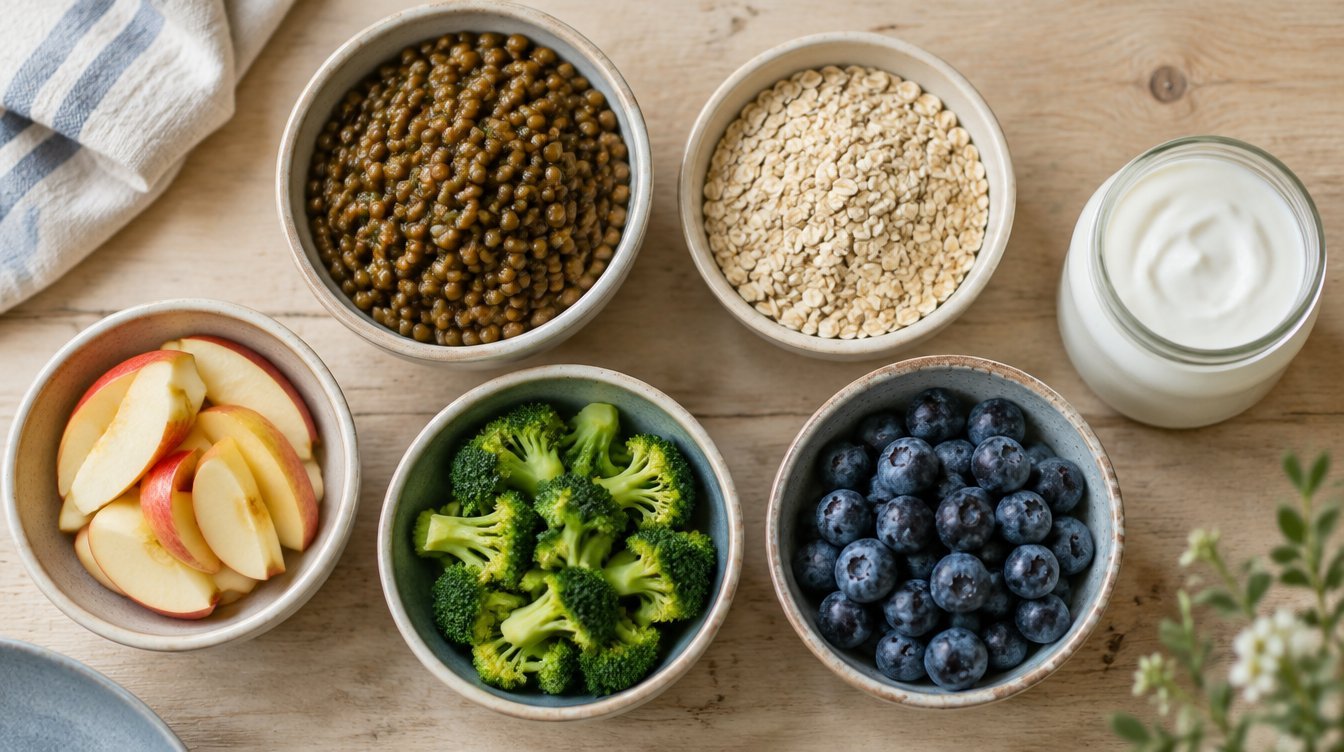
- Build meals around plants. Beans, lentils, oats, whole grains, vegetables, fruit, nuts and seeds supply the fiber gut bacteria ferment. Our gut health diet plan lays out a week of meals.
- Raise fiber gradually. Adding a lot at once can cause gas, bloating and cramping, so Mayo Clinic suggests increasing it over a few weeks and drinking plenty of water. High-fiber foods also tend to be more filling (Mayo Clinic).
- Try fermented foods you enjoy. Plain yogurt, kefir, kimchi and sauerkraut are easy places to start. See fermented foods for gut health and kimchi and weight loss.
- Cut back on sugary drinks and high-calorie snacks. NIDDK lists these among the habits that contribute to weight gain.
Be careful with gut “weight loss” products
Supplements marketed for a “flat belly” or a “metabolism reset” through the gut are not backed by human trials showing real weight loss. Dietary supplements do not need FDA review or approval before they are sold, and makers do not have to show they work. Weight-loss supplements can cause side effects and interact with medicines, so talk with your health care provider first, especially if you have high blood pressure, diabetes, heart disease or liver disease (NIH ODS).
Probiotics are generally safe in healthy people but can cause gas. The risk of harmful effects is higher in people with severe illness or a weakened immune system (NCCIH). For a closer look at specific products, see supplements for gut health and weight loss compared.
When to see a doctor
Talk with a doctor before starting a weight-loss plan if you have a chronic health condition or take regular medicines, since some medicines and conditions affect weight (NIDDK). Also get checked if you are losing weight without trying. Mayo Clinic says losing more than 5% of your body weight over 6 to 12 months without meaning to is a concern, and for older adults even less may matter (Mayo Clinic). Weight loss along with ongoing diarrhea, severe belly pain or blood in the stool also needs prompt medical care (Mayo Clinic).
Related topics
- Best Probiotic for Weight Loss: which strains have been studied.
- Best Supplements for Gut Health and Weight Loss: label-based comparisons.
- Gut Health Diet Plan: a practical week of meals.
- Fiber Supplement: when a supplement can help you reach your fiber goal.
- Best Time to Eat Yogurt for Weight Loss: fitting yogurt into a weight plan.
- How to Improve Gut Health: everyday habits that support your gut.
Sources
- Factors Affecting Weight & Health (National Institute of Diabetes and Digestive and Kidney Diseases)
- Dietary Supplements for Weight Loss: Fact Sheet for Consumers (NIH Office of Dietary Supplements)
- Probiotics: Usefulness and Safety (National Center for Complementary and Integrative Health)
- Fiber (The Nutrition Source, Harvard T.H. Chan School of Public Health)
- Unexplained weight loss: When to see a doctor (Mayo Clinic)
- Dietary fiber: Essential for a healthy diet (Mayo Clinic)
- Inflammatory bowel disease (IBD): Symptoms and causes (Mayo Clinic)
- Turnbaugh PJ, et al. An obesity-associated gut microbiome with increased capacity for energy harvest (Nature, 2006)
- Ridaura VK, et al. Gut microbiota from twins discordant for obesity modulate metabolism in mice (Science, 2013)
- David LA, et al. Diet rapidly and reproducibly alters the human gut microbiome (Nature, 2014)
- Yu EW, et al. Fecal microbiota transplantation for the improvement of metabolism in obesity: The FMT-TRIM double-blind placebo-controlled pilot trial (PLoS Medicine, 2020)
- Allegretti JR, et al. Effects of Fecal Microbiota Transplantation With Oral Capsules in Obese Patients (Clinical Gastroenterology and Hepatology, 2020)
- Borgeraas H, et al. Effects of probiotics on body weight, body mass index, fat mass and fat percentage in subjects with overweight or obesity: a systematic review and meta-analysis of randomized controlled trials (Obesity Reviews, 2018)
- Ko J, et al. Effects of probiotics and synbiotics on body weight management in individuals with overweight or obesity: a systematic review and meta-analysis of randomized controlled trials (Physical Activity and Nutrition, 2026)
- Depommier C, et al. Supplementation with Akkermansia muciniphila in overweight and obese human volunteers: a proof-of-concept exploratory study (Nature Medicine, 2019)
- Miketinas DC, et al. Fiber Intake Predicts Weight Loss and Dietary Adherence in Adults Consuming Calorie-Restricted Diets: The POUNDS Lost Study (Journal of Nutrition, 2019)
- Wastyk HC, et al. Gut-microbiota-targeted diets modulate human immune status (Cell, 2021)
This article is for general information and is not medical advice. Talk to your doctor or a registered dietitian before changing your diet, supplements or medication, especially if you have a health condition.


