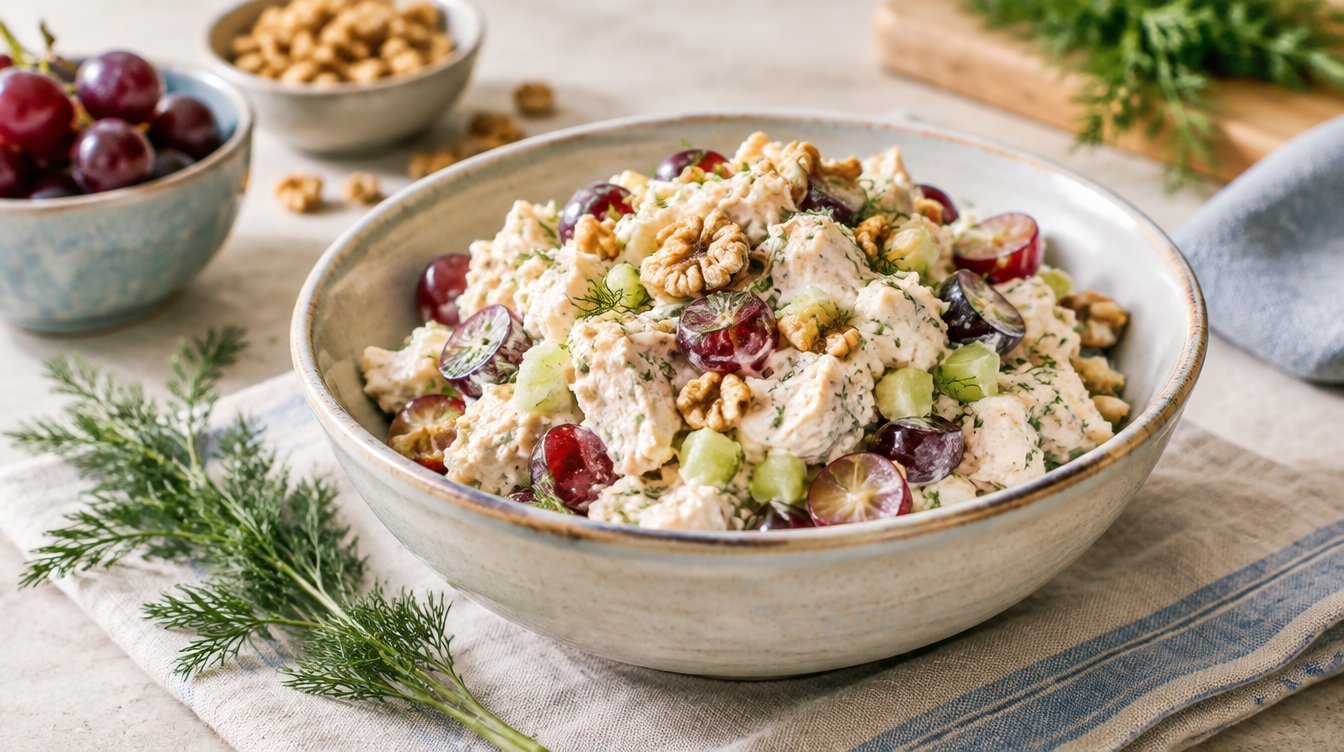
Chicken Salad with Greek Yogurt: What You Need to Know
What chicken salad with Greek yogurt is
Chicken salad with Greek yogurt is the classic deli salad with some or all of the mayonnaise swapped for plain Greek yogurt. You still get cold, chopped chicken in a creamy dressing, but the dressing is tangier, much lower in fat and higher in protein.
It works because strained Greek yogurt is thick enough to coat chicken the way mayo does. Regular yogurt is thinner and tends to turn the salad watery. If you are new to the style, our guide to what Greek yogurt is explains why straining matters.
How the swap changes the numbers
The difference shows up most in fat and calories. Here is a half cup of each dressing base, calculated from USDA FoodData Central values per 100 grams and USDA cup weights (220 g per cup of mayonnaise, 245 g per cup of Greek yogurt).
| Half cup of | Calories | Fat | Saturated fat | Protein | Sodium |
|---|---|---|---|---|---|
| Mayonnaise, regular | 748 | 82 g | 12.9 g | 1 g | 699 mg |
| Greek yogurt, whole milk, plain | 115 | 5.4 g | 2.9 g | 10.8 g | 42 mg |
| Greek yogurt, nonfat, plain | 72 | 0.5 g | 0.1 g | 12.6 g | 44 mg |
For context, the Daily Value for saturated fat is 20 g and for sodium is 2,300 mg. A half cup of regular mayo uses up about 65% of the saturated fat Daily Value before you add anything else. These are typical USDA values, not measurements of any one product, so your jar or tub may differ a little.
The chicken carries most of the protein either way. Roasted chicken breast has about 31 g of protein per 100 g, and a cup of chopped breast weighs about 140 g (USDA FoodData Central). Two cups of chopped chicken bring roughly 87 g of protein to the bowl.
Why it matters for gut health
Chicken salad is served cold, and that matters for the yogurt. FDA’s yogurt rules note that heat treatment after culturing inactivates the cultures, which is why such products must say they don’t contain live and active cultures (21 CFR 131.200). Mixing yogurt into a cold salad doesn’t cook it, so whatever live cultures the yogurt had stay in it.
Yogurt is also easier on many people who don’t digest lactose well. A review of studies found that the bacteria in yogurt help digest its lactose, so many lactose-intolerant people tolerate yogurt better than milk (Savaiano 2014). That review looked at yogurt itself, not mixed dishes, but the principle carries over.
Keep expectations realistic. A few spoonfuls of yogurt in a salad are a small serving, and not every yogurt has probiotic strains with proven benefits. Our article on Greek yogurt with probiotics explains how to read a culture list. Add-ins help too: a cup of chopped celery adds about 1.6 g of fiber (USDA FoodData Central).
How to make it
You don’t need an exact recipe. Use this ratio as a starting point and adjust to taste. It makes about four servings.
- Cook the chicken. Poach, roast or grill boneless breasts or thighs until the thickest part reaches 165°F (74°C) on a food thermometer (FoodSafety.gov). Leftover or rotisserie chicken works too.
- Chill it. Refrigerate the cooked chicken until cold, then chop or shred about 2 cups (roughly 280 g).
- Mix the dressing. Stir together 1/2 cup plain Greek yogurt, 1 tablespoon lemon juice, 1 teaspoon Dijon mustard, 1/4 teaspoon salt and black pepper.
- Add crunch. Fold in 1/2 cup diced celery and 2 tablespoons minced red onion or chives.
- Combine and rest. Fold the chicken into the dressing, taste, and adjust salt and lemon. Chill 30 minutes so the flavors settle.
Serve it on whole-grain bread, in lettuce cups, or with crackers and sliced vegetables. For more ideas in the same style, see our savory Greek yogurt recipes.
Common problems and quick fixes
- Watery salad: the chicken was still warm, the yogurt was thin, or juicy add-ins like cucumber released liquid. Chill the chicken fully, pat add-ins dry, and use thicker yogurt.
- Too sour: cut the lemon juice, add a little honey or diced apple, or replace a few spoonfuls of yogurt with mayo.
- Bland: yogurt needs more salt and acid than mayo does. Add salt a pinch at a time and finish with lemon zest or fresh herbs.
- Dry the next day: chicken soaks up dressing as it sits. Stir in a spoonful of fresh yogurt before serving.
Choosing and handling the yogurt
- Pick plain. Vanilla or fruit yogurts add sugar and odd flavors. Read the label for 0 g added sugar.
- Choose your fat level. Whole milk Greek yogurt tastes closest to mayo. Nonfat is leanest but tangier and can taste thin.
- Go half and half. If the full swap tastes too sharp, use half yogurt and half mayo. You still cut much of the fat.
- Thicken if needed. If your yogurt is loose, strain it in the fridge for an hour or two before mixing. This also stops the salad from weeping.
- Make your own. Homemade yogurt strained to Greek thickness works well here; see how to make Greek yogurt.
Flavor variations to try

- Classic deli: celery, red grapes, toasted walnuts and a pinch of dill.
- Curry: 1 teaspoon curry powder, diced apple, raisins and sliced green onion.
- Greek-style: cucumber, olives, red onion, oregano and a little feta.
- Herb and lemon: parsley, chives, tarragon and extra lemon zest.
- Buffalo: a spoonful of hot sauce, diced celery and a few crumbles of blue cheese.
If you like the tang, the same yogurt base makes a good Greek yogurt dressing for green salads.
Storage and food safety
Chicken salad keeps 3 to 4 days in the refrigerator, and it doesn’t freeze well (FoodSafety.gov). Store it covered at 40°F or below and use a clean spoon each time you serve.
Don’t leave it out for long. Perishable food spoils quickly between 40°F and 140°F, and USDA advises no more than two hours out of the fridge, or one hour when it is above 90°F (USDA FSIS). For picnics, pack it in a cooler with ice packs.
Check the yogurt too. Use it before its date and see our guide to yogurt storage temperature for how to keep it fresh.
Related topics
- Greek Yogurt Marinated Chicken: another way to pair yogurt and chicken.
- Dinner Recipes with Greek Yogurt: more main-dish ideas.
- Greek Yogurt Sauce: a base for dips and spreads.
- Greek Yogurt Protein: how much protein different styles carry.
- Homemade Greek Yogurt: make the yogurt yourself.
Sources
- Salad dressing, mayonnaise, regular (USDA FoodData Central, SR Legacy)
- Yogurt, Greek, whole milk, plain (USDA FoodData Central, FNDDS)
- Yogurt, Greek, nonfat milk, plain (USDA FoodData Central, FNDDS)
- Chicken, broilers or fryers, breast, meat only, cooked, roasted (USDA FoodData Central, SR Legacy)
- Celery, raw (USDA FoodData Central, SR Legacy)
- Daily Value on the Nutrition and Supplement Facts Labels (FDA)
- 21 CFR 131.200 Yogurt (eCFR)
- Savaiano DA. Lactose digestion from yogurt: mechanism and relevance (Am J Clin Nutr, 2014)
- Safe Minimum Internal Temperature Chart (FoodSafety.gov)
- Cold Food Storage Chart (FoodSafety.gov)
- USDA Urges Consumers to Keep Clear of the Danger Zone This Summer (USDA Food Safety and Inspection Service, 2016)