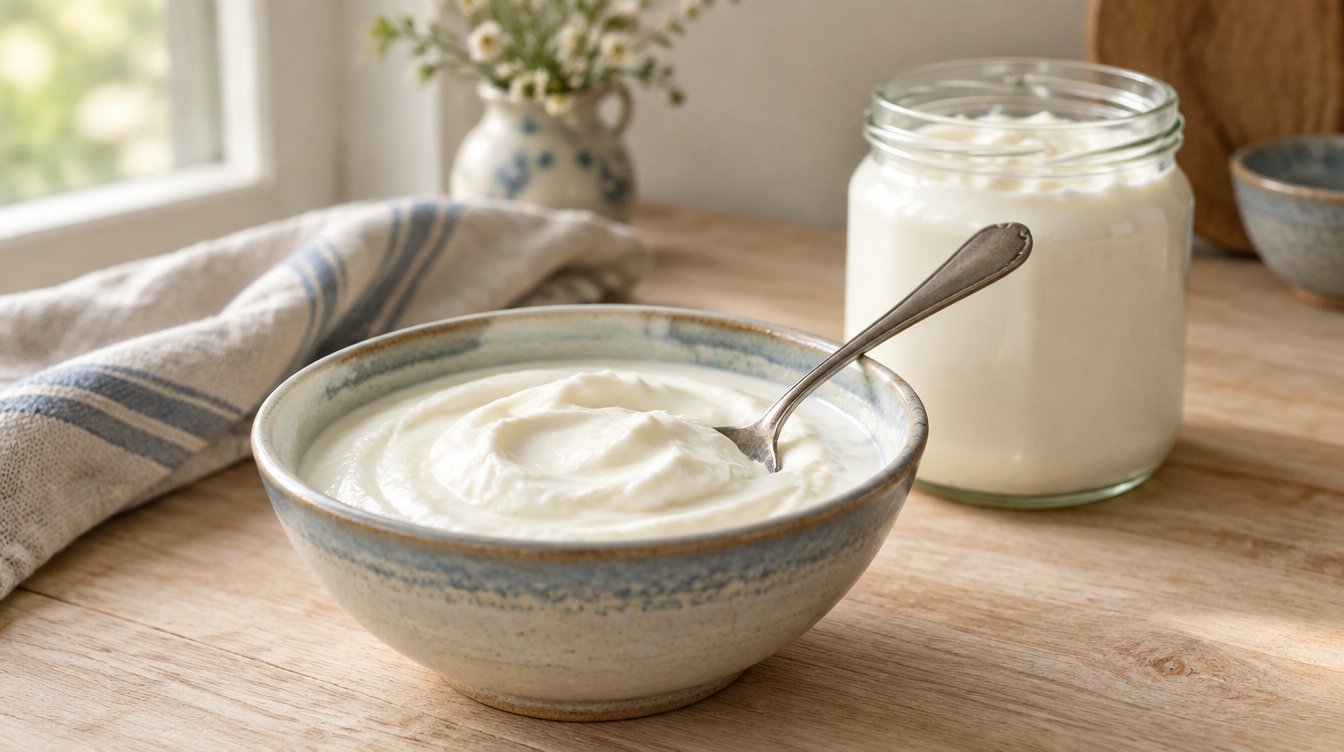
How to Make Sour Yogurt: A Step-by-Step Guide
What you will end up with
This method makes about 1 quart of plain yogurt with a sharper, more pronounced tang than a standard 6- to 8-hour batch. Total time is about 15 to 17 hours, nearly all of it hands-off: roughly 45 minutes to heat and cool the milk, 10 to 12 hours of incubation, and at least 4 hours of chilling.
The method is the usual one for homemade yogurt with two changes: a longer incubation and a steady temperature held at the upper end of the normal range. If you have never made yogurt before, read how to make yogurt at home first.
Why yogurt tastes sour
Yogurt is milk fermented by a culture that, under the federal yogurt standard, contains the lactic acid-producing bacteria Lactobacillus delbrueckii subsp. bulgaricus and Streptococcus thermophilus. These bacteria turn milk sugar into lactic acid. As Washington State University Extension puts it, the more lactic acid produced, the tangier the yogurt tastes.
Acid is also what sets the milk. A University of Alaska Fairbanks Cooperative Extension guide says yogurt should set firm at about pH 4.6, and that incubating it for several hours after it has set produces more acidity and a more tart flavor, and eventually causes whey to separate. Cooling stops the process: the University of Illinois Extension advises refrigerating yogurt once it gels to stop acid production.
Temperature changes the speed. In a University of Wisconsin lab study, milk gels warmed to 40.5 or 44°C (about 105 or 111°F) after setting reached pH 4.6 faster than gels held at 37°C, but they also had more whey separation. An earlier study from the same lab found that incubating at about 46°C (115°F) instead of 40°C produced gels with more whey separation and a more open structure. Time is the gentler tool for extra tang, and heat is the riskier one. Our yogurt temperature guide covers the full range.
Equipment
- Heavy-bottomed pot, 2 to 3 quarts.
- Instant-read or candy thermometer. Every step below depends on it.
- Whisk and ladle.
- Clean jars with lids. Illinois Extension notes that several small containers incubate faster than one large one.
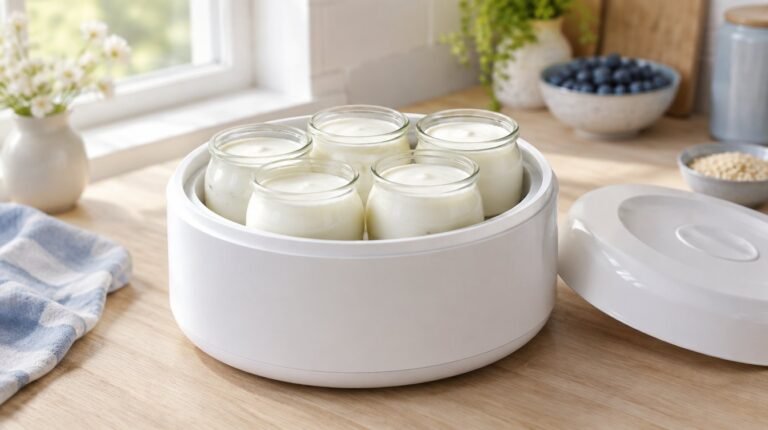
- An incubator that holds a steady temperature for 12 hours: a yogurt maker with a temperature setting, an oven with the light on, or a cooler with warm water.
- Optional: a fine-mesh strainer or cheesecloth for thicker yogurt.
Ingredients
- 1 quart milk. Whole or 2% gives the creamiest result.
- 2 tablespoons plain yogurt with live and active cultures, the amount per quart used in the Illinois Extension recipe, or freeze-dried starter dosed as its package directs.
- Optional: 1/4 cup nonfat dry milk. Illinois Extension suggests stirring it into cold milk before heating for a thicker yogurt. It also helps a long-fermented batch hold its shape.
Step by step
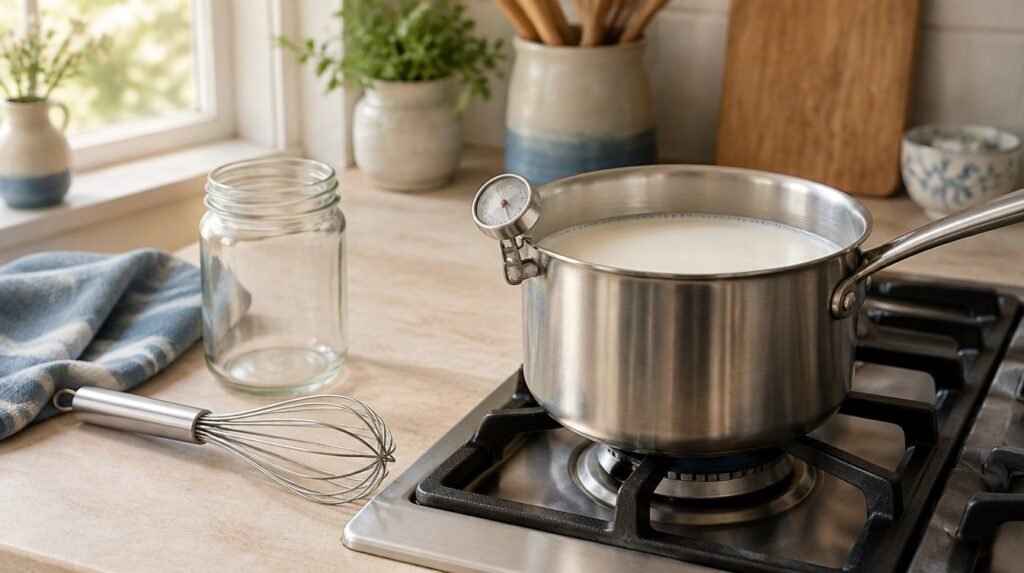
- Clean everything. Wash the pot, whisk, jars and lids in hot soapy water. Unclean equipment is on the Illinois Extension list of causes for separated, off-flavored yogurt.
- Heat the milk to 180°F (82°C). Warm it over medium-low heat, stirring often so it does not scorch, for about 15 to 20 minutes. If you added dry milk, whisk it in before heating. For a firmer set, hold the milk at 180°F for 10 to 20 minutes, the range WSU Extension gives for thinner to thicker yogurt. Do not let it boil.
- Cool to 110-115°F (43-46°C). Set the pot in a sink of cold water and stir. This takes about 10 to 15 minutes. Adding starter to milk that is too hot can keep the yogurt from setting.
- Add the starter. Whisk the 2 tablespoons of yogurt with about 1 cup of the warm milk until smooth, then stir the mixture back into the pot.
- Fill and cover the jars. Pour the milk into the jars and put the lids on loosely.
- Incubate at about 110°F (43°C) for 10 to 12 hours. Keep the temperature steady and stay within the 108-115°F (42-46°C) range Illinois Extension gives. Do not stir, shake or move the jars. Most batches set in 6 to 8 hours; the extra hours are what build the tang.
- Taste from a spare jar. From about hour 8, spoon a little from one jar every 2 hours. Stop when it is as sour as you like.
- Chill right away. Move the jars to a refrigerator at 40°F (4°C) or below and chill for at least 4 hours before eating. The yogurt firms as it cools.
For more detail on timing, see how long to incubate yogurt.
How to make it more sour, safely
Ferment longer, not hotter
Add time in 2-hour steps rather than raising the temperature. Each extra hour after setting adds acidity, according to the UAF guide. A lab study of fermentation time also found that longer fermentation increased whey separation, so expect more liquid on top as the tang builds. Stir it back in or pour it off.
Keep the temperature steady
Going above 115°F to speed things up tends to cost texture. The Wisconsin studies above linked warmer incubation with more whey separation, and a University of Kentucky guide lists excessive or uneven incubation temperatures among the causes of grainy, weeping yogurt.
Strain to concentrate
Straining makes the yogurt thicker and more intense, though it does not add acid, and some of the sour whey drains away. Start from a long-fermented batch and strain it in the refrigerator for 2 to 4 hours for Greek-style yogurt, the time Illinois Extension gives. How to make Greek yogurt has the full method.
Back-slop from a tart batch
Using a spoonful of your last batch as starter carries its culture forward. Illinois Extension recommends using a homemade batch as starter within 5 to 7 days, because fresher yogurt has more active bacteria. The Kentucky guide notes that a sharp flavor can come from the bulgaricus bacteria becoming dominant, which it ties to starter that is not fresh. Over many generations the balance can drift; heirloom starter weakened over time explains what to watch for.
Failure modes and fixes
| Problem | Likely cause | Fix |
|---|---|---|
| Grainy or curdled texture | Excessive or uneven incubation temperature; disturbing the gel (Kentucky guide) | Hold a steady 108-115°F and leave the jars alone until chilled |
| A lot of whey on top | Very long incubation, too-hot incubation or agitation (UAF guide; Illinois Extension) | Stir it back in or strain it; next time stop 1 to 2 hours sooner |
| Did not set | Starter without live cultures, milk too hot when starter was added, or incubation too cool (Illinois Extension) | Discard it (see below) and start again with fresh starter and a checked thermometer |
| Too sharp or bitter | Over-fermented; bitterness can come from unwanted bacteria (Kentucky guide) | Shorten incubation; use fresh milk, fresh starter and clean equipment |
| Off smell, mold or fuzzy spots | Contamination | Discard the whole batch |
When to throw it out
Sour is expected; spoiled is not. The UAF guide says to discard any yogurt with visible signs of microbial growth or any odor other than the acidic smell of fresh yogurt, and to discard batches that fail to set, since that may point to a bad culture or unwanted microorganisms. Store finished yogurt at 40°F or below; Illinois Extension says to eat it within 14 days. See how long homemade yogurt lasts for more on storage.
Ways to use extra-sour yogurt
A very tangy batch shines where you want sharpness rather than sweetness. Some easy uses:
- Dips and spreads: strain it thick and season with garlic, lemon zest, herbs and olive oil.
- Dressings: thin it with a little water or milk and use it in place of buttermilk or sour cream.
- Marinades: mix with spices and coat chicken or vegetables before cooking.
- Breakfast: balance the tang with ripe fruit or a drizzle of honey instead of buying flavored yogurt.
For recipes built around a tangy base, see savory Greek yogurt recipes.
Frequently asked questions
How long should I incubate yogurt to make it more sour?
Most batches set in 6 to 8 hours; 10 to 12 hours at about 110°F gives noticeably more tang. Extension guidance notes that incubating after the yogurt sets produces more acidity (UAF Cooperative Extension).
Does a higher temperature make yogurt more sour?
Warmer incubation reaches the target acidity faster, but lab studies link it with more whey separation and weaker texture. Holding a steady 108-115°F and adding time is the more reliable route.
Is extra-sour yogurt safe to eat?
Sourness on its own is not a sign of spoilage. Discard yogurt with visible growth, an odor other than a clean acidic smell, or a batch that never set.
Why is my sour yogurt watery?
The liquid is whey, and long incubation, high heat or moving the jars all increase separation. Stir it back in, or strain the yogurt for a thicker result.
Can I use my sour batch as the next starter?
Yes. Illinois Extension recommends using homemade yogurt as starter within 5 to 7 days, while its bacteria are most active.
Related topics
- Yogurt Starter: choosing and keeping a culture.
- Whey from Yogurt: what the liquid is and how to use it.
- How to Incubate Yogurt: ways to hold a steady temperature.
- Homemade Yogurt: the basics in one place.
Sources
- 21 CFR 131.200: Yogurt (Electronic Code of Federal Regulations)
- Yogurt Made Simple (FS173E) (Washington State University Extension, 2015)
- Making Yogurt at Home (University of Alaska Fairbanks Cooperative Extension, via University of California Cooperative Extension)
- Making Yogurt at Home (University of Illinois Extension, 2024)
- Making Yogurt at Home (IP-36) (University of Kentucky Cooperative Extension)
- Lee WJ, Lucey JA. Structure and physical properties of yogurt gels: effect of inoculation rate and incubation temperature (Journal of Dairy Science, 2004)
- Peng Y, et al. Physical properties of acid milk gels prepared at 37 degrees C up to gelation but at different incubation temperatures for the remainder of fermentation (Journal of Dairy Science, 2010)
- Peng Y, et al. Impact of preacidification of milk and fermentation time on the properties of yogurt (Journal of Dairy Science, 2009)