Prebiotic vs Probiotic: Which Is Better?
The verdict
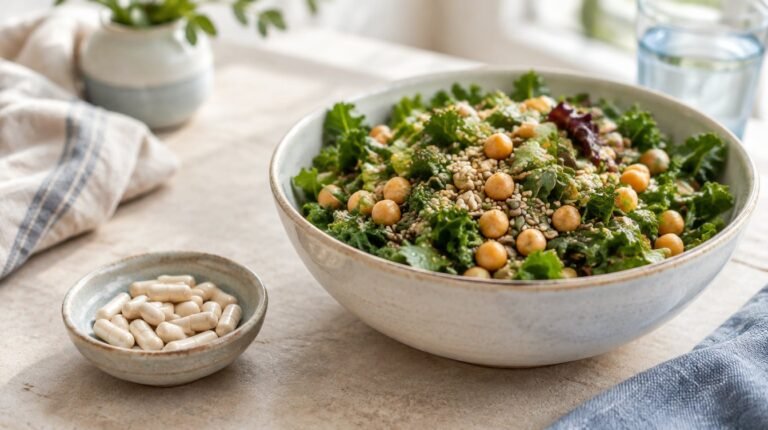
Neither one is better across the board, because they do different jobs. Prebiotics are food for the helpful microbes already living in your gut, mostly certain types of fiber. Probiotics are the live microbes themselves. For most healthy adults, the best-supported first step is eating more fiber-rich plants, which supply prebiotics, plus some fermented foods. A probiotic supplement makes most sense for a specific use where a specific strain has been studied, ideally after talking with your doctor.
This article is general information, not medical advice.
What prebiotics and probiotics are
An expert panel convened by the International Scientific Association for Probiotics and Prebiotics (ISAPP) defines probiotics as live microorganisms that, when taken in adequate amounts, give a health benefit. Its definition of a prebiotic is a substrate that is selectively utilized by host microorganisms conferring a health benefit. In plain terms, a probiotic is a microbe, and a prebiotic is something your microbes eat that leads to a benefit.
The National Center for Complementary and Integrative Health (NCCIH) is clear that prebiotics are not the same as probiotics. Mayo Clinic puts it simply: probiotics are found naturally in fermented foods such as yogurt and sauerkraut, while prebiotics are mainly in high-fiber foods. Products that combine the two are called synbiotics, a term ISAPP updated in 2020.
Not every fiber counts as a prebiotic. ISAPP notes that the best-studied prebiotics are specific fibers, and that foods such as onions, garlic, bananas, chicory root and Jerusalem artichokes contain them, though usually at low levels. Likewise, not every fermented food is probiotic: Harvard’s Nutrition Source points out that baking, heating or pasteurizing after fermentation kills the microbes, as in sourdough bread.
Prebiotics vs probiotics side by side
| Prebiotics | Probiotics | |
|---|---|---|
| What it is | Food for gut microbes, mostly specific fibers | Live bacteria or yeasts |
| Food sources | Garlic, onions, leeks, asparagus, bananas, whole grains, beans | Yogurt and kefir with live cultures, sauerkraut, kimchi, miso, tempeh |
| Common supplements | Inulin, oligofructose and other fiber powders | Capsules, powders and drinks with named strains |
| How it works | Feeds microbes you already have | Adds live microbes that may affect the gut community or immune response |
| Strongest evidence | Fiber-rich diets and bowel regularity | Specific strains for specific uses, such as antibiotic-associated diarrhea in children |
| Common side effects | Gas and bloating, especially at higher doses | Gas in healthy people; rare but serious infections in high-risk groups |
| Regulation as supplements | Not FDA-approved before sale | Not FDA-approved before sale |
Food sources come from Harvard’s Nutrition Source; side effects from NIH’s Office of Dietary Supplements and NCCIH; regulation from the FDA, which does not have the authority to approve dietary supplements for safety and effectiveness before they are sold.
Where each one wins
Where prebiotics win
Prebiotics come built into everyday food, and most people are short on fiber. Adults need about 25 to 35 grams of fiber a day, but most Americans get only about 15 grams, according to Harvard’s Nutrition Source. The NIDDK gives a similar target of 22 to 34 grams for adults. Closing that gap with beans, whole grains, fruit and vegetables feeds the microbes you already have, at grocery-store prices.
There is some trial evidence for prebiotic supplements too. In a randomized, placebo-controlled crossover trial of 44 adults with constipation, 12 grams a day of chicory inulin for four weeks raised stool frequency to a median of 4 per week, compared with 3 on placebo. It was a small study, and two of its authors were affiliated with the company that makes the inulin tested.
The trade-off is gas. In a tolerance study of 26 healthy adults, up to 10 grams a day of native inulin and up to 5 grams of oligofructose were well tolerated, while 10 grams of oligofructose clearly increased symptoms, mostly flatulence and bloating. Harvard advises adding prebiotic foods gradually, and people with irritable bowel syndrome (IBS) may react to many of them because they are high in FODMAPs, the hard-to-digest carbohydrates that NIDDK says some people with IBS do better limiting.
Where probiotics win
Probiotics have their clearest evidence for a few specific situations. A 2019 Cochrane review of 33 studies with 6,352 children found that diarrhea linked to antibiotics occurred in 8 percent of children given probiotics, compared with 19 percent of those who were not, with moderate-certainty evidence. The NHS also notes some evidence that probiotics may ease some symptoms of IBS.
Fermented foods are worth a mention here. In a 17-week Stanford study of 36 healthy adults (18 per group), a diet high in fermented foods steadily increased gut microbial diversity and lowered markers of inflammation, while a high-fiber diet did not change diversity in that time. It was small and short, but it suggests live-culture foods do something fiber alone may not.
The limits are real. Effects are strain-specific: NCCIH explains that if one kind of Lactobacillus helps with a problem, a different one may not. The NHS warns that because of how probiotics are regulated, a product may not contain the bacteria on its label, enough of them, or bacteria that survive to reach the gut. And per the Office of Dietary Supplements, a higher CFU count alone does not mean a product has greater health benefits.
Can you have both?
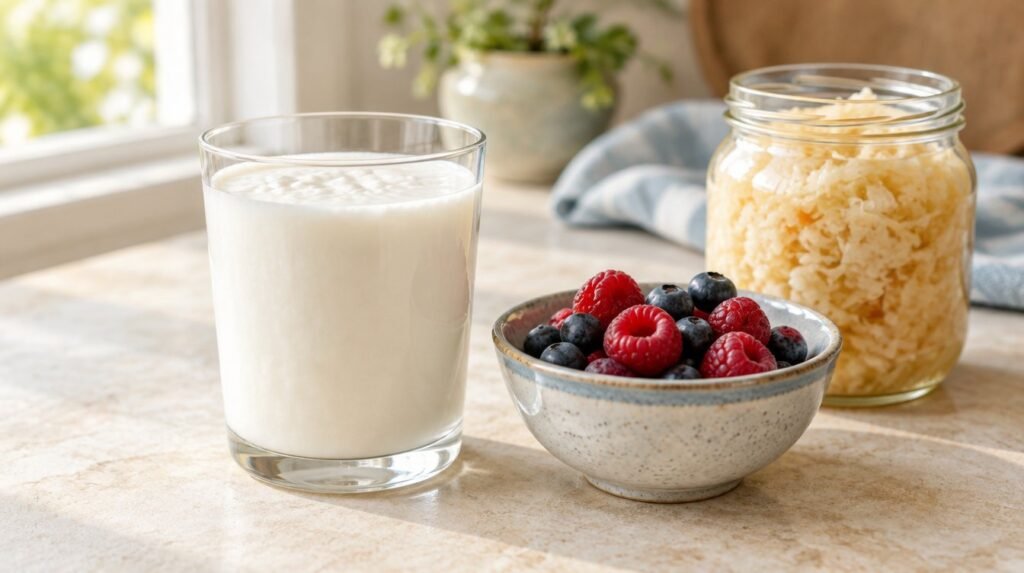
Yes, and for food it is easy. A bowl of plain yogurt with a sliced banana and oats, or kefir blended with berries, gives you live cultures alongside fiber. Our guides to probiotic foods and fermented foods for gut health list good options, and the best fruits for gut health covers fiber-rich produce to pair with them.
Combined supplements are a different matter. ISAPP’s synbiotic consensus says a product earns that name through evidence of a health benefit, not just by mixing a probiotic with a fiber. If you see “prebiotic + probiotic” on a label, look for research on that exact combination. Fiber powders on their own are covered in our fiber supplement guide.
Who should pick which
- You eat little fiber: start with prebiotic-rich foods and other fiber, adding it slowly. The NIDDK also advises drinking enough liquid to help fiber work.
- You are taking antibiotics: ask your doctor or pharmacist whether a studied probiotic strain makes sense for you. Our guide to restoring gut health after antibiotics covers food steps.
- You have IBS: go carefully with prebiotics, since many are high in FODMAPs. Probiotic results in IBS are mixed, so a doctor or dietitian is the best guide.
- You are healthy and want a “gut health” habit: food first. Fiber-rich plants plus yogurt, kefir or sauerkraut with live cultures cover both sides.
- You are seriously ill, have a weakened immune system, or are caring for a premature baby: do not use probiotics without medical advice. NCCIH reports severe or fatal infections in premature infants given probiotics, and the risk of harm is greater in people with severe illness or weak immune systems.
If you have an existing health condition or are pregnant, the NHS advice to talk to a doctor before taking probiotic supplements is a sensible rule. For more on doses, see can you take too many probiotics.
When to see a doctor
Some gas and bloating after adding fiber is normal. The NIDDK says to talk with a doctor if gas symptoms bother you, change suddenly, or come with abdominal pain, constipation, diarrhea or weight loss. For constipation, NIDDK advises seeing a doctor right away if you also have:
- bleeding from the rectum or blood in your stool
- constant pain in your abdomen
- inability to pass gas, or vomiting
- fever or lower back pain
- weight loss without trying
Neither prebiotics nor probiotics are a substitute for diagnosis or treatment when something is wrong.
Frequently asked questions
Should I take a prebiotic and a probiotic at the same time?
You can, and the simplest way is through food, such as yogurt with live cultures topped with fruit and oats. For supplements, look for research on the exact product or combination.
Do prebiotics cause gas?
They can, especially at higher doses or when added quickly. In one small trial, up to 10 grams a day of native inulin was well tolerated, while larger doses of oligofructose caused more gas and bloating (Bonnema et al.).
Are prebiotics just fiber?
Most well-studied prebiotics are specific fibers, but not all fiber is prebiotic. A prebiotic has to be selectively used by gut microbes in a way that gives a health benefit.
Is yogurt a probiotic?
Yogurt with live cultures is a probiotic food, but not every yogurt has been shown to deliver a specific health benefit. Our guide on whether all yogurt has probiotics explains what to look for.
Related topics
- Probiotic Foods: everyday foods that carry live cultures.
- Prebiotic Fibers for Culturing: inulin, GOS, FOS and resistant starch explained.
- Best Probiotic: how to compare supplements by strain and evidence.
- What Is Prebiotic Soda?: what those fiber-added drinks contain.
- Probiotic vs Yogurt: capsules compared with live-culture yogurt.
Sources
- Probiotics: What You Need To Know (National Center for Complementary and Integrative Health)
- Probiotics: Fact Sheet for Consumers (NIH Office of Dietary Supplements)
- Probiotics and prebiotics: What you should know (Mayo Clinic)
- Probiotics (NHS)
- FDA 101: Dietary Supplements (U.S. Food and Drug Administration)
- The Microbiome (Harvard T.H. Chan School of Public Health, The Nutrition Source)
- Fiber (Harvard T.H. Chan School of Public Health, The Nutrition Source)
- Prebiotics (International Scientific Association for Probiotics and Prebiotics)
- Eating, Diet, & Nutrition for Constipation (NIDDK)
- Symptoms & Causes of Constipation (NIDDK)
- Symptoms & Causes of Gas in the Digestive Tract (NIDDK)
- Eating, Diet, & Nutrition for Irritable Bowel Syndrome (NIDDK)
- Hill C, et al. Expert consensus document: The International Scientific Association for Probiotics and Prebiotics consensus statement on the scope and appropriate use of the term probiotic (Nature Reviews Gastroenterology & Hepatology, 2014)
- Gibson GR, et al. Expert consensus document: The ISAPP consensus statement on the definition and scope of prebiotics (Nature Reviews Gastroenterology & Hepatology, 2017)
- Swanson KS, et al. The ISAPP consensus statement on the definition and scope of synbiotics (Nature Reviews Gastroenterology & Hepatology, 2020)
- Guo Q, et al. Probiotics for the prevention of pediatric antibiotic-associated diarrhea (Cochrane Database of Systematic Reviews, 2019)
- Micka A, et al. Effect of consumption of chicory inulin on bowel function in healthy subjects with constipation (International Journal of Food Sciences and Nutrition, 2017)
- Bonnema AL, et al. Gastrointestinal tolerance of chicory inulin products (Journal of the American Dietetic Association, 2010)
- Wastyk HC, et al. Gut-microbiota-targeted diets modulate human immune status (Cell, 2021)
This article is for general information and is not medical advice. Talk to your doctor or a registered dietitian before changing your diet, supplements or medication, especially if you have a health condition.