Sourdough Benefits: What the Evidence Shows
What sourdough is
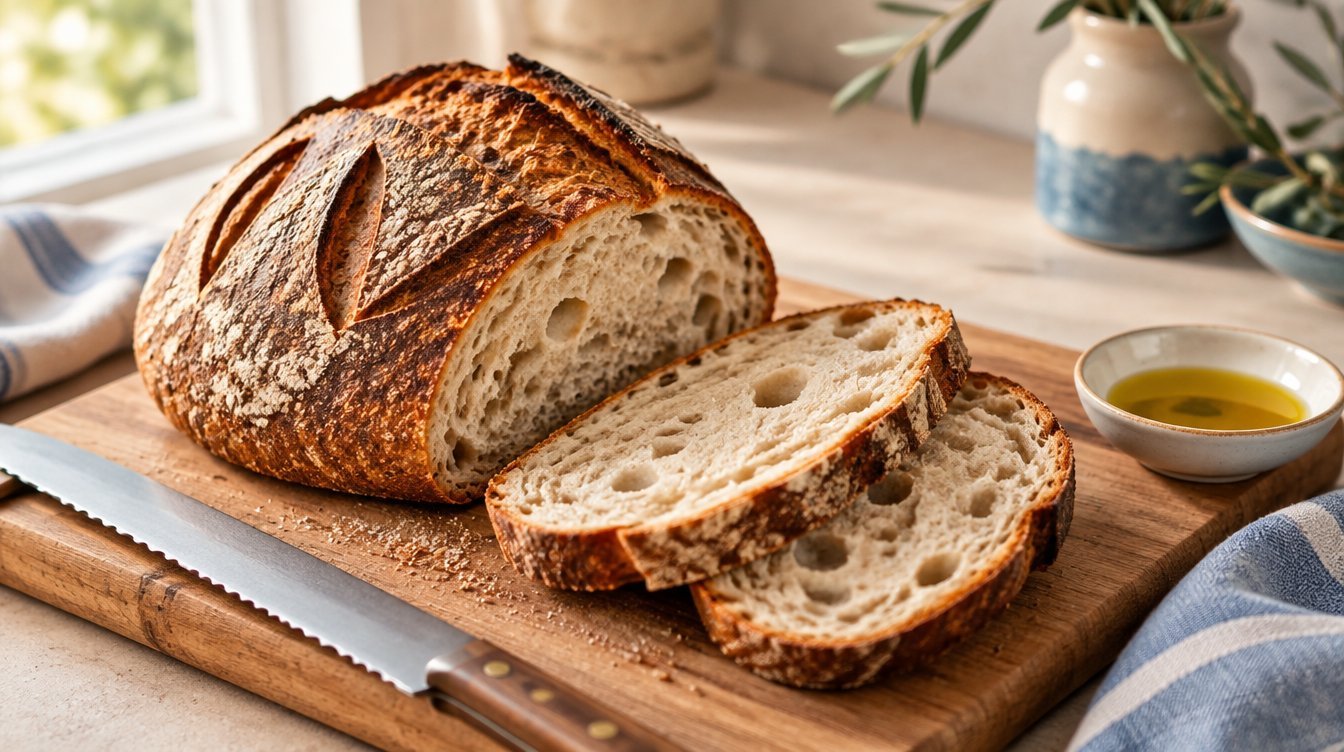
Sourdough is bread leavened with a starter: a mix of flour and water that has been fermented by communities of lactic acid bacteria and wild yeasts. Bakers keep a starter going by feeding it fresh flour and water, a practice called backslopping (De Vuyst et al., Critical Reviews in Food Science and Nutrition, 2023). The bacteria make acids that give the bread its tang, and the yeasts make the gas that raises it.
Most bread sold in stores is raised with baker’s yeast alone and ferments for a much shorter time. Sourdough itself is not one thing, though. A 2024 review of 253 studies found large differences in how much starter bakers used, how long and how warm they fermented the dough, and how sour the bread ended up (De Bondt et al., Annual Review of Food Science and Technology, 2024). That matters because research results on one sourdough may not apply to another.
Sourdough benefits at a glance
Sourdough has a reputation as the “healthy” bread. Here is how the main claims hold up in human studies.
| Claim | What studies show | Strength of evidence |
|---|---|---|
| Easier to digest | Long fermentation lowers some FODMAPs, but in one trial people with IBS did not feel better on sourdough | Lab evidence good; human evidence weak |
| Better for blood sugar | Two systematic reviews found no consistent advantage over yeast bread | Weak or inconsistent |
| More available minerals | Fermentation breaks down phytate, but long-term human studies did not show better iron status | Mechanism strong; human results inconclusive |
| Contains probiotics | Baking heat kills most live microbes | Not supported |
| Safe for celiac disease | Regular sourdough made with wheat, rye or barley still contains gluten | Not supported |
The broadest look at the research is a 2023 systematic review of 25 randomized trials with 542 adults. The authors concluded that it is “difficult to establish a clear consensus” that sourdough itself is better for health than yeast bread, because starters, flours and fermentation methods vary so much. Some trials using specific strains and conditions did find better results for blood sugar, fullness or digestive comfort (Ribet et al., Advances in Nutrition, 2023).
What the research shows
Digestion and FODMAPs
FODMAPs are fermentable carbohydrates that can trigger gas and bloating in people with irritable bowel syndrome. Wheat contains fructans, one type of FODMAP. In lab tests, some yeasts found in traditional sourdough broke down far more fructans than others, so the starter matters (Fraberger et al., Nutrients, 2018).
The best human test so far is a small one. In a double-blind, 7-day trial, 26 people with IBS who felt wheat bothered them ate either a long-fermented sourdough wheat bread or a yeast bread. The sourdough was lower in FODMAPs and in certain wheat proteins, yet digestive symptoms and inflammation markers did not differ between the breads (Laatikainen et al., Nutrients, 2017). If wheat bread bothers you, sourdough may or may not help, and a short personal trial is reasonable. Our list of foods that are hard to digest covers other common triggers.
Blood sugar
Sourdough is often said to raise blood sugar less than other bread. A 2026 systematic review of 27 studies in healthy adults concluded that evidence for a benefit of sourdough over yeast bread on blood sugar and insulin is “neither sufficient nor convincing” (Starowicz et al., Frontiers in Nutrition, 2026).
Individual trials point the same way. In a crossover trial with 44 healthy young adults who ate 180 grams a day of each whole meal bread for 2 weeks, glucose responses, food intake at the next meal and gut bacteria did not differ between sourdough and yeast versions (Chatonidi et al., Appetite, 2026). An Israeli crossover trial comparing whole-grain sourdough with industrial white bread for a week each found no average difference in clinical measures. Responses varied a lot from person to person, and a person’s gut bacteria predicted which bread gave them the lower rise (Korem et al., Cell Metabolism, 2017).
Minerals and phytate
Whole grains contain phytate, a compound that binds iron and zinc. Sourdough fermentation breaks phytate down, which in theory frees more minerals. A 2026 systematic review found only 8 human studies on iron. Short-term studies showed more iron absorbed after low-phytate breads, but longer trials did not improve iron stores, and in one 12-week trial of low-phytate sourdough rye, ferritin fell. The authors called the results inconclusive (Nikolaou et al., Frontiers in Nutrition, 2026).
Probiotics
A sourdough starter is alive, but a baked loaf mostly is not. Baking heat kills most of the bacteria and yeast. Researchers who want live bacteria to survive in bread have had to try protecting them in gel beads (Zadeike et al., Gels, 2024). We cover this in detail in Does Sourdough Bread Have Probiotics? For live cultures, foods like yogurt, kefir and raw sauerkraut are better bets.
Gluten and celiac disease
Sourdough bacteria can break down some gluten, which has led to claims that sourdough is safe for celiac disease. It is not, unless it is specially made. In one small trial, baked goods made from wheat flour that was fully broken down with selected sourdough bacteria plus fungal enzymes showed no signs of harm in 5 people with celiac disease over 60 days. Two of 6 people who ate normal wheat baked goods dropped out because of symptoms (Greco et al., Clinical Gastroenterology and Hepatology, 2011). That process is not how ordinary sourdough is made.
NIDDK lists wheat, barley and rye, and the breads made from them, as sources of gluten that people with celiac disease must avoid (NIDDK). If you need gluten-free bread, look for a “gluten-free” label. The FDA set compliance rules in 2020 for gluten-free claims on fermented foods (FDA).
How to choose and use sourdough

The strongest reason to pick a bread for gut health is its fiber, not its leavening. Mayo Clinic lists whole-wheat bread as a good fiber source and notes that refined grains such as white bread have less (Mayo Clinic). A white sourdough is still a refined bread.
- Read the ingredient list: traditional sourdough is flour, water, salt and starter. Some loaves sold as sourdough also use baker’s yeast, and methods vary widely (De Bondt et al., 2024).
- Pick whole grain when you can: look for whole wheat, whole rye or another whole grain listed first (Mayo Clinic).
- Add fiber slowly: Mayo Clinic suggests adding fiber to your diet slowly over a few weeks (Mayo Clinic).
- If you have IBS: try a small portion and note how you feel. Results in the research varied by person.
- If you have celiac disease: only eat bread labeled gluten-free.
- Build a meal around it: sourdough toast with beans, eggs or a Greek yogurt dip adds protein and makes a fuller plate.
Sourdough is a fine bread to enjoy for its flavor and texture. The evidence does not yet show it is better for your gut than other breads made from the same flour. For a wider list of foods with stronger evidence, see our guide to the best foods for gut health.
Is sourdough bread good for your gut?
It can be part of a gut-friendly diet, especially whole-grain versions, but a 2023 review of 25 trials found no clear health advantage of sourdough itself over yeast bread (Ribet et al., 2023).
Is sourdough low FODMAP?
Long fermentation can lower FODMAPs, but in one 7-day trial people with IBS had the same symptoms on sourdough and yeast bread (Laatikainen et al., 2017).
Can people with celiac disease eat sourdough?
Not regular sourdough made from wheat, rye or barley, which contains gluten. Choose bread labeled gluten-free (NIDDK).
Related topics
- Does Sourdough Bread Have Probiotics?: why baked bread is not a probiotic food.
- Fermented Foods for Gut Health: foods that still carry live cultures.
- Best Foods for Gut Health: fiber-rich staples with evidence.
- Foods That are Hard to Digest: common triggers for bloating.
- Bread with Greek Yogurt: a different way to add tang to homemade bread.
Sources
- Ribet L, et al. Nutritional benefits of sourdoughs: A systematic review (Advances in Nutrition, 2023)
- Starowicz M, et al. Effects of sourdough and yeast fermented breads consumption on glycaemia in healthy populations: a systematic review (Frontiers in Nutrition, 2026)
- Nikolaou A, et al. Effects of sourdough- or regular-bread fermentation, and phytate reduction on iron bioavailability, absorption, and iron status in humans: a systematic review of intervention studies (Frontiers in Nutrition, 2026)
- Laatikainen R, et al. Pilot Study: Comparison of Sourdough Wheat Bread and Yeast-Fermented Wheat Bread in Individuals with Wheat Sensitivity and Irritable Bowel Syndrome (Nutrients, 2017)
- Chatonidi G, et al. Effect of whole meal yeast-leavened, sourdough-leavened and yeast-sourdough-leavened bread consumption on appetite, energy intake, and postprandial metabolic responses (Appetite, 2026)
- Korem T, et al. Bread Affects Clinical Parameters and Induces Gut Microbiome-Associated Personal Glycemic Responses (Cell Metabolism, 2017)
- Fraberger V, et al. Applicability of Yeast Fermentation to Reduce Fructans and Other FODMAPs (Nutrients, 2018)
- Greco L, et al. Safety for patients with celiac disease of baked goods made of wheat flour hydrolyzed during food processing (Clinical Gastroenterology and Hepatology, 2011)
- De Vuyst L, et al. Sourdough production: fermentation strategies, microbial ecology, and use of non-flour ingredients (Critical Reviews in Food Science and Nutrition, 2023)
- De Bondt Y, et al. Wheat Sourdough Breadmaking: A Scoping Review (Annual Review of Food Science and Technology, 2024)
- Zadeike D, et al. Exploring Calcium Alginate-Based Gels for Encapsulation of Lacticaseibacillus paracasei to Enhance Stability in Functional Breadmaking (Gels, 2024)
- Eating, Diet, & Nutrition for Celiac Disease (National Institute of Diabetes and Digestive and Kidney Diseases)
- Gluten-Free Labeling of Foods (U.S. Food and Drug Administration)
- Dietary fiber: Essential for a healthy diet (Mayo Clinic)