Rosacea and Gut Health: What You Need to Know
What rosacea is
Rosacea is a long-term inflammatory skin condition that causes redness and a rash, usually on the nose and cheeks, and it can affect the eyes too, according to the National Institute of Arthritis and Musculoskeletal and Skin Diseases (NIAMS). It tends to come and go in flares. The exact cause is unknown, and it is not caused by poor hygiene or spread from person to person.
Mayo Clinic lists the main signs as flushing or lasting redness, small visible blood vessels, acne-like bumps, a hot or burning feeling, and, in some people, thickened skin on the nose. Many people also have eye symptoms such as dryness, irritation and swollen eyelids. Redness can be harder to see on brown and Black skin.
Rosacea has no permanent fix, but treatment can keep it under control. The NHS says it can get worse without treatment, which is one reason not to rely on diet changes alone.
Why gut health comes up with rosacea
Doctors have noticed for years that some people with rosacea also have digestive problems. Researchers now talk about a “gut-skin axis,” the idea that the gut and its bacteria can influence inflammation elsewhere in the body, including the skin. For a wider look at that idea, see our guide to gut health and skin. Here is what the rosacea research actually looked at.
Small intestinal bacterial overgrowth (SIBO)
The best-known study comes from Italy. In a 2008 trial in Clinical Gastroenterology and Hepatology, researchers gave breath tests to 113 people with rosacea and 60 matched people without it. SIBO showed up in 52 of the rosacea patients but only 3 of the controls.
People with SIBO were then randomized to an antibiotic (rifaximin) or a placebo. After the overgrowth was cleared, skin lesions cleared in 20 of 28 patients and greatly improved in 6 more, while the placebo group stayed the same or got worse. The study was small, the dermatologists rating the skin knew who got which treatment, and it was run by one research group, so it needs confirming. If you are curious about SIBO in general, our article on SIBO and bad breath explains how it is tested.
Digestive diseases
A much larger look came from Denmark. A 2017 nationwide cohort study in the British Journal of Dermatology compared 49,475 people with rosacea to more than 4.3 million people without it. Rosacea was linked with a higher risk of celiac disease, Crohn’s disease, ulcerative colitis and irritable bowel syndrome (IBS).
That same study did not find a link with SIBO or H. pylori infection, based on medical records. The authors said the reason for the overlap is unknown, and that gut complaints in people with rosacea should be taken seriously by doctors.
H. pylori, the stomach bacterium
Results here are mixed. A 2017 meta-analysis of 14 studies found only a weak link that did not reach statistical significance, and treating H. pylori did not clearly improve rosacea. A larger 2024 meta-analysis in PLOS One pooled 23 studies and found H. pylori was more common in people with rosacea, but the link disappeared in population-based studies that relied on prescription records. Both groups of authors called for better studies.
Differences in gut bacteria
Some small studies have compared stool samples. A 2021 case-control study from Taiwan found lower bacterial richness and a different mix of bacteria in people with rosacea, but it included only 11 rosacea patients. Studies like this show a difference, not which came first.
What the evidence does and doesn’t show
Putting it together, the gut and rosacea do seem connected in some people. What the research cannot yet say is whether gut changes help cause rosacea, whether both share a common driver such as inflammation or genes, or whether changing your gut will change your skin.
| Claim | Evidence strength | Source |
|---|---|---|
| People with rosacea are more likely to have some digestive diseases | Moderate: one very large registry study | Egeberg 2017 |
| SIBO is more common in rosacea, and clearing it may help | Early: one small trial, not blinded for skin ratings | Parodi 2008 |
| H. pylori is linked with rosacea | Mixed: depends on how infection was measured | Gao 2024, Jørgensen 2017 |
| Gut bacteria differ in rosacea | Early: small case-control studies | Chen 2021 |
| Probiotics improve rosacea | Early: one trial of 60 people, used alongside an antibiotic | Yu 2024 |
On probiotics specifically, a 2024 randomized trial in mSystems gave 60 rosacea patients two weeks of the antibiotic doxycycline, then three months of a multi-strain probiotic, a placebo or nothing. The probiotic group had better skin scores and lower facial oil levels. It is one small study in people who also took an antibiotic, so it does not show that probiotics on their own help rosacea.
Practical steps that fit both your skin and your gut
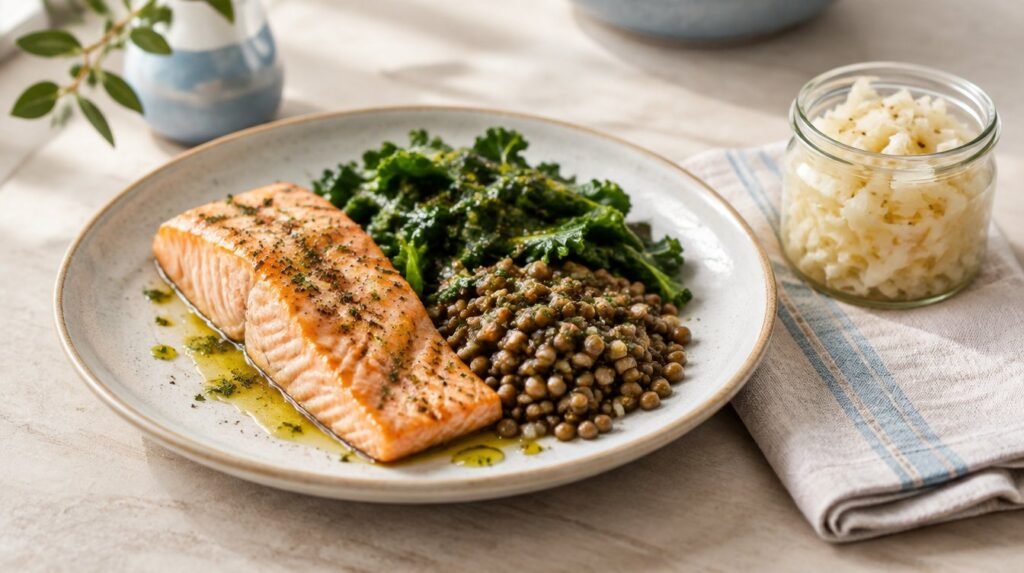
None of these steps is a rosacea treatment. They are low-risk habits that line up with what skin experts advise and with good digestive health in general.
- Track your triggers: NIAMS suggests keeping a written record of what seems to make your rosacea worse. Common triggers include sun, stress, hot or cold weather, wind, hard exercise, spicy foods, alcohol and hot drinks.
- Write down gut symptoms too: if bloating, diarrhea or belly pain show up in the same diary, that is useful information for your doctor, given the links described above.
- Check how you handle heat and spice: the NHS lists spicy foods and hot drinks as triggers. Letting tea or coffee cool a little is an easy test. Our article on whether spicy food is good for you covers the gut side.
- Lean on plants, fish and olive oil: in a 2023 cross-sectional study of 105 rosacea patients and 39 controls, the authors concluded that vegetables, legumes, oily fish, olive oil and nuts, with less meat, cheese and alcohol, appeared helpful. That kind of survey shows patterns, not proof.
- Add fermented foods if you enjoy them: plain yogurt, kefir and sauerkraut are reasonable everyday foods for gut health. See fermented foods for gut health for options. There is no trial showing they clear rosacea.
- Talk to a doctor before probiotic supplements if you are high risk: NCCIH says the risk of harm from probiotics is greater in people with severe illness or a weakened immune system.
- Protect and baby your skin: NIAMS also recommends daily sunscreen of SPF 30 or higher, a gentle cleanser for sensitive skin, and skipping exfoliants and alcohol-based products.
Be wary of anyone selling a gut test or “rosacea cleanse” as the answer. The research is still early, and Mayo Clinic notes that the cause of rosacea is not known. If you want to know more about what diet changes can and cannot do for skin, read your skin before and after a gut health diet.
When to see a doctor
This article is general information, not medical advice. Mayo Clinic advises seeing a healthcare professional, such as a dermatologist, if you have ongoing redness or eye symptoms. Get prompt care if you notice:
- Eye pain, blurred vision, sensitivity to light, a red eye or a gritty feeling. The NHS says these need an urgent appointment because they can be signs of keratitis, which can be serious.
- Facial redness or bumps that keep coming back or are getting worse.
- Ongoing digestive symptoms, such as diarrhea, belly pain or bloating, alongside your rosacea, since the Danish study linked rosacea with celiac disease, IBS and inflammatory bowel disease.
Bring your trigger and symptom diary. It can help your doctor decide whether a gut problem is worth checking for.
Related topics
- Gut Health and Skin: the broader gut-skin research.
- Gut Health and Acne: rosacea is often confused with acne.
- Eczema and Gut Health: another skin condition with gut research behind it.
- Does SIBO Cause Bad Breath?: more on SIBO and how it is tested.
- Fermented Foods for Gut Health: everyday foods with live cultures.
Sources
- Rosacea: Symptoms, Causes, and Risk Factors (National Institute of Arthritis and Musculoskeletal and Skin Diseases)
- Rosacea: Diagnosis, Treatment, and Steps to Take (National Institute of Arthritis and Musculoskeletal and Skin Diseases)
- Rosacea: Symptoms and causes (Mayo Clinic)
- Rosacea (NHS)
- Probiotics: What You Need To Know (National Center for Complementary and Integrative Health)
- Parodi A, et al. Small intestinal bacterial overgrowth in rosacea: clinical effectiveness of its eradication (Clinical Gastroenterology and Hepatology, 2008)
- Egeberg A, et al. Rosacea and gastrointestinal disorders: a population-based cohort study (British Journal of Dermatology, 2017)
- Jørgensen AR, et al. Rosacea is associated with Helicobacter pylori: a systematic review and meta-analysis (Journal of the European Academy of Dermatology and Venereology, 2017)
- Gao Y, et al. Association between rosacea and helicobacter pylori infection: A meta-analysis (PLOS One, 2024)
- Chen YJ, et al. An altered fecal microbial profiling in rosacea patients compared to matched controls (Journal of the Formosan Medical Association, 2021)
- Yu J, et al. Effect of combined probiotics and doxycycline therapy on the gut-skin axis in rosacea (mSystems, 2024)
- Guertler A, et al. Dietary Patterns in Acne and Rosacea Patients: A Controlled Study and Comprehensive Analysis (Nutrients, 2023)
This article is for general information and is not medical advice. Talk to your doctor or a registered dietitian before changing your diet, supplements or medication, especially if you have a health condition.