Gut Health Powder: What You Need to Know
What is a gut health powder?
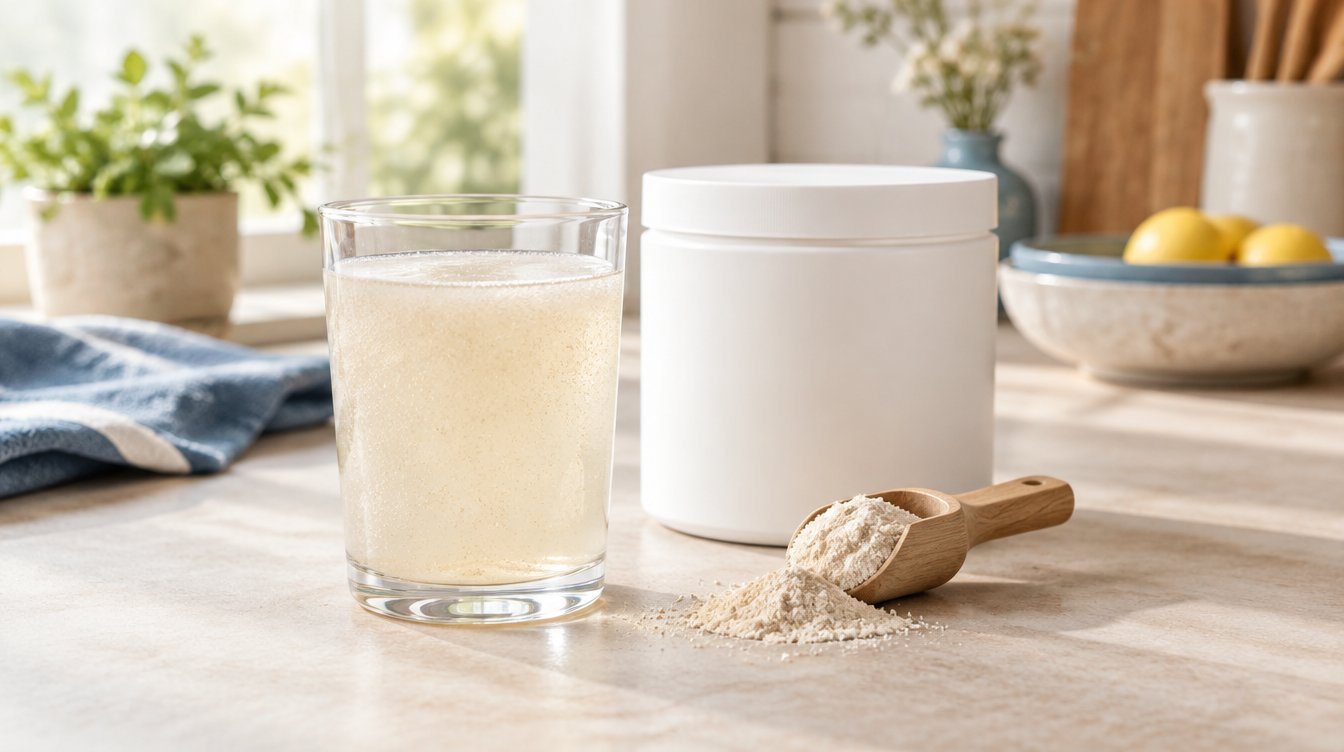
A gut health powder is a dietary supplement you stir into water, a smoothie or yogurt, sold with the promise of better digestion or a healthier gut. There is no legal definition of the term. One tub might be plain psyllium fiber, another a greens blend with 40 plant extracts, another a mix of probiotics, collagen and glutamine.
That variety matters. Some ingredients have decent human research behind them, mostly fiber. Others are added because they sound good on a label.
One point applies to all of them. In the US, the FDA does not have the authority to approve dietary supplements for safety and effectiveness before they are sold. The company is responsible for making sure the product is safe and the label is truthful.
What goes into gut health powders
Most products draw from the same handful of ingredient groups:
| Ingredient type | Common examples | What the human research shows |
|---|---|---|
| Soluble or bulk-forming fiber | Psyllium husk, pectin, partially hydrolyzed guar gum | The strongest evidence in the category, mainly for constipation |
| Prebiotic fiber | Inulin, chicory root, Jerusalem artichoke, FOS | Raises bifidobacteria in small trials; modest help with stool frequency |
| Probiotics | Lactobacillus, Bifidobacterium, Bacillus strains | Strain-specific; results for one strain don’t carry over to another |
| Amino acids and proteins | L-glutamine, collagen peptides | Glutamine: one promising trial in a narrow group; collagen: little gut-specific research |
| Greens and plant extracts | Spirulina, wheatgrass, beet, herbal blends | Mostly untested as finished products; doses often too small to judge |
Fiber: the ingredient with the most support
An 2022 meta-analysis in the American Journal of Clinical Nutrition pooled 16 randomized trials with 1,251 adults who had chronic constipation. Fiber supplements improved how many people responded to treatment and made stools softer. Psyllium did best, especially at doses above 10 grams a day taken for at least four weeks. The authors noted that the studies varied a lot, and fiber also increased gas.
For context, the NIDDK says most adults should get 22 to 34 grams of fiber a day, depending on age and sex. A powder can help close a gap, but most of that should still come from beans, whole grains, fruit, vegetables and nuts.
Prebiotics such as inulin
Prebiotics are fibers that gut bacteria feed on. In a three-week trial of 45 healthy volunteers, snack bars with inulin from chicory or Jerusalem artichoke raised bifidobacteria counts compared with placebo bars. Some people also reported mild to moderate gas.
A 2014 meta-analysis of five small trials (252 people) found inulin improved stool frequency and consistency in chronic constipation, but it did not improve pain or bloating. So inulin may help regularity, and it can make bloating worse for some people while they adjust.
Probiotics in powder form
Probiotic effects depend on the exact strain. As NCCIH explains, if one kind of Lactobacillus helps with a problem, that doesn’t mean another kind will. The NIH Office of Dietary Supplements adds that higher CFU counts alone do not necessarily mean greater health benefits, and that CFUs can decline over time.
Powders add one more question: whether the bacteria survive heat, moisture and months on a shelf. Look for a count guaranteed through the expiration date, not just at the time of manufacture.
Glutamine, collagen and greens
Glutamine has one notable trial. In a randomized trial published in Gut, 106 adults who developed diarrhea-predominant IBS after a gut infection took 5 grams of glutamine three times a day or placebo for eight weeks, and the glutamine group improved far more. That was a specific group with measured gut permeability, and the authors called for larger trials. It does not show that glutamine helps healthy people.
Collagen and greens blends are popular, but we found little research testing them for digestion. Greens powders can add some vitamins, yet they don’t match the fiber of real vegetables. The Dietary Guidelines for Americans rest on the idea that nutrient needs should be met primarily from foods and beverages.
How to choose a gut health powder
The back of the tub tells you more than the front. Check these points:
- Know your goal. If regularity is the goal, a plain fiber supplement such as psyllium has the best track record. Multi-ingredient blends add cost without adding much proof.
- Watch for proprietary blends. Under FDA labeling rules, a company may list only the total weight of a proprietary blend, not the amount of each ingredient in it. You can’t compare those doses to the research.
- Check fiber grams per scoop. Trials that helped constipation often used several grams of fiber or more a day. A blend with 1 or 2 grams is unlikely to do the same.
- Look for named probiotic strains. A strain has a code after the species name. Without it, you can’t match the product to a study.
- Consider a third-party seal. The NIH Office of Dietary Supplements says seals from groups such as U.S. Pharmacopeia, NSF International and ConsumerLab.com show a product was properly made and contains what the label lists, but they do not guarantee it is safe or effective.
How to use one without upsetting your stomach
- Start low. The NIDDK advises adding fiber a little at a time so your body gets used to the change. A half dose for the first week is a reasonable start.
- Drink enough water. MedlinePlus says psyllium powder should be mixed with at least 8 ounces (240 mL) of liquid.
- Space it from medicines. MedlinePlus lists drugs, including digoxin, aspirin and nitrofurantoin, that should not be taken within 3 hours of psyllium. Ask your pharmacist about anything else you take.
- Give it time. In the fiber trials, benefits often showed up after about four weeks of steady use.
You can also get many of the same ingredients from food. Our guide to the best foods for gut health covers high-fiber and fermented options, and fermented foods such as yogurt and kefir provide live cultures without a scoop.
Who should talk to a doctor first
In healthy people, probiotics rarely cause infections or other health problems, though they may cause gas. The risk is higher for people who are severely ill or immunocompromised, or who have a central venous catheter, according to the NIH Office of Dietary Supplements. If that describes you, talk to your doctor before using a probiotic powder. NCCIH also advises against using probiotics as a reason to put off seeing a health care provider.
For fiber powders, MedlinePlus says to tell your doctor if you are pregnant or breastfeeding, take other medicines, or have kidney disease, diabetes, rectal bleeding, a past intestinal blockage, or trouble swallowing. The ODS also warns that some supplements interact with medicines.
When to see a doctor
A powder is not a fix for new or worsening symptoms. The NIDDK says to see a doctor right away if you have constipation along with bleeding from the rectum, blood in your stool, constant belly pain, inability to pass gas, vomiting, fever, lower back pain or weight loss without trying. Talk with a doctor if gas symptoms change suddenly or come with pain, diarrhea or weight loss. This article is general information, not medical advice.
Do gut health powders work?
It depends on what is in them. Fiber powders such as psyllium have the best evidence, mainly for constipation (van der Schoot et al., 2022).
Is a gut health powder better than a capsule?
Not by itself. Powders make it easier to take several grams of fiber, while capsules suit small-dose ingredients such as probiotics.
Can a gut health powder cause bloating?
Yes. Fiber and inulin can increase gas, especially at first, so start with a small dose and add more slowly (NIDDK).
Related topics
- Fiber Supplement: how the main fiber types differ
- Gut Health Supplements: a wider look at capsules, powders and gummies
- AG1 Gut Health: what one well-known greens powder contains
- Resistant Starch Supplement: another prebiotic fiber option
- Constipation Relief: food and habit changes to try first
- Bone Broth Benefits: what the research says about another popular gut product
Sources
- FDA 101: Dietary Supplements (U.S. Food and Drug Administration)
- 21 CFR 101.36 Nutrition labeling of dietary supplements (eCFR)
- Dietary Supplements: What You Need To Know (NIH Office of Dietary Supplements)
- Probiotics: Fact Sheet for Consumers (NIH Office of Dietary Supplements)
- Probiotics: Fact Sheet for Health Professionals (NIH Office of Dietary Supplements)
- Probiotics: Usefulness and Safety (National Center for Complementary and Integrative Health)
- Treatment for Constipation (NIDDK)
- Eating, Diet, & Nutrition for Constipation (NIDDK)
- Symptoms & Causes of Constipation (NIDDK)
- Symptoms & Causes of Gas in the Digestive Tract (NIDDK)
- Psyllium (MedlinePlus, National Library of Medicine)
- van der Schoot A, et al. The effect of fiber supplementation on chronic constipation in adults: an updated systematic review and meta-analysis of randomized controlled trials (American Journal of Clinical Nutrition, 2022)
- Collado Yurrita L, et al. Effectiveness of inulin intake on indicators of chronic constipation; a meta-analysis of controlled randomized clinical trials (Nutrición Hospitalaria, 2014)
- Kleessen B, et al. Jerusalem artichoke and chicory inulin in bakery products affect faecal microbiota of healthy volunteers (British Journal of Nutrition, 2007)
- Zhou Q, et al. Randomised placebo-controlled trial of dietary glutamine supplements for postinfectious irritable bowel syndrome (Gut, 2019)
- Dietary Guidelines for Americans, 2020-2025 (USDA and HHS)
This article is for general information and is not medical advice. Talk to your doctor or a registered dietitian before changing your diet, supplements or medication, especially if you have a health condition.