Eczema and Gut Health: What You Need to Know
Eczema and gut health: the short answer
Eczema, or atopic dermatitis, is mainly a skin barrier and immune condition, but the gut seems to play a part in who develops it. Babies who later get eczema tend to have less varied gut bacteria early in life, and probiotics in pregnancy and infancy may slightly lower the risk. For eczema you already have, probiotics make little or no difference to symptoms, according to a 2018 Cochrane review. Daily skin care is still the base of treatment.
Eczema is common. The National Institute of Allergy and Infectious Diseases (NIAID) estimates it affects 10 to 30 percent of children and 2 to 10 percent of adults in the United States.
What eczema is
Atopic dermatitis is a long-term skin condition with dry, itchy, scaly rashes. People with it may have skin that lacks certain proteins that keep water in and irritants out, according to MedlinePlus. It is often called “the itch that rashes” because scratching an itch brings on the rash.
It tends to come and go in flare-ups. The NHS says it can’t be cured, but treatment can manage symptoms, and it often gets better with age. Many people with eczema also have asthma or hay fever, and it often runs in families (MedlinePlus).
No one knows exactly what causes it. NIAID points to genes, environmental factors such as certain chemicals and air pollution, and the skin’s own microbes (NIAID). Common triggers include pollen, dust mites, cold dry air, wool, fragrances, stress and, in people with food allergy, certain foods.
Skin bacteria come first
Before looking at the gut, it helps to know that the bacteria most closely tied to eczema live on the skin. NIAID reports that 60 to 90 percent of people with atopic dermatitis are likely to carry Staphylococcus aureus on their skin, and many eventually develop infections that worsen the eczema (NIAID).
An NIH study of children with eczema found that the share of Staphylococcus, especially S. aureus, rose during flares and tracked with worse severity, and that skin bacteria became more diverse after treatment. NIAID notes it is still unclear whether these skin microbe changes are a cause or an effect of the disease (NIAID).
Where gut health fits
The gut connection shows up mainly in early life. A Swedish study followed 40 infants, 20 who developed allergy-linked eczema and 20 who had no allergic problems by age 2. The babies who developed eczema had lower gut bacterial diversity at 1 month old. The study was small, and it shows an association rather than cause.
The gut also matters through food. Eczema is the strongest risk factor for developing food allergy (NIAID). In NIAID’s LEAP study, infants who ate peanut foods early were far less likely to have peanut allergy later, and researchers suspect that tiny amounts of peanut reaching babies through the skin may help sensitize some of them (NIAID). If your baby has eczema, ask your pediatrician about when and how to introduce allergy-causing foods.
In adults, the link is less clear. Diet can change gut bacteria. A 17-week Stanford trial in 36 healthy adults found that a high-fermented-food diet increased gut microbial diversity and lowered inflammatory markers, but it did not study eczema.
Probiotics for eczema: prevention vs. treatment
The research splits into two questions with different answers:
| Question | What the evidence shows | Certainty |
|---|---|---|
| Can probiotics treat eczema you already have? | A Cochrane review of 39 trials (2,599 people) found probiotics probably make little or no difference to symptoms. Total severity (SCORAD) scores were about 4 points lower on a 103-point scale, below the 8.7 points considered meaningful. | Low to moderate |
| Can probiotics in pregnancy or infancy lower eczema risk? | A 2015 meta-analysis of 29 trials found lower eczema risk when probiotics were taken in the last trimester, while breastfeeding, or given to infants. | Low or very low |
| Do guidelines recommend them? | The World Allergy Organization conditionally suggests probiotics for pregnant women, breastfeeding mothers and infants at high risk of allergy. | Very low quality evidence |
NIAID lists probiotics for pregnant women and infants among the few prevention strategies tied to a small or modest drop in childhood eczema risk, alongside early skin-barrier moisturizers and avoiding unnecessary antibiotics in pregnancy and delivery (NIAID). Results depend on the strain, though. The NIH Office of Dietary Supplements notes that one analysis found Lactobacillus rhamnosus GG did not reduce eczema risk in children up to age 4.
Safety matters most for the youngest. NCCIH reports cases of severe or fatal infections in premature infants given probiotics, and says risks are greater for people with severe illness or weakened immune systems. Check with a doctor before giving any probiotic to a baby. For more on probiotic safety, see can you take too many probiotics.
Food, elimination diets and fermented foods
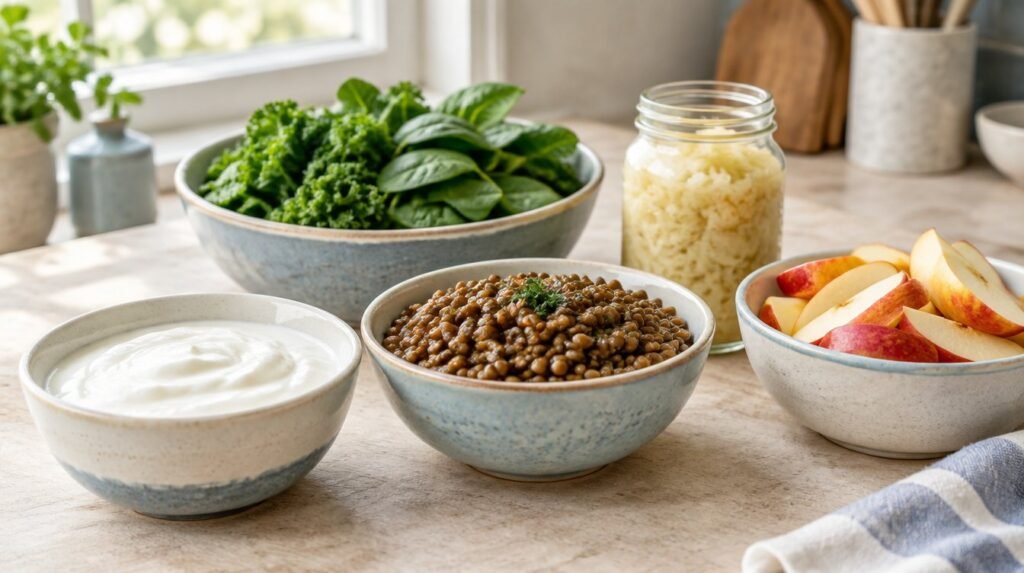
Cutting foods is tempting, but it carries risks. A 2022 meta-analysis of 10 trials with 599 people, mostly young children, found that elimination diets may give only a slight, potentially unimportant improvement in eczema. The authors warned that unnecessary elimination may raise the risk of developing true food allergy.
Allergy tests can mislead, too. People with eczema often have high overall IgE levels, which can produce positive tests without a real food allergy, and NIAID warns that this can lead to overly restrictive diets, malnutrition or poor weight gain (NIAID). The NHS advises not changing your diet, or a breastfed baby’s diet, unless a doctor tells you to. That said, Mayo Clinic notes that some infants and children do flare after foods like eggs and cow’s milk, which is worth raising with their doctor.
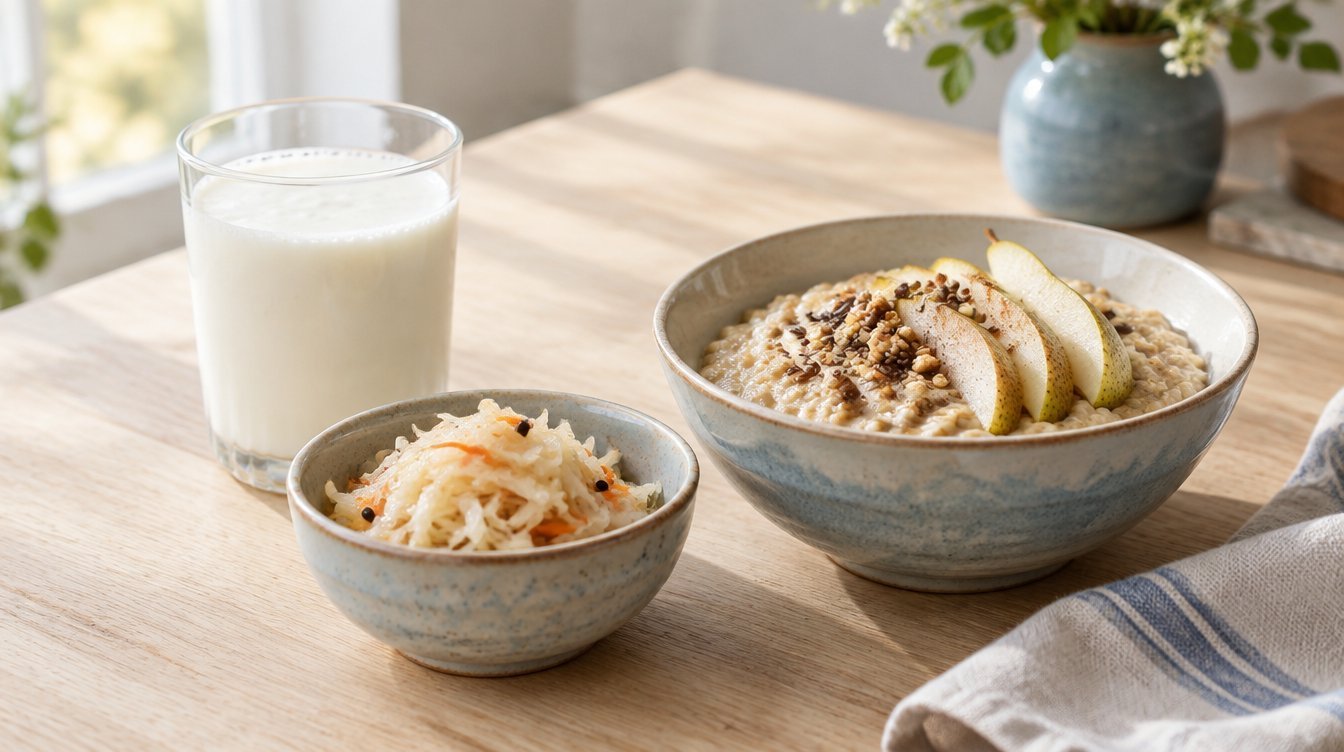
If you tolerate them, fermented foods such as yogurt, kefir and sauerkraut can be part of a varied diet. Our guides to fermented foods for gut health and probiotic foods list options. Just don’t expect them to replace skin treatment.
Skin care that has the strongest support
- Moisturize often. Apply emollients at least twice a day and keep going even when skin improves (NHS).
- Bathe briefly. Short, cooler baths are better than long, hot ones; apply moisturizer while skin is still damp (MedlinePlus).
- Avoid your triggers. Common ones include soap, detergents, wool and heat (NHS).
- Protect against scratching. Keep nails short, and use anti-scratch mittens for babies (NHS).
When to see a doctor
See a doctor if you or your child have symptoms of eczema, if treatments aren’t helping, or if itching affects sleep and daily life (NHS; Mayo Clinic). Get urgent help if the eczema is blistered, crusty, leaking or has pus-filled spots; is painful, swollen or warm; suddenly gets worse; or comes with a fever or feeling unwell. These can be signs of infection or eczema herpeticum, a serious viral complication (NHS). This article is general information, not medical advice.
Frequently asked questions
Can probiotics clear up eczema?
The evidence says probably not. A Cochrane review of 39 trials found probiotics make little or no difference to eczema symptoms (Cochrane, 2018).
Does poor gut health cause eczema?
That has not been shown. Lower gut bacterial diversity in early infancy is linked with later eczema, but the causes of eczema are still unknown (NIAID).
Should I cut dairy or eggs for eczema?
Only with a doctor’s guidance. Elimination diets show at most a slight benefit and may raise the risk of food allergy (Oykhman et al., 2022).
Related topics
- Gut Health and Acne: What You Need to Know: another skin condition with a gut link.
- Probiotics for Immune Support: what probiotics may and may not do for immunity.
- Skin Before and After Gut Health Diet: realistic expectations for diet changes.
- How to Restore Gut Health After Antibiotics: if you are treating an infection.
- Probiotic Foods: everyday foods with live cultures.
Sources
- Eczema (Atopic Dermatitis) (National Institute of Allergy and Infectious Diseases)
- Eczema Causes & Triggers Research (National Institute of Allergy and Infectious Diseases)
- Eczema Prevention Research (National Institute of Allergy and Infectious Diseases)
- Eczema (Atopic Dermatitis) Complications (National Institute of Allergy and Infectious Diseases)
- Food Allergy Causes & Prevention (National Institute of Allergy and Infectious Diseases)
- Atopic eczema (NHS)
- Atopic dermatitis (MedlinePlus, U.S. National Library of Medicine)
- Atopic dermatitis (eczema): Symptoms and causes (Mayo Clinic)
- Probiotics: What You Need To Know (National Center for Complementary and Integrative Health)
- Probiotics: Fact Sheet for Health Professionals (NIH Office of Dietary Supplements)
- Makrgeorgou A, et al. Probiotics for treating eczema (Cochrane Database Syst Rev, 2018)
- Abrahamsson TR, et al. Low diversity of the gut microbiota in infants with atopic eczema (J Allergy Clin Immunol, 2012)
- Cuello-Garcia CA, et al. Probiotics for the prevention of allergy: a systematic review and meta-analysis of randomized controlled trials (J Allergy Clin Immunol, 2015)
- Fiocchi A, et al. World Allergy Organization-McMaster University Guidelines for Allergic Disease Prevention (GLAD-P): Probiotics (World Allergy Organ J, 2015)
- Oykhman P, et al. Dietary elimination for the treatment of atopic dermatitis: a systematic review and meta-analysis (J Allergy Clin Immunol Pract, 2022)
- Kong HH, et al. Temporal shifts in the skin microbiome associated with disease flares and treatment in children with atopic dermatitis (Genome Res, 2012)
- Wastyk HC, et al. Gut-microbiota-targeted diets modulate human immune status (Cell, 2021)
This article is for general information and is not medical advice. Talk to your doctor or a registered dietitian before changing your diet, supplements or medication, especially if you have a health condition.