Non Electric Yogurt Maker: What You Need to Know
What a non-electric yogurt maker is
A non-electric yogurt maker keeps cultured milk warm with stored heat, such as boiling water, a pre-warmed container or insulation, instead of a heater. Regular yogurt needs about 108 to 112°F for 6 to 10 hours. University of Alaska Fairbanks Extension lists a thermos, an insulated cooler, an oven or a heating pad as ways to hold about 110°F for several hours.
Ultimate Gut is published by Ultimate Health Solutions, which sells a yogurt maker. We describe other machines only from what their makers publish.
Why bother making yogurt at all? In a small 17-week randomized study of 36 healthy adults, a diet high in fermented foods increased gut microbiome diversity and lowered several inflammatory markers. It tested mixed fermented foods, not yogurt alone, so treat it as a link, not a promise.
Your non-electric options
Insulated yogurt makers (EasiYo)
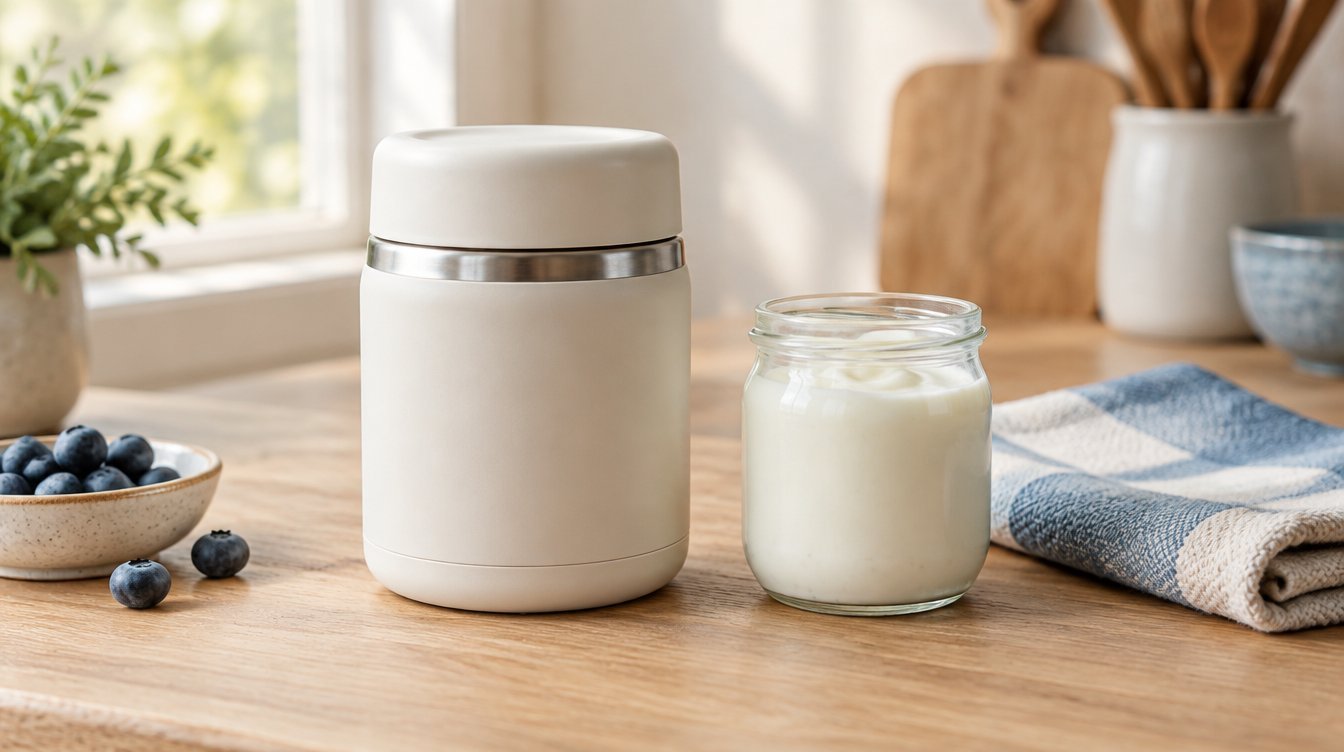
EasiYo’s yogurt maker has “no electronic parts or power required.” You pour boiling water up to the top of the plastic insert, set the jar on it, close the lid and leave it on the counter. EasiYo’s instructions say the yogurt sets in 8 to 12 hours. The maker comes with a 1 kg jar and a temperature strip, and the page lists it at $25 (October 2026).
The system is designed around EasiYo’s powdered sachets, mixed with room-temperature water at 15 to 20°C. Its FAQ doesn’t recommend fresh milk and says setting time varies with water and kitchen temperature. EasiYo’s page doesn’t describe how the maker is insulated.
Thermos or vacuum food jar
A thermos is on UAF Extension’s list of incubators; a wide-mouth one is easiest to fill and empty. Fill it with hot tap water for 10 minutes to pre-warm it, pour that out, then add milk that is already at incubation temperature. Fill it close to the top, since less air space means less heat loss. It suits small batches.
Cooler with warm water
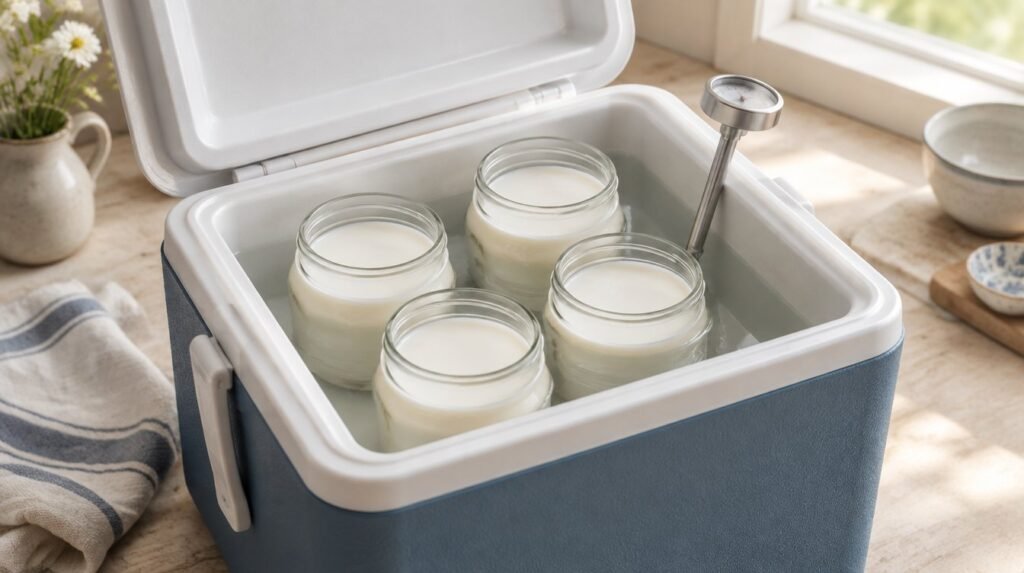
University of Illinois Extension says to fill an insulated cooler halfway with water around 120°F, set covered containers inside so the water reaches their sides without covering them, close the lid and wrap the cooler in a towel. UAF suggests pre-warming the cooler and using 110°F water halfway up the jars. The water’s mass holds heat, and you can top it up.
Insulated bag or box
A soft insulated bag works on the same idea as a cooler, with less insulation. Wrap the jars in towels, tuck in a sealed bottle of hot water, and check the temperature more often than you would with a cooler.
Oven with the light on
An oven is a closed, draft-free box. WSU Extension says to pre-warm it to 200°F, turn it off, and turn it on for short periods so it doesn’t drop below 100°F; a gas pilot light may be enough. Many cooks rely on the oven light instead, but how warm that gets varies by oven, so measure it first. Our oven yogurt guide has the details.
Room temperature, for mesophilic cultures
Some cultures don’t need added heat. The FAO dairy manual says mesophilic cultures grow best at about 30°C (86°F) and holds a mesophilic mother culture at 20°C (68°F) for 16 hours. Finnish viili is made with mesophilic starters. A survey of artisanal Russian fermented milks found that those fermented at or below room temperature were dominated by Lactococcus or Lactobacillus, while those fermented warmer were dominated by Streptococcus.
Don’t assume every heirloom culture is mesophilic. A study of traditional Georgian matsoni found it was largely dominated by Streptococcus thermophilus and Lactobacillus delbrueckii subsp. bulgaricus, the classic heat-loving yogurt bacteria. Follow your culture supplier’s temperature directions. A sunny windowsill is not a thermostat; measure it before trusting it.
How to keep 108 to 112°F for 6 to 10 hours
- Pre-warm the vessel. Fill the thermos, jars or cooler with hot water for about 10 minutes, then drain.
- Add culture at the right temperature. Cool heated milk to 108 to 112°F before adding starter, as WSU Extension directs. Above 115°F, the bacteria can be killed.
- Fill and close. Fill containers near the top and close them tightly.
- Insulate. Wrap in towels and keep the setup away from drafts, cold counters and windows.
- Check every 2 hours or so. Measure the water bath or a jar of water placed beside the yogurt, so you don’t disturb the batch. If it drops below about 108°F, add hot water to the bath or swap in fresh hot water.
- Stop when it sets. Refrigerate as soon as it sets; longer incubation makes it more acidic and can separate the whey.
Checking with a thermometer
UAF Extension recommends a thermometer that reads 0 to 220°F and can be calibrated. To check yours, the University of Georgia describes an ice-water test: in a slush that is at least half ice, the thermometer should read 32°F once it settles. Our yogurt temperature guide lists targets by culture.
Food safety cautions
- The danger zone. USDA says perishable food spoils rapidly between 40 and 140°F, where bacteria can double in as little as 20 minutes. Yogurt incubates in that range on purpose; the acid from an active culture is what protects it. The main risk with stored-heat methods is a batch that drifts cool and sours slowly.
- Use pasteurized milk. Heat and acidity are both needed for safe yogurt, so the National Center for Home Food Preservation says to pasteurize milk that isn’t commercially pasteurized.
- When to discard. Throw out batches that fail to set, and any yogurt with mold or a smell other than fresh, tangy yogurt, per UAF Extension.
- Store cold. Keep yogurt at 40°F or lower. See how long homemade yogurt lasts.
Pros and cons of each option
| Option | How it holds heat | Pros | Cons |
|---|---|---|---|
| EasiYo-style maker | Boiling water around the jar inside a closed housing | No power, simple steps, low listed price | Built around its own sachets; no temperature reading beyond the strip |
| Thermos | Vacuum insulation | Inexpensive and compact | Small batches only |
| Cooler and warm water | Mass of warm water | Large batches; easy to top up | Takes space; needs checking |
| Insulated bag | Trapped air and towels | Portable, already in most kitchens | Loses heat fastest; frequent checks |
| Oven (pre-warmed or light on) | Enclosed, draft-free space | Fits many jars | Easy to overheat; ties up the oven; still uses some power |
| Room temperature | None needed | Simplest of all | Only for mesophilic cultures; room temperature varies |
Who should pick an electric machine instead
- People making L. reuteri yogurt. In one lab study, L. reuteri strains did best at about 93 to 99°F. Holding a narrow range like that through a long ferment is hard with stored heat. See our L. reuteri guide.
- People who can’t check every couple of hours. A thermostat and a timer do the watching for you.
- Cold kitchens. Stored heat drains faster in a cold room.
- Frequent batch makers. Repeating the same results is easier with a set temperature.
Our homemade yogurt machine guide compares electric types and features.
Related topics
- How to Incubate Yogurt: every way to keep a batch warm.
- How to Make Yogurt without a Yogurt Maker: step-by-step no-machine methods.
- Cuisinart Yogurt Maker: what one electric model does and doesn’t do.
- Yogurt Starter: choosing and keeping a starter.
- How Long to Incubate Yogurt: timing by culture and texture.
Sources
- Smith DK. Yogurt Made Simple (FS173E) (Washington State University Extension, 2015)
- Cascio J. Making Yogurt at Home (FNH-00062) (University of Alaska Fairbanks Cooperative Extension Service, 2021)
- Wastyk HC, et al. Gut-microbiota-targeted diets modulate human immune status (Cell, 2021)
- Black Yogurt Maker (EasiYo, product page checked October 2026)
- Our Yogurt: how to make EasiYo (EasiYo, checked October 2026)
- FAQs (EasiYo, checked October 2026)
- Making Yogurt at Home (University of Illinois Extension, 2024)
- Small-Scale Dairy Farming Manual, Technology Unit 10.1: Starter cultures (Food and Agriculture Organization of the United Nations)
- Saxelin ML, et al. Ultrastructure and host specificity of bacteriophages of Streptococcus cremoris, Streptococcus lactis subsp. diacetylactis, and Leuconostoc cremoris from Finnish fermented milk “Viili” (Applied and Environmental Microbiology, 1986)
- Kochetkova TV, et al. Microbial communities of artisanal fermented milk products from Russia (Microorganisms, 2022)
- Quero GM, et al. Microbiological, physico-chemical, nutritional and sensory characterization of traditional Matsoni (Food Microbiology, 2014)
- Reese A. Calibrate food thermometer before Xmas cooking (University of Georgia CAES Field Report, updated 2025)
- USDA Urges Consumers to Keep Clear of the Danger Zone This Summer (USDA Food Safety and Inspection Service, 2016)
- Nummer BA. Fermenting Yogurt at Home (National Center for Home Food Preservation, University of Georgia Cooperative Extension, 2002)
- Mauro CSI, Garcia S. Coconut milk beverage fermented by Lactobacillus reuteri: optimization process and stability during refrigerated storage (Journal of Food Science and Technology, 2019)