Yogurt Cake: What You Need to Know
What yogurt cake is
Yogurt cake is a simple butter-free cake made with plain yogurt, eggs, sugar, flour, a leavening agent and usually a neutral oil. It bakes up moist and slightly tangy, with a tender crumb that stays soft for days. Lemon zest and vanilla are common flavorings, and it is usually baked in a loaf pan or a round cake pan.
It is popular because it is hard to get wrong. There is no creaming of butter, no mixer needed and no special equipment. You whisk the wet ingredients, fold in the dry ones and bake. Some recipes even use the yogurt container itself as the measuring cup for the sugar, flour and oil.
If you bake with yogurt often, our guides to baking with plain yogurt and baking with Greek yogurt cover other recipes and swaps.
Why yogurt works so well in cake
Yogurt does three jobs in a cake batter. It adds moisture, it adds a little protein and fat that help with structure and tenderness, and it adds acid.
That acid matters. Under the U.S. federal standard for yogurt (21 CFR 131.200), yogurt must be cultured with Lactobacillus delbrueckii subsp. bulgaricus and Streptococcus thermophilus and reach a pH of 4.6 or lower. When that acidic yogurt meets baking soda in the batter, the two react and release carbon dioxide, which helps the cake rise. Many yogurt cake recipes use baking powder too, for a steadier lift.
The type of yogurt changes the result. Here is how plain and Greek whole-milk yogurt compare per 100 grams, using USDA FoodData Central:
| Per 100 g | Plain yogurt, whole milk | Greek yogurt, plain, whole milk |
|---|---|---|
| Calories | 78 | 94 |
| Protein | 3.8 g | 8.8 g |
| Fat | 4.5 g | 4.4 g |
| Carbohydrate | 5.6 g | 4.8 g |
| Source | USDA FDC 2259793 | USDA FDC 2259794 |
Greek yogurt is strained, so it is thicker and drier. If you swap it in for regular yogurt, the batter will be stiffer. Thin it with a few tablespoons of milk until it looks like loose regular yogurt. Our explainer on what Greek yogurt is shows how the straining works.
Is yogurt cake good for gut health?
Yogurt cake is a pleasant dessert, but it is not a probiotic food. The live cultures in yogurt do not survive a hot oven.
Researchers have tested this directly. In a 2019 study in Probiotics and Antimicrobial Proteins, plain cakes were baked at 200°C (392°F) for 20 minutes with probiotic microbes mixed into the batter. None of the unprotected probiotics survived; only some protected by special double-layer capsules made it through. A 2020 study in Current Microbiology found the same for Lactobacillus rhamnosus GG in bread: unprotected cells lost all viability during baking at every time and temperature tested.
This is the same reason the yogurt standard requires a label saying “does not contain live and active cultures” on yogurt that has been heat-treated after culturing, per 21 CFR 131.200. Once yogurt is baked, it is still a nutritious ingredient, but the bacteria are gone. Our article on whether you can cook Greek yogurt covers this in more detail.
If you want live cultures with your cake, add them after baking. Serve each slice with a spoonful of cold plain yogurt, the way you might use whipped cream. The cultures in that topping have not been heated. For more ways to get live cultures, see probiotic foods.
Two other changes make the cake a little friendlier to a gut-healthy diet:
- Use less sugar: the FDA lists baked goods and desserts among the main sources of added sugars for most Americans, and sets the Daily Value for added sugars at 50 grams. Cutting the sugar in a yogurt cake by about a quarter usually still gives a pleasant, lightly sweet cake.
- Swap in some whole wheat flour: USDA data list whole wheat flour at 10.6 g of fiber per 100 g, compared with 3.0 g for unenriched all-purpose flour. Replacing a third to half of the flour adds fiber without making the cake heavy. White whole wheat flour gives a milder taste.
How to make a basic yogurt cake
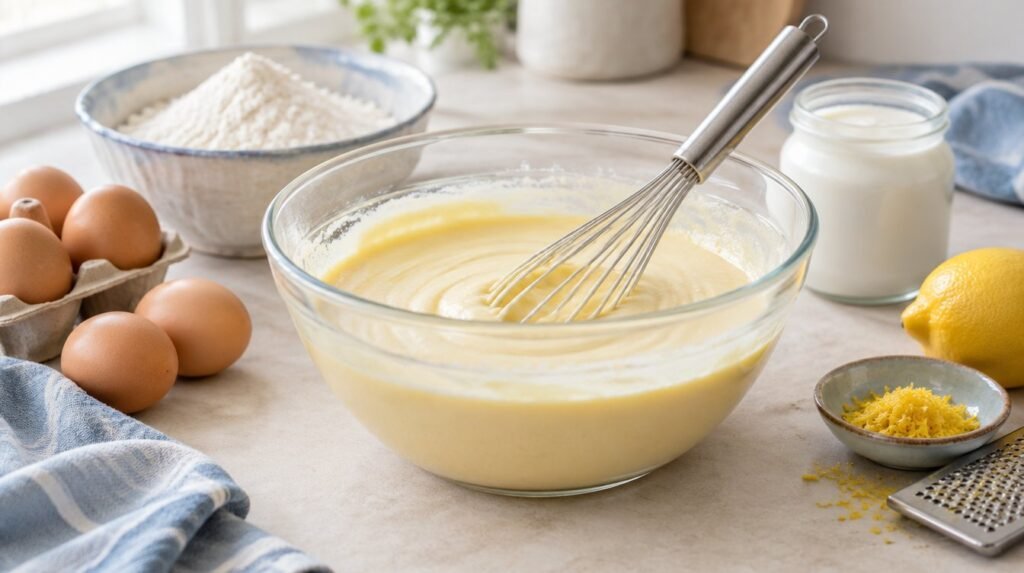
This is a typical lemon yogurt cake. It makes one 9-by-5-inch loaf or one 9-inch round cake, about 10 slices.
- 1 cup plain whole-milk yogurt
- 3/4 to 1 cup granulated sugar
- 3 large eggs, at room temperature
- 1/2 cup neutral oil, such as canola or light olive oil
- Finely grated zest of 1 lemon and 1 teaspoon vanilla extract
- 1 3/4 cups all-purpose flour
- 2 teaspoons baking powder, 1/2 teaspoon baking soda and 1/4 teaspoon salt
- Heat the oven to 350°F (177°C). Grease the pan and line the bottom with parchment.
- Rub the lemon zest into the sugar with your fingers for 30 seconds to release its oils.
- Whisk in the yogurt, eggs, oil and vanilla until smooth.
- In a second bowl, whisk the flour, baking powder, baking soda and salt.
- Fold the dry ingredients into the wet ones with a spatula until no dry flour remains. A few small lumps are fine. Overmixing makes the cake tough.
- Pour into the pan. Bake a 9-inch round for 35 to 40 minutes, or a loaf for 50 to 60 minutes, until the top springs back and a toothpick in the center comes out clean.
- Cool in the pan for 10 minutes, then turn out onto a rack and cool completely before slicing.
For a glaze, whisk 1 cup powdered sugar with 2 tablespoons lemon juice and pour it over the cooled cake. For a less sweet finish, skip the glaze and serve with fresh yogurt and berries.
Easy swaps and variations
| Swap | What changes | Tip |
|---|---|---|
| Greek yogurt for plain | Thicker batter, denser crumb | Thin with 2 to 4 tablespoons of milk |
| Melted butter for oil | Richer flavor, slightly firmer crumb once cool | Use the same amount, cooled |
| Whole wheat flour for part of the flour | More fiber, nuttier taste | Start with a third of the flour |
| Less sugar | Less sweet, slightly less tender | Cut by up to a quarter |
| Add fruit | Moister cake, longer bake | Toss 1 cup berries in a spoonful of flour first |
| Homemade yogurt | Flavor depends on how tart your batch is | Use plain, unsweetened yogurt |
Homemade yogurt works well, and a tart batch gives a tangier cake. If you make your own, our homemade yogurt guide explains how incubation time affects sourness. For another yogurt bake, try Greek yogurt banana bread.
Storing yogurt cake
A plain or simply glazed yogurt cake keeps its texture well because of the oil and yogurt. Wrap it tightly once it is fully cool so it does not dry out, and eat it within a few days for the best texture.
Toppings change the rules. If you add whipped cream, cream cheese frosting or a fresh yogurt topping, keep the cake in the refrigerator at 40°F (4°C) or below, the fridge temperature FoodSafety.gov uses in its storage charts. For longer storage, freeze slices wrapped well; FoodSafety.gov notes that food kept frozen at 0°F (-18°C) or below can be kept indefinitely, and that freezer time limits are for quality only.
Related topics
- Baking with Plain Yogurt: more recipes that use regular yogurt.
- Baking with Greek Yogurt: swaps and ratios for Greek yogurt.
- Greek Yogurt Dessert: other sweet ideas that use yogurt.
- Can You Cook Greek Yogurt?: what heat does to yogurt.
- Homemade Yogurt: make your own yogurt for baking and topping.
Sources
- 21 CFR 131.200 Yogurt (Electronic Code of Federal Regulations)
- Yogurt, plain, whole milk (FDC 2259793) (USDA FoodData Central)
- Yogurt, Greek, plain, whole milk (FDC 2259794) (USDA FoodData Central)
- Flour, whole wheat, unenriched (FDC 790085) (USDA FoodData Central)
- Flour, wheat, all-purpose, unenriched, unbleached (FDC 790018) (USDA FoodData Central)
- Added Sugars on the Nutrition Facts Label (U.S. Food and Drug Administration)
- Cold Food Storage Chart (FoodSafety.gov)
- Arslan-Tontul S, et al. The Use of Probiotic-Loaded Single- and Double-Layered Microcapsules in Cake Production (Probiotics and Antimicrobial Proteins, 2019)
- Ezekiel OO, et al. Viability of Lactobacillus rhamnosus GG in Simulated Gastrointestinal Conditions and After Baking White Pan Bread at Different Temperature and Time Regimes (Current Microbiology, 2020)