Activia Danone: What You Need to Know
The short answer
Activia is Danone’s probiotic yogurt line, sold in the U.S. by Danone US. Every product contains the same probiotic strain, Bifidobacterium animalis subsp. lactis DN-173 010/CNCM I-2494, which Danone says has been tested in more than 18 clinical studies on digestive health. Those trials show a modest benefit for minor digestive discomfort, mostly in women who ate it every day. The trade-off is added sugar: the flavored cups we checked have 6 to 7 grams each.
Ultimate Gut is published by Ultimate Health Solutions, which sells a yogurt maker, probiotic capsules and an inulin fiber supplement. None of the products reviewed here are ours, and these brands don’t pay us.
Product facts below come from Activia’s U.S. product pages and Nutrition Facts panels (labels checked October 2026). We did not buy, taste or test any of them.
What Activia is and what is in it
The Activia product range includes probiotic yogurt cups, small “Dailies” drinks, larger yogurt drinks, Zero Added Sugar cups and Fiber cups with oats and wheat. Each label lists yogurt cultures (L. bulgaricus, L. lactis and S. thermophilus) plus the “live and active probiotic” B. lactis DN-173 010/CNCM I-2494. Activia’s FAQ says products contain “billions” of this strain but does not give a count.
| Product (per serving) | Serving | Calories | Total sugars | Added sugars | Protein |
|---|---|---|---|---|---|
| Activia Strawberry cup | 113 g (4 oz) | 80 | 9 g | 6 g | 4 g |
| Activia Vanilla cup | 113 g | 90 | 9 g | 7 g | 4 g |
| Activia Dailies Strawberry | 93 mL bottle | 70 | 10 g | 6 g | 3 g |
| Activia Strawberry drink | 207 mL bottle | 160 | 23 g | 14 g | 7 g |
| Activia Zero Added Sugar Strawberry | 113 g | 50 | 5 g | 0 g | 4 g |
| Activia Fiber Strawberry | 113 g | 90 | 8 g | 6 g | 4 g |
| Dannon Plain Whole Milk (for comparison) | 170 g (3/4 cup) | 110 | 7 g | 0 g | 6 g |
The sugar in plain yogurt is the milk’s own lactose, which the FDA does not count as added sugar. Scaled to a 4 oz cup, Danone’s own plain whole milk yogurt has about 5 g of total sugars and none added. The Daily Value for added sugars is 50 g, so two strawberry Activia cups a day (the amount the brand recommends) supply 12 g, about a quarter of it. The Zero Added Sugar line is sweetened with sucralose and acesulfame potassium instead; see our Activia Zero Sugar guide.
What Activia claims vs what the evidence shows
Activia’s current U.S. claim is narrow. Its FAQ says eating Activia twice a day for two weeks, as part of a balanced diet, “may help reduce the frequency of minor digestive discomfort,” defined as bloating, gas, abdominal discomfort and rumbling. It cites two double-blind randomized trials and a pooled analysis.
What the trials found
- Transit time: in a crossover study of 36 healthy women, three 125 g cups a day for 10 days shortened colonic transit time compared with a control fermented milk (Marteau 2002).
- IBS with constipation: in 274 primary care adults over 6 weeks, quality-of-life scores improved in both groups; the responder rate (65% vs 48%) and bloating were better with Activia at week 3, and stool frequency rose in people with fewer than 3 stools a week (Guyonnet 2007).
- Minor digestive symptoms: a second trial in 324 women did not confirm the main result, though a pooled analysis of both trials (538 women) favored the probiotic product (Marteau 2013). A later pooled analysis reported symptom scores falling after 2 weeks (Marteau 2019).
- Meta-analysis: three trials with 598 adults, 96.5% of them women, found a modest improvement in gut discomfort; about 10 people needed to eat the product for one to benefit (Eales 2017).
- Children: in 159 constipated children, twice-daily servings for 3 weeks raised stool frequency no more than a control product did (Tabbers 2011).
Limits of the evidence
Most trials were funded or co-authored by Danone, and nearly all participants were adult women. Effects were modest, and one of the two main trials missed its primary goal. The studies tested minor symptoms or IBS in adults, not the treatment of any disease, and the benefit is linked to eating it every day; the FAQ notes it ends when you stop.
The 2010 FTC settlement
In December 2010, the Federal Trade Commission announced a settlement with Dannon over Activia and DanActive advertising. The FTC charged that Dannon lacked support for claims that one daily serving relieves temporary irregularity and slow intestinal transit, and that its “clinically proven” claims were false. Under the order, Activia ads making irregularity or transit-time claims must convey that three servings a day are needed, unless two well-designed human studies show fewer servings work. Dannon also agreed to pay $21 million to 39 states. The settlement was not an admission that the company broke the law.
Price
Activia’s U.S. site does not list prices, so we have not calculated a price per serving. Store prices vary by pack size and retailer.
Who it may suit and who should skip it
- May suit: people who enjoy flavored yogurt and want one whose probiotic strain has been studied for occasional bloating or discomfort, and who are willing to eat it twice a day.
- Consider Zero Added Sugar or plain yogurt if you are limiting added sugar, especially with the larger drinks (14 g added sugar per bottle).
- Skip it if you have a milk allergy; the Fiber cups also contain wheat.
- Talk to a doctor about ongoing constipation, diarrhea or pain rather than relying on yogurt. Our guide to yogurt for an upset stomach covers when food helps and when it does not.
Alternatives
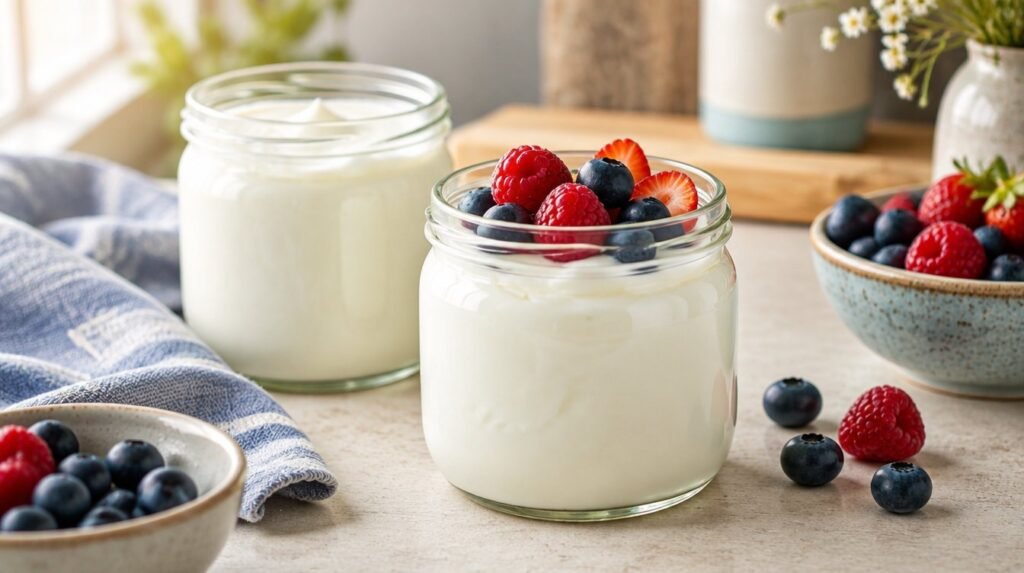
Plain yogurt with live and active cultures gives you the yogurt cultures without added sugar, and you can sweeten it with fruit. Not every yogurt still carries live microbes, as our explainer on whether all yogurt has probiotics shows. For other options sorted by their cultures, see the best yogurt for probiotics. Kefir is another fermented dairy choice; compare the best kefir brands.
Making plain yogurt at home
Homemade yogurt lets you control the milk, the starter and the sugar. The University of Alaska Fairbanks Cooperative Extension method for 1 quart of milk:
- Heat pasteurized milk to 185 to 200°F, stirring often; hold at 185°F for 10 minutes for thinner yogurt or 20 minutes for thicker.
- Cool the pot in cold water to 112 to 115°F.
- Blend 1/4 cup of plain yogurt with live and active cultures (or a dry starter) into a cup of the warm milk, then stir it back in. The mix should be about 110°F.
- Incubate covered and undisturbed for 4 to 7 hours at 110°F, plus or minus 5°F.
- Chill right away at 40°F or lower; it keeps about 10 to 21 days.
Holding a steady temperature is the hardest part. Our guides to making yogurt at home and yogurt temperature go step by step.
Is Activia yogurt good for you?
It can fit a healthy diet: a strawberry cup has 80 calories, 4 g protein and 6 g added sugar, and its probiotic strain has modest evidence for minor digestive discomfort, mostly in women (Eales 2017).
How often do you need to eat Activia?
Activia says twice a day for two weeks, and that the benefit continues only while you keep eating it (Activia FAQ).
What probiotic is in Activia?
Every Activia product lists Bifidobacterium animalis subsp. lactis DN-173 010/CNCM I-2494, along with standard yogurt cultures.
Is plain yogurt a good alternative to Activia?
Plain yogurt with live and active cultures has no added sugar, but it does not contain the Activia strain, which Danone says is exclusive to Activia in the U.S., so the Activia trials do not apply to it.
Related topics
- Best Yogurt for Probiotics: yogurts compared by the cultures on their labels.
- Does All Yogurt Have Probiotics?: what “live and active cultures” means.
- Activia Zero Sugar: the no-added-sugar line in detail.
- Dannon Plain Whole Milk Yogurt: Danone’s plain yogurt, label by label.
- How to Make Yogurt at Home: a full homemade method.
Sources
- Activia Probiotic Products (Activia, Danone US, checked October 2026)
- Activia Strawberry Probiotic Yogurt (Activia, label checked October 2026)
- Activia Vanilla Probiotic Yogurt (Activia, label checked October 2026)
- Activia Dailies Strawberry (Activia, label checked October 2026)
- Activia Strawberry Probiotic Yogurt Drink (Activia, label checked October 2026)
- Activia Zero Added Sugar Strawberry (Activia, label checked October 2026)
- Activia Fiber Strawberry (Activia, label checked October 2026)
- Frequently Asked Questions (Activia, checked October 2026)
- For Healthcare Professionals (Activia, checked October 2026)
- Dannon Plain Whole Milk Yogurt (Dannon, label checked October 2026)
- Added Sugars on the Nutrition Facts Label (U.S. Food and Drug Administration)
- Dannon Agrees to Drop Exaggerated Health Claims for Activia Yogurt and DanActive Dairy Drink (Federal Trade Commission, 2010)
- Marteau P, et al. Bifidobacterium animalis strain DN-173 010 shortens the colonic transit time in healthy women (Alimentary Pharmacology & Therapeutics, 2002)
- Guyonnet D, et al. Effect of a fermented milk containing Bifidobacterium animalis DN-173 010 on the health-related quality of life and symptoms in irritable bowel syndrome in adults in primary care (Alimentary Pharmacology & Therapeutics, 2007)
- Marteau P, et al. A randomized, double-blind, controlled study and pooled analysis of two identical trials of fermented milk containing probiotic Bifidobacterium lactis CNCM I-2494 in healthy women reporting minor digestive symptoms (Neurogastroenterology & Motility, 2013)
- Eales J, et al. Systematic review and meta-analysis: the effects of fermented milk with Bifidobacterium lactis CNCM I-2494 and lactic acid bacteria on gastrointestinal discomfort in the general adult population (Therapeutic Advances in Gastroenterology, 2017)
- Marteau P, et al. Consumption of a fermented milk product containing Bifidobacterium lactis CNCM I-2494 in women complaining of minor digestive symptoms: rapid response which is independent of dietary fibre intake or physical activity (Nutrients, 2019)
- Tabbers MM, et al. Fermented milk containing Bifidobacterium lactis DN-173 010 in childhood constipation: a randomized, double-blind, controlled trial (Pediatrics, 2011)
- Making Yogurt at Home (University of Alaska Fairbanks Cooperative Extension, via UC Master Food Preservers, 2015)