Activia Zero Sugar: What You Need to Know
The short answer
What shoppers call Activia Zero Sugar is labeled “Zero 0g Added Sugar.” The 4 oz cups have 50 to 60 calories, 4 g of protein and 5 g of total sugars from milk and fruit, sweetened with sucralose and acesulfame potassium; the small Dailies drinks use stevia extract. All contain Activia’s probiotic strain, B. lactis DN-173 010/CNCM I-2494, which has modest evidence for minor digestive discomfort, mostly in women, from trials of other Activia products.
Ultimate Gut is published by Ultimate Health Solutions, which sells a yogurt maker, probiotic capsules and an inulin fiber supplement. None of the products reviewed here are ours, and these brands don’t pay us.
Product facts below come from Activia’s U.S. Zero 0g Added Sugar product pages and their Nutrition Facts panels (labels checked October 2026). We did not buy, taste or test any of them.
What’s in Activia Zero 0g Added Sugar
The line has Vanilla and Strawberry cups in 4-packs, two mixed-flavor 12-packs of cups, and two 8-packs of 93 mL Dailies drinks. The Strawberry cup label lists cultured nonfat milk, strawberries, water and modified food starch, then less than 1% each of inulin, pectin, natural flavors, carmine for color, sucralose, calcium lactate, xanthan gum, acesulfame potassium and malic acid.
| Ingredient or strain | Amount on label | What research exists |
|---|---|---|
| B. lactis DN-173 010/CNCM I-2494 (probiotic) | “Billions” per cup; no exact count given | Several randomized trials in adults, mostly women, with key studies commissioned or co-authored by Danone; modest benefit for minor digestive discomfort |
| Yogurt cultures: L. bulgaricus (2 strains), L. lactis, S. thermophilus | Not stated | Standard yogurt cultures |
| Sucralose and acesulfame potassium (cups) | Less than 1%; exact amount not stated | FDA-approved sweeteners with set intake limits; one 2-week trial linked sucralose with changed glucose responses |
| Stevia extract (Dailies) | Less than 1%; exact amount not stated | High-purity steviol glycosides have FDA GRAS notices |
| Inulin (prebiotic fiber) | Less than 1% in cups; 1 g total fiber per serving on most labels | Too small an amount to compare with fiber studies |
| Modified food starch, pectin, xanthan gum (cups); food starch, pectin, guar gum (Dailies) | Not stated | Thickeners |
Check the sweetener on the pack you buy. The line page says “sweetened with stevia extract,” which matches the Peach & Strawberry Dailies label, but the Vanilla, Strawberry and Strawberry & Blueberry cup labels list sucralose and acesulfame potassium instead.
What “zero sugar” means on a yogurt label
Activia’s claim is “0g added sugar,” which is not the same as sugar free. Under FDA rule 21 CFR 101.60, a food can say “sugar free” only if it has less than 0.5 g of sugars per serving. These cups have 5 g, so they can’t use that term.
A “no added sugar” claim means no sugars or sugar-containing ingredients, such as concentrated fruit juice, were added, and the food it resembles normally has added sugar. Unless the food is low calorie, the label must say it isn’t and point to the Nutrition Facts, hence the Zero footnote “Not a low calorie food.”
The 5 g of sugar on the label comes mostly from lactose, the natural sugar in milk, plus a little from fruit. The FDA does not count sugars naturally found in milk, fruit and vegetables as added sugars, and sets the Daily Value for added sugars at 50 g. During fermentation, starter bacteria digest some of the lactose and turn it into lactic acid, which thickens and sours the milk, according to the University of Illinois Extension.
Activia Zero vs regular Activia and plain yogurt
| Product (per serving) | Serving | Calories | Total sugars | Added sugars | Protein | Calcium | Sweetener |
|---|---|---|---|---|---|---|---|
| Zero Vanilla cup | 113 g | 50 | 5 g | 0 g | 4 g | 170 mg | Sucralose, acesulfame K |
| Zero Strawberry cup | 113 g | 50 | 5 g | 0 g | 4 g | 170 mg | Sucralose, acesulfame K |
| Zero Blueberry cup | 113 g | 60 | 5 g | 0 g | 4 g | 160 mg | Sucralose, acesulfame K |
| Zero Peach Dailies | 93 mL | 45 | 4 g | 0 g | 3 g | 120 mg | Stevia extract |
| Regular Activia Strawberry cup | 113 g | 80 | 9 g | 6 g | 4 g | 150 mg | Cane sugar |
| Plain low-fat yogurt (USDA) | 113 g* | 71 | 8 g | — | 6 g | 207 mg | None |
*USDA lists plain low-fat yogurt per 100 g; we scaled it to 113 g.
The Zero cup has 30 fewer calories and 6 g less added sugar than regular strawberry Activia. Next to plain low-fat yogurt, it has fewer calories and about 3 g less sugar, but about 2 g less protein and less calcium; water and starch sit near the top of its ingredient list. Plain yogurt has no sweeteners or thickeners.
One trade-off cuts the other way. Plain yogurt with live cultures does not contain Activia’s strain, which Activia says is found only in its products among U.S. yogurts, so the Activia trials don’t apply to it. Our guide to the best yogurt for gut health compares other options by label.
What the research on the probiotic shows
Activia’s FAQ says eating it twice a day for two weeks may help reduce how often you have minor digestive discomfort such as bloating and gas, and that the effect ends when you stop. The research behind that claim:
- IBS with constipation: in 274 primary care adults over 6 weeks, quality-of-life scores improved in both groups; the responder rate (65% vs 48%) and bloating were better with the probiotic product at week 3 (Guyonnet 2007). The lead author listed a Danone address.
- Minor digestive symptoms: a 4-week trial in 324 women missed its main goal, though a pooled analysis with an earlier trial (538 women) favored the probiotic product (Marteau 2013).
- Meta-analysis: three trials with 598 adults, 96.5% of them women, found a modest improvement in gut discomfort; about 10 people needed to eat the product for one to benefit. Danone commissioned the analysis (Eales 2017).
These studies used fermented milk products with the strain, not the Zero 0g Added Sugar recipe, and we found no published trial of the Zero line itself. The strain should be the same, but the evidence is modest, mostly in women, and key studies were commissioned or co-authored by Danone. Our Activia Danone guide covers the full research record and the 2010 FTC settlement over earlier Activia advertising.
The sweeteners: what the evidence says
The FDA lists sucralose and acesulfame potassium as approved food additives. Sucralose is about 600 times sweeter than sugar, with an acceptable daily intake of 5 mg per kg of body weight; acesulfame potassium is about 200 times sweeter, with a limit of 15 mg per kg. High-purity steviol glycosides from stevia are covered by GRAS notices that the FDA has not questioned. Activia does not list how much of each sweetener a serving contains.
There are open questions. In 2023 the World Health Organization made a conditional recommendation against using non-sugar sweeteners, including sucralose, acesulfame K and stevia, for weight control, citing no long-term weight benefit. Its review also noted possible links with type 2 diabetes and heart disease, which the WHO said could be confounded. The advice does not apply to people who already have diabetes.
On the gut side, a randomized trial gave 120 healthy adults sachets of saccharin, sucralose, aspartame or stevia for 2 weeks, at doses below the daily limits. Each sweetener changed the gut and mouth microbiome, and saccharin and sucralose worsened blood sugar responses as a group, with large differences from person to person (Suez 2022). It was short and used sachets, not yogurt, so it doesn’t show harm from Activia.
Price
Activia’s U.S. site does not list prices, so we have not calculated a price per serving. Store prices vary by pack size and retailer.
Who it may suit and who should skip it
- May suit: people who want Activia’s strain without added sugar and are fine with non-sugar sweeteners.
- Choose plain yogurt for more protein and calcium per cup and no sweeteners; add fruit for sweetness.
- Skip it if you have a milk allergy; every product lists milk. The strawberry and blueberry cups are colored with carmine, which some people avoid.
- Talk to a doctor about ongoing constipation, diarrhea, pain or bleeding rather than relying on yogurt. Our guide to yogurt for an upset stomach covers when food helps and when it doesn’t.
Making plain yogurt at home
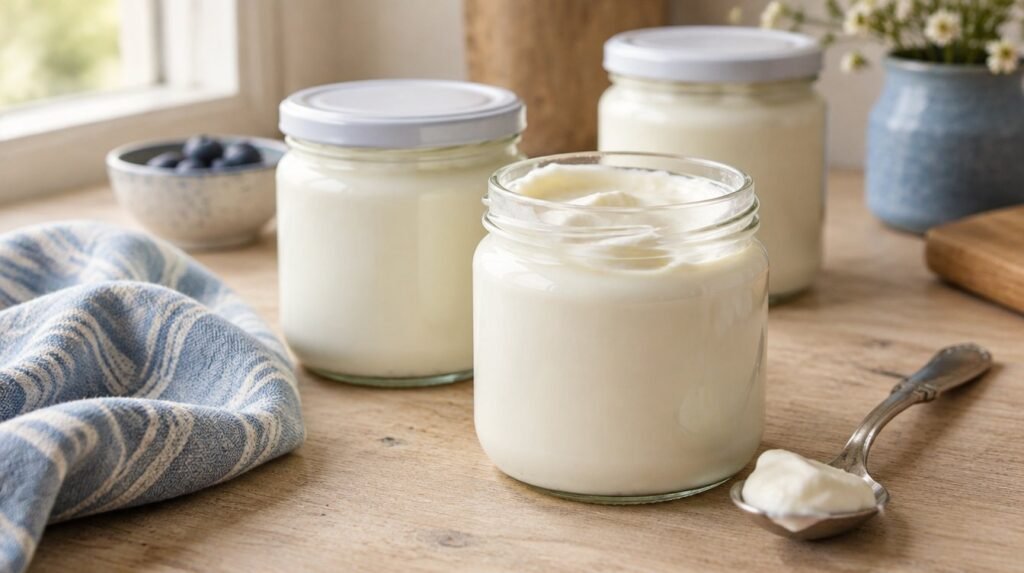
Homemade yogurt lets you control exactly what goes in. The University of Illinois Extension method for 1 quart of milk:
- Heat 1 quart of milk slowly to 180 to 185°F, stirring so it doesn’t scorch.
- Let it cool to 108 to 115°F.
- Mix 2 tablespoons of plain yogurt with live cultures into about 1 cup of the warm milk, then stir it back into the pot. Fresh starter works best.
- Pour into clean lidded containers and keep them at 108 to 115°F for 6 to 10 hours without moving them.
- Once set, refrigerate at 40°F or below and eat within 14 days.
Holding a steady temperature is the hardest part. Our guides to making yogurt at home and yogurt temperature go step by step.
Related topics
- Activia Danone: the full Activia range, its research and the FTC settlement.
- Best Yogurt for Gut Health: yogurts compared by label.
- Plain Yogurt: the simplest no-added-sugar option.
- Is Oikos Triple Zero Good for Gut Health?: another zero-added-sugar cup.
- How to Make Yogurt at Home: a full homemade method.
Sources
- Zero 0g Added Sugar product line (Activia, Danone US, checked October 2026)
- Activia Zero 0g Added Sugar Vanilla (Activia, label checked October 2026)
- Activia Zero 0g Added Sugar Strawberry (Activia, label checked October 2026)
- Activia Zero 0g Added Sugar Strawberry & Blueberry 12-pack (Activia, label checked October 2026)
- Activia Zero 0g Added Sugar Peach & Strawberry Dailies (Activia, label checked October 2026)
- Activia Strawberry Probiotic Yogurt (Activia, label checked October 2026)
- Frequently Asked Questions (Activia, checked October 2026)
- 21 CFR 101.60: Nutrient content claims for the calorie content of foods (Electronic Code of Federal Regulations)
- Added Sugars on the Nutrition Facts Label (U.S. Food and Drug Administration)
- Aspartame and Other Sweeteners in Food (U.S. Food and Drug Administration)
- WHO advises not to use non-sugar sweeteners for weight control in newly released guideline (World Health Organization, 2023)
- Yogurt, plain, low fat (FDC ID 170886) (USDA FoodData Central)
- Making Yogurt at Home (University of Illinois Extension, 2024)
- Suez J, et al. Personalized microbiome-driven effects of non-nutritive sweeteners on human glucose tolerance (Cell, 2022)
- Guyonnet D, et al. Effect of a fermented milk containing Bifidobacterium animalis DN-173 010 on the health-related quality of life and symptoms in irritable bowel syndrome in adults in primary care (Alimentary Pharmacology & Therapeutics, 2007)
- Marteau P, et al. A randomized, double-blind, controlled study and pooled analysis of two identical trials of fermented milk containing probiotic Bifidobacterium lactis CNCM I-2494 in healthy women reporting minor digestive symptoms (Neurogastroenterology & Motility, 2013)
- Eales J, et al. Systematic review and meta-analysis: the effects of fermented milk with Bifidobacterium lactis CNCM I-2494 and lactic acid bacteria on gastrointestinal discomfort in the general adult population (Therapeutic Advances in Gastroenterology, 2017)