Are Chobani Yogurt Drinks Healthy? What the Evidence Says
Are Chobani yogurt drinks healthy?
It depends. Chobani’s current yogurt drinks, its High Protein Greek Yogurt Drinks, list 15 to 30 g of protein, 0 g of added sugar and no lactose, which fits federal added-sugar advice. The trade-off is how they taste sweet: the one full label we could read uses stevia and monk fruit, which the 2025–2030 Dietary Guidelines advise limiting.
This page covers the yogurt drinks on Chobani’s website, not its oat milk or creamers. Ultimate Gut is not affiliated with Chobani. Label facts come from Chobani’s own pages and label data, checked in October 2026, and can change.
What the label and official guidance show
What’s in the bottles
| Drink | Bottle | Protein | Added sugar | Lactose-free |
|---|---|---|---|---|
| 15 g High Protein (e.g., Mixed Berry Vanilla) | 7 oz | 15 g | 0 g | Yes |
| 20 g High Protein (e.g., Strawberries & Cream) | 10 oz | 20 g | 0 g | Yes |
| 30 g High Protein (e.g., Vanilla Ice Cream) | 14 oz | 30 g | 0 g | Yes |
The only complete label we could read was for the 20 g Mixed Berry Vanilla bottle, in label data Chobani supplies to retailers. It is mostly lowfat Greek yogurt, water and berries, with small amounts of flavorings, chicory root fiber, lactase, thickeners, stevia extract and monk fruit extract. Per bottle: 170 calories, 20 g protein, 3 g fat (2 g saturated), 1 g fiber, 11 g total sugars (0 g added), 120 mg sodium and 320 mg calcium.
Sugar: within the Dietary Guidelines
The Dietary Guidelines for Americans recommend no amount of added sugars, cap one meal at 10 g, and say dairy snacks such as yogurt should not exceed 2.5 g of added sugar per 2/3-cup equivalent. At 0 g, these drinks meet all three. The FDA’s Daily Value for added sugars is 50 g, and the sugars naturally in milk and fruit don’t count toward it.
Per bottle, the 20 g drink also stays within the FDA’s added-sugar, sodium and saturated-fat limits for dairy foods labeled “healthy” (2.5 g, 230 mg and 2 g). That claim also requires a minimum amount of dairy, which a label doesn’t show.
Sweeteners: permitted, but the guidelines say limit them
The FDA has not questioned manufacturers’ conclusions that high-purity stevia sweeteners and monk fruit extract are generally recognized as safe. Even so, the Dietary Guidelines recommend no amount of non-nutritive sweeteners and advise limiting foods that contain them, and the World Health Organization conditionally recommends against non-sugar sweeteners, stevia included, for weight control (people with diabetes excepted).
Gut evidence is early. In a 2-week randomized trial of 120 adults, saccharin, sucralose, aspartame and stevia each changed the gut microbiome, and saccharin and sucralose impaired blood-sugar responses; the abstract reports no such effect for the other two. Monk fruit wasn’t tested.
Protein: the main strength
The Dietary Guidelines set a protein goal of 1.2–1.6 g per kilogram of body weight per day: about 82 to 109 g for a 150-pound (68 kg) adult. A 20 g bottle covers roughly a fifth to a quarter of that. For comparison, 3/4 cup of Chobani’s plain nonfat Greek yogurt gives 16 g with no sweetener.
Live cultures and gut health
Chobani’s drinks page advertises billions of probiotics, but the drink label data we read names no strains and gives no count; Chobani’s plain Greek yogurt tub lists six named cultures. ISAPP, a scientific association, reserves “probiotic” for specific strains with evidence of a health benefit. Yogurt has more human research than most fermented foods, more than 20 randomized trials of yogurt and cultured milk, though much of the evidence is observational. In a Stanford trial of 36 adults, 10 weeks of a diet high in fermented foods such as yogurt, kefir and kimchi increased microbiome diversity and lowered 19 inflammatory proteins. No study we found tested these drinks.
Lactose-free
Chobani labels the drinks lactose-free, and the 20 g bottle’s ingredients include lactase, the enzyme that digests lactose. The NIDDK says lactose-free milk products may help people with lactose intolerance lower their lactose intake.
Caveats: what could change the answer
- One full label. Chobani’s pages for the 15 g and 30 g drinks don’t list ingredients, so we can’t confirm their sweeteners. Check the bottle.
- Marketing claims are untested. Chobani says the drinks keep you fuller for longer; we found no published study of these drinks.
- Sweetener research is young. Trials are short and effects varied from person to person. The FDA considers authorized sweeteners safe for the general population under their conditions of use.
- Other bottles. Older Chobani Greek yogurt drinks may still be sold; read the Added Sugars line on any bottle.
Practical takeaway: who Chobani yogurt drinks suit
A Chobani High Protein drink is a reasonable choice if you want portable protein with no added sugar and no lactose, for example after a workout.
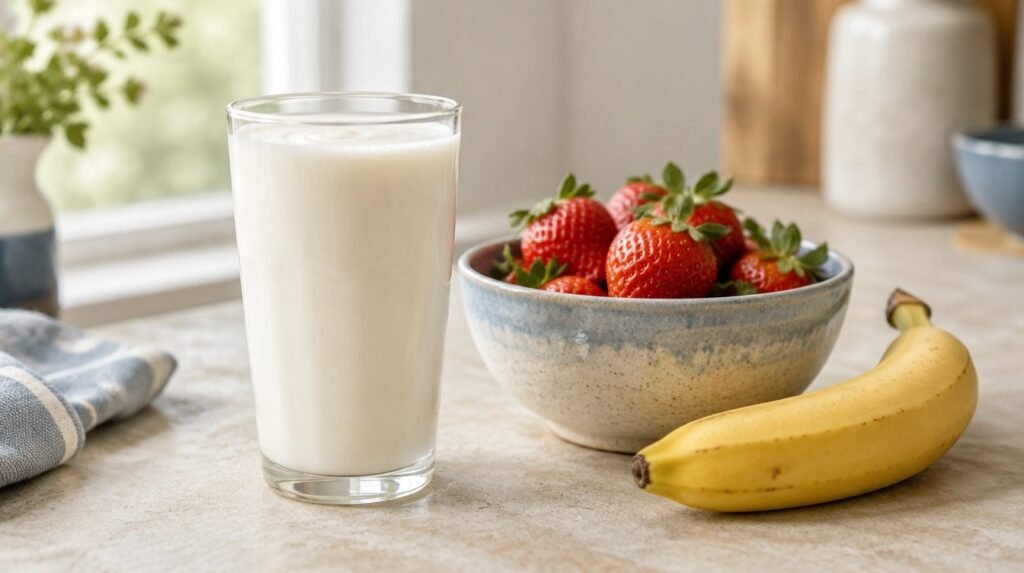
You may prefer something else if you’re cutting back on non-nutritive sweeteners, as the Dietary Guidelines advise, or want a food with named live cultures. Plain yogurt is the simplest swap; see Plain Yogurt: What You Need to Know. For a drink, blend plain yogurt with fruit and a splash of milk: USDA MyPlate’s batido smoothie has 0 g added sugars per 8-ounce serving, and plain Greek yogurt raises the protein. Chobani Recipes You Can Make at Home has more ideas for a plain tub.
Frequently asked questions
Do Chobani yogurt drinks have probiotics?
Chobani advertises billions of probiotics, but the label data we read names no strains or count, and “probiotic” should mean strains with proven benefits (ISAPP).
Do Chobani yogurt drinks have added sugar?
Chobani lists 0 g of added sugar for its High Protein drinks. The 20 g bottle gets its sweetness from milk, fruit, stevia and monk fruit (label data).
Are Chobani yogurt drinks lactose-free?
Yes. Chobani labels them lactose-free, and the 20 g bottle lists added lactase (label data).
Are stevia and monk fruit safe?
The FDA has not questioned their GRAS status in high-purity form (FDA), but the Dietary Guidelines advise limiting foods with non-nutritive sweeteners.
More on choosing yogurt
- Plain Yogurt: What You Need to Know: the unsweetened baseline.
- Chobani Recipes You Can Make at Home: four recipes using a plain tub.
- Best Yogurt for Probiotics: Compared (2026): what culture lists do and don’t tell you.
- Plain Yogurt Recipes You Can Make at Home: includes a no-added-sugar smoothie.
- Best Yogurt for Gut Health: Compared (2026): plain yogurts compared on cultures and sugar.
Sources
- Chobani. High Protein Greek Yogurt Drinks (product line page). Checked October 2026.
- Chobani. Mixed Berry Vanilla 15G High Protein Greek Yogurt Drink (product page). Checked October 2026.
- Chobani. Strawberries & Cream 20G High Protein Greek Yogurt Drink (product page). Checked October 2026.
- Chobani. Vanilla Ice Cream 30G High Protein Greek Yogurt Drink (product page). Checked October 2026.
- Chobani. Drinks (High Protein line page). Checked October 2026.
- Chobani, Inc. (brand owner). Chobani 20G Protein Mixed Berry Vanilla Lowfat Greek Yogurt Drink: product sell sheet with label data, hosted by Syndigo (last saved September 23, 2026). Checked October 2026.
- Chobani, LLC. Product Information: Non-Fat Plain Chobani Greek Yogurt 32oz (product sheet, 2022). Checked October 2026.
- U.S. Department of Agriculture and U.S. Department of Health and Human Services. Dietary Guidelines for Americans, 2025–2030.
- U.S. Food and Drug Administration. Added Sugars on the Nutrition Facts Label.
- U.S. Food and Drug Administration. Use of the “Healthy” Claim on Food Labeling.
- U.S. Food and Drug Administration. Aspartame and Other Sweeteners in Food.
- World Health Organization. WHO advises not to use non-sugar sweeteners for weight control in newly released guideline, May 15, 2023.
- Suez J, Cohen Y, Valdés-Mas R, et al. Personalized microbiome-driven effects of non-nutritive sweeteners on human glucose tolerance. Cell. 2022;185(18):3307-3328.
- Hill C, et al. The International Scientific Association for Probiotics and Prebiotics consensus statement on the scope and appropriate use of the term probiotic. Nature Reviews Gastroenterology & Hepatology. 2014.
- Marco ML, et al. The International Scientific Association for Probiotics and Prebiotics (ISAPP) consensus statement on fermented foods. Nature Reviews Gastroenterology & Hepatology. 2021.
- Stanford Medicine. Fermented-food diet increases microbiome diversity, decreases inflammatory proteins, study finds. 2021.
- National Institute of Diabetes and Digestive and Kidney Diseases. Eating, Diet, & Nutrition for Lactose Intolerance.
- USDA MyPlate Kitchen, Center for Nutrition Policy and Promotion. Batido (Smoothie).