
Greek Yogurt Protein: What You Need to Know
How much protein is in Greek yogurt?
Greek yogurt protein runs about 9 to 10 grams per 100 g of plain yogurt, or 15 to 17 grams in a 6-ounce (170 g) serving, according to USDA data. That is nearly twice the protein of regular plain yogurt, because straining drains off liquid whey while most of the milk protein stays in the curd.
Here are USDA values for plain yogurt, scaled to 170 g, the reference amount FDA uses for yogurt:
| Plain yogurt | Protein per 100 g | Protein per 170 g | Calories per 170 g |
|---|---|---|---|
| Greek, nonfat | 10.2 g | 17.3 g | 100 |
| Greek, low-fat | 9.95 g | 16.9 g | 124 |
| Greek, whole milk | 9.0 g | 15.3 g | 165 |
| Regular, nonfat | 5.73 g | 9.7 g | 95 |
| Regular, low-fat | 5.25 g | 8.9 g | 107 |
| Regular, whole milk | 3.47 g | 5.9 g | 104 |
Fat level changes protein only slightly, but it changes calories. Brands also vary: FDA notes that makers may add milk-derived ingredients to reach a desired protein content in Greek-style yogurt.
Why straining concentrates protein
About 79% of milk protein is casein (University of Guelph), which barely dissolves at pH 4.6. Yogurt must reach that pH or lower (21 CFR 131.200), so casein forms the gel that stays in the strainer, and whey proteins denatured by heating the milk coagulate with it (University of Wisconsin–Madison). The acid whey that drains off held only 0.4 to 0.7% protein in one analysis, against about 3.5% lactose (Karastamatis et al., 2022).
Straining mostly removes water, milk sugar and minerals, including calcium: USDA lists 110 mg per 100 g in nonfat Greek against 199 mg in regular nonfat. By our arithmetic, straining whole-milk yogurt to half its weight gives about 6 g of protein per 100 g; matching USDA’s 9 g means straining to about a third. Factories may also add milk or whey protein concentrates (UW–Madison); see How Is Greek Yogurt Made? Explained.
Greek yogurt vs. skyr, cottage cheese and milk
| Food (USDA) | Protein per 100 g | Serving | Protein per serving | Calories per serving |
|---|---|---|---|---|
| Greek yogurt, plain nonfat | 10.2 g | 6 oz (170 g) | 17.3 g | 100 |
| Cottage cheese, 2% | 10.4 g | ½ cup (113 g) | 11.8 g | 92 |
| Milk, nonfat | 3.37 g | 1 cup (245 g) | 8.3 g | 83 |
| Milk, whole | 3.15 g | 1 cup (244 g) | 7.7 g | 149 |
Gram for gram, low-fat cottage cheese matches nonfat Greek yogurt, but it has far more sodium: 308 mg per 100 g against 36 mg. Milk has about a third of the protein by weight. Skyr, an Icelandic-style strained cultured dairy food, is made in a similar way but has no USDA entry, so check its label for protein.
Protein quality in plain terms
Quality means supplying the nine amino acids your body can’t make, in a form you digest well. The Dietary Reference Intakes list milk, cheese and yogurt among foods whose proteins provide all nine in adequate amounts, so they are called complete proteins. In 2013 an FAO expert group recommended a newer score, DIAAS, which measures amino acid digestion at the end of the small intestine (Moughan and Lim, 2024). In a 2017 study in pigs, dairy protein ingredients scored 123 to 141, above the “excellent” cutoff of 100, while pea protein concentrate scored 73 and wheat 54. A dairy industry program funded it, and it tested milk powders, not yogurt.
Why Greek yogurt protein matters, including for your gut
How much protein adults need
The Recommended Dietary Allowance is 0.8 g per kilogram of body weight a day: 46 g for women, 56 g for men and 71 g in pregnancy or breastfeeding, set to cover 97 to 98% of people (National Academies). The Dietary Guidelines for Americans, 2025–2030 set a higher goal of 1.2 to 1.6 g/kg and advise protein foods at every meal. For a 154-pound (70 kg) adult, a 170 g serving of nonfat Greek yogurt covers about 31% of the RDA, or 15 to 21% of the new target.
Fullness and muscle
The evidence is small trials. In 15 women, a 160-calorie Greek yogurt snack with 24 g of protein reduced hunger and delayed dinner by about 26 minutes versus a low-protein yogurt (Douglas et al., 2013), but a trial in 32 women found no difference between 14 g and 5 g (Ortinau et al., 2013). In 30 untrained young men, Greek yogurt during 12 weeks of training led to greater strength and lean-mass gains than a carbohydrate pudding (Bridge et al., 2019).
Where the gut comes in
Most protein is digested in the small intestine. What escapes, more likely at very high intakes, is fermented by colon bacteria into compounds such as ammonia and hydrogen sulfide, some linked to harm in mostly animal and lab studies; fermentable fiber appears to steer bacteria away from protein fermentation (Diether and Willing, 2019). Human evidence is thin, but it is a reason to eat Greek yogurt with fiber-rich foods.
Greek yogurt also has less milk sugar: 3.24 g of total sugars per 100 g in nonfat Greek against 7.68 g in regular nonfat, and some people with lactose intolerance find yogurt easier to tolerate (NIDDK). If it carries live cultures, those alone don’t make it a proven probiotic (ISAPP, 2021).
How to get the most protein from Greek yogurt
Reading the label
- Weight, not cups: compare protein per gram, since container sizes vary.
- Claims: “high protein” means at least 20% of the Daily Value per 170 g serving, “good source” 10 to 19% (21 CFR 101.54). The Daily Value is 50 g, and a label with a protein claim must show a %DV adjusted for protein quality (21 CFR 101.9).
- Ingredients: milk or whey protein concentrate means protein was added, not only concentrated by straining.
- Added sugars: the 2025–2030 guidelines cap yogurt snacks at 2.5 g per ⅔ cup; plain has none.
Making it thicker at home
Straining plain yogurt yourself raises its protein per spoonful. Strain it covered in the refrigerator at 40°F (4°C) or below (FoodSafety.gov), never on the counter, where perishable food shouldn’t sit more than 2 hours (USDA FSIS). Ultimate Health Solutions, the company that publishes this site, recommends checking every hour and expecting roughly half the starting volume. Full steps are in How to Make Greek Yogurt: A Step-by-Step Guide.
The drained whey holds little protein; the same guide suggests using it like buttermilk in baking, marinades, dressings or smoothies.
Everyday ways to use it
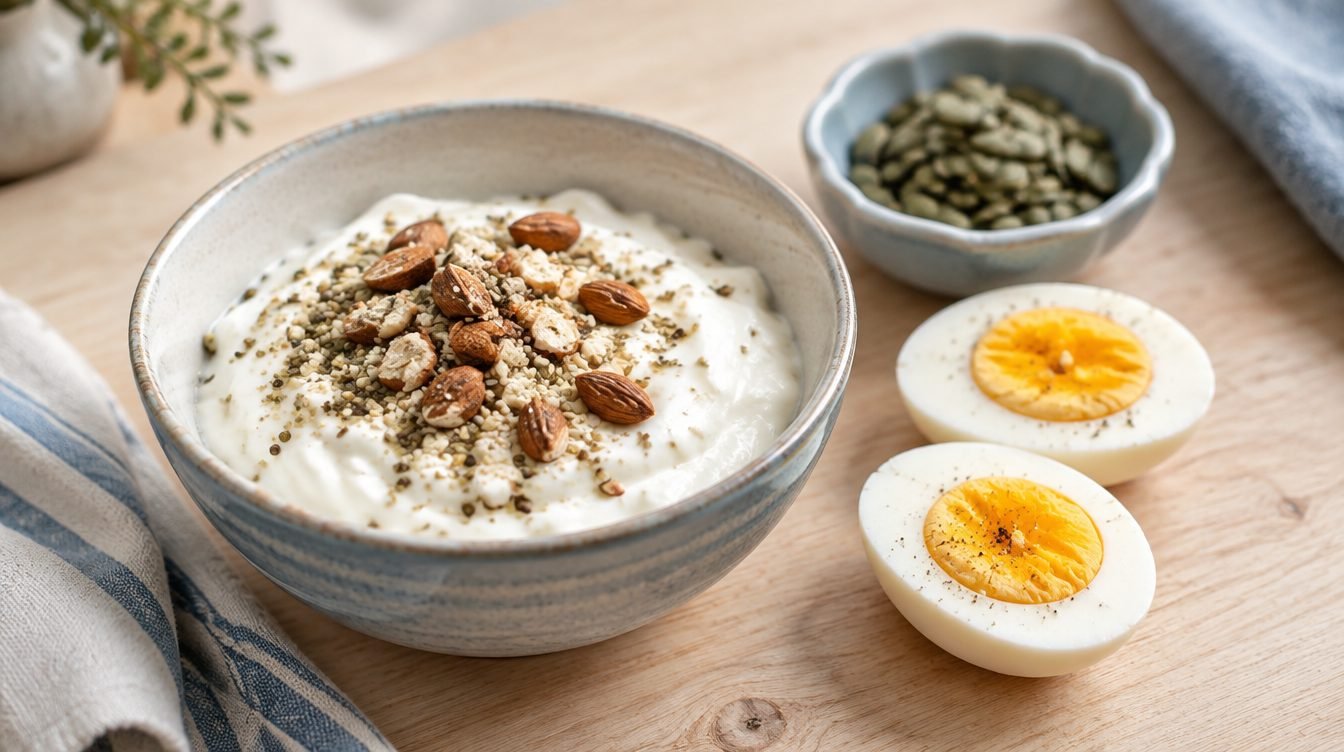
- Breakfast: add fruit, oats or seeds for the fiber yogurt lacks.
- Savory swaps: thick strained yogurt can replace sour cream or cream cheese (Washington State University Extension); Nonfat Greek Yogurt Recipes You Can Make at Home has dishes for the leanest kind.
Dairy Greek yogurt is not an option with a milk allergy (FDA). People with chronic kidney disease may need moderate protein and should set the amount with a dietitian or clinician (NIDDK).
More on Greek yogurt
- Is Greek Yogurt Good for You? What the Evidence Says: the wider health research.
- Homemade Greek Yogurt: What You Need to Know: yield, cost and storage when you strain your own.
- Greek Yogurt Recipes You Can Make at Home: everyday meals with plain Greek yogurt.
- Savory Greek Yogurt Recipes You Can Make at Home: dips, sauces and bowls.
- Dinner Recipes with Greek Yogurt You Can Make at Home: protein-rich main dishes.
Sources
- Yogurt, Greek, plain, nonfat (FDC ID 170894) (USDA FoodData Central)
- Yogurt, Greek, plain, lowfat (FDC ID 170903) (USDA FoodData Central)
- Yogurt, Greek, plain, whole milk (FDC ID 171304) (USDA FoodData Central)
- Yogurt, plain, skim milk (FDC ID 170887) (USDA FoodData Central)
- Yogurt, plain, low fat (FDC ID 170886) (USDA FoodData Central)
- Yogurt, plain, whole milk (FDC ID 171284) (USDA FoodData Central)
- Cheese, cottage, lowfat, 2% milkfat (FDC ID 172182) (USDA FoodData Central)
- Milk, nonfat, fluid, with added vitamin A and vitamin D (FDC ID 171269) (USDA FoodData Central)
- Milk, whole, 3.25% milkfat, with added vitamin D (FDC ID 171265) (USDA FoodData Central)
- 21 CFR 101.12 Reference amounts customarily consumed per eating occasion (Electronic Code of Federal Regulations, National Archives)
- 21 CFR 101.9 Nutrition labeling of food (Electronic Code of Federal Regulations, National Archives)
- 21 CFR 101.54 Nutrient content claims for “good source,” “high,” “more,” and “high potency” (Electronic Code of Federal Regulations, National Archives)
- 21 CFR 131.200 Yogurt (Electronic Code of Federal Regulations, National Archives)
- Milk and Cream Products and Yogurt Products; Final Rule (U.S. Food and Drug Administration, Federal Register, June 11, 2021)
- Goff HD, Hill AR, Ferrer MA. Milk Proteins: Caseins, Casein Micelles, Whey Proteins, Enzymes (Dairy Science and Technology eBook, University of Guelph)
- Wilbanks D. Yogurt Monograph Series: Concentrating Yogurt (Center for Dairy Research, University of Wisconsin–Madison, Dairy Pipeline, Winter 2024)
- Karastamatis S, Zoidou E, Moatsou G, Moschopoulou E. Effect of modified manufacturing conditions on the composition of Greek strained yogurt and the quantity and composition of generated acid whey (Foods, 2022)
- Dietary Reference Intakes: Macronutrients (National Academies of Sciences, Engineering, and Medicine)
- Dietary Guidelines for Americans, 2025–2030 (U.S. Department of Agriculture and U.S. Department of Health and Human Services)
- Moughan PJ, Lim WXJ. Digestible indispensable amino acid score (DIAAS): 10 years on (Frontiers in Nutrition, 2024)
- Mathai JK, Liu Y, Stein HH. Values for digestible indispensable amino acid scores (DIAAS) for some dairy and plant proteins may better describe protein quality than values calculated using the concept for protein digestibility-corrected amino acid scores (PDCAAS) (British Journal of Nutrition, 2017; copy hosted by the University of Illinois)
- Douglas SM, Ortinau LC, Hoertel HA, Leidy HJ. Low, moderate, or high protein yogurt snacks on appetite control and subsequent eating in healthy women (Appetite, 2013, via PubMed)
- Ortinau LC, Culp JM, Hoertel HA, Douglas SM, Leidy HJ. The effects of increased dietary protein yogurt snack in the afternoon on appetite control and eating initiation in healthy women (Nutrition Journal, 2013)
- Bridge A, et al. Greek yogurt and 12 weeks of exercise training on strength, muscle thickness and body composition in lean, untrained, university-aged males (Frontiers in Nutrition, 2019)
- Diether NE, Willing BP. Microbial fermentation of dietary protein: an important factor in diet–microbe–host interaction (Microorganisms, 2019)
- Eating, Diet, & Nutrition for Lactose Intolerance (National Institute of Diabetes and Digestive and Kidney Diseases)
- Marco ML, et al. The International Scientific Association for Probiotics and Prebiotics (ISAPP) consensus statement on fermented foods (Nature Reviews Gastroenterology & Hepatology, 2021)
- 4 Steps to Food Safety (FoodSafety.gov, U.S. Department of Health and Human Services)
- How Temperatures Affect Food (USDA Food Safety and Inspection Service)
- Smith DK. Yogurt Made Simple (Washington State University Extension, distributed by the UC Master Food Preserver Program)
- Food Allergies: What You Need to Know (U.S. Food and Drug Administration)
- Eating Right for Chronic Kidney Disease (National Institute of Diabetes and Digestive and Kidney Diseases)
- The Ultimate Yogurt Guide (eBook), Ultimate Health Solutions, publisher of this site


