Does Canned Sauerkraut Have Probiotics? What the Evidence Says
The verdict: canned sauerkraut has no live probiotics
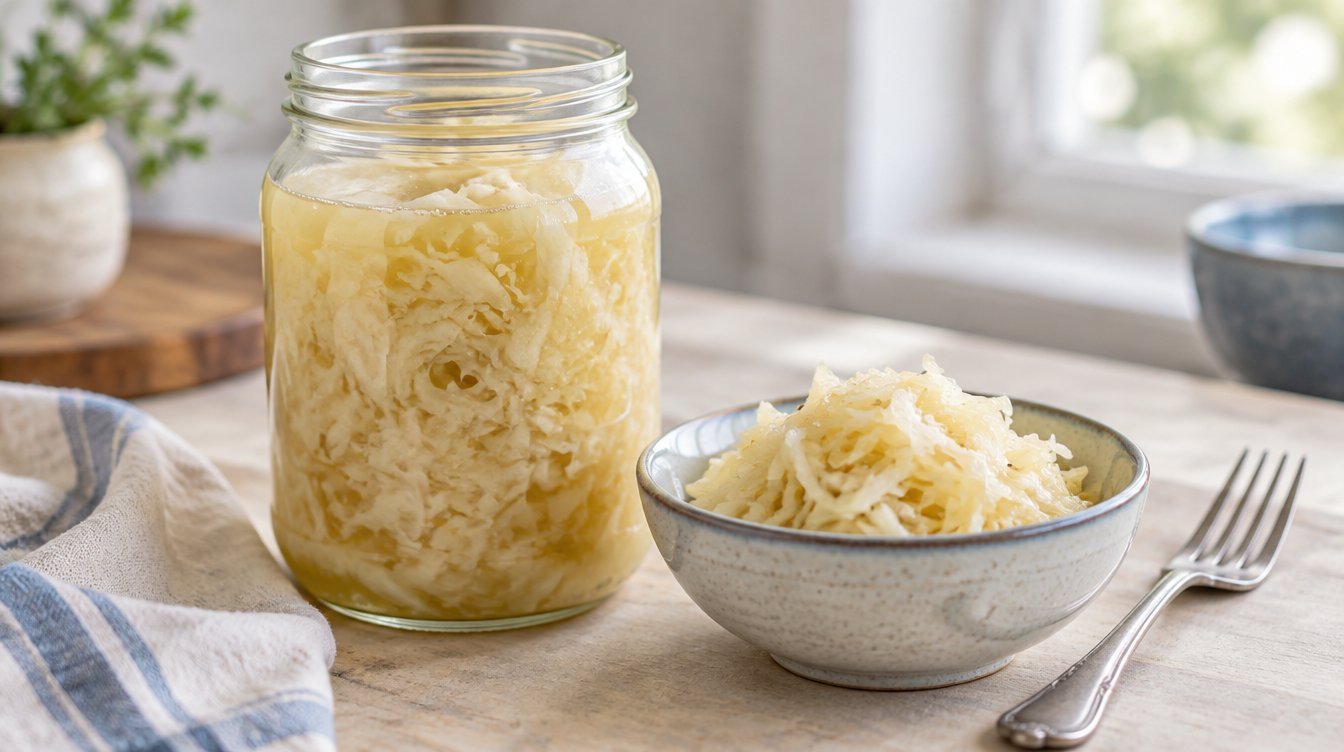
No. Canned and other shelf-stable sauerkraut is heat-processed so it can sit safely at room temperature, and that heat kills the lactic acid bacteria that fermented it. Raw, unpasteurized sauerkraut sold in the refrigerated case still has live bacteria.
Canned kraut still has fiber and some vitamin C, and in two small trials pasteurized sauerkraut changed gut bacteria too. Sodium is the catch with both kinds.
What the research shows
Canning is a heat step
The USDA grade standard for canned sauerkraut describes cabbage and salt “cured by natural fermentation” that may be canned by processing “sufficiently by heat to assure preservation” in sealed containers. It may also be packaged in sealed containers with or without sodium benzoate, a preservative.
The ISAPP consensus statement on fermented foods puts “heat-treated or pasteurized fermented vegetables” in the group with no live microorganisms, while non-heated fermented vegetables keep them. Home canning works the same way: the National Center for Home Food Preservation (NCHFP) processes sauerkraut jars in a boiling-water canner for 10 to 25 minutes at low altitude, depending on jar size and packing method.
Raw sauerkraut has live bacteria, in varying amounts
Cabbage ferments are started by Leuconostoc mesenteroides and then taken over by Lactiplantibacillus species and Levilactobacillus brevis, according to the ISAPP panel. They come from the cabbage itself, so batches differ.
Counts vary widely. A 2026 Ghent University survey of 75 unpasteurized, store-bought fermented vegetables found lactic acid bacteria ranging from under 10 to several hundred million colony-forming units (CFU) per gram. In a 2021 Australian lab study of low-salt sauerkraut, bacteria peaked at 10 to 100 million CFU per gram and fell to about 1 to 3 million by day 96. The authors suggested eating it within 7 weeks for the most live microbes.
Live bacteria aren’t the same as probiotics. A probiotic is a live microbe given in an amount shown to provide a health benefit, as defined in a 2014 expert consensus statement. Raw kraut carries an undefined mix, and the NIH Office of Dietary Supplements notes that not all fermented foods contain probiotics with proven benefits.
Pasteurized sauerkraut still did something in trials
In a 2018 randomized, double-blind pilot study, 34 Norwegian adults with irritable bowel syndrome ate pasteurized (15 people) or unpasteurized (19 people) sauerkraut daily for 6 weeks. Symptom scores improved in both groups, with no significant difference between them. The authors called the study underpowered and suggested the effect owed more to compounds in the cabbage than to live bacteria.
A 2025 crossover trial in Germany gave 87 healthy adults 100 grams a day of fresh or pasteurized sauerkraut for 4 weeks each. Both changed individual bacterial species, with more pronounced changes after pasteurized kraut, which alone raised blood short-chain fatty acids. The authors concluded that healthy gut microbiomes resist short-term diet changes fairly well.
So far, live bacteria haven’t clearly beaten pasteurized kraut in these small trials. For the wider evidence, see fermented foods for gut health.
What canned sauerkraut still provides
Values below are for canned sauerkraut, solids and liquids, from USDA FoodData Central, with percent Daily Values from the FDA.
| Nutrient | Per 1/2 cup (71 g) | Per 1 cup (142 g) |
|---|---|---|
| Calories | 13 | 27 |
| Fiber | 2.1 g (7% DV) | 4.1 g (15% DV) |
| Vitamin C | 10.4 mg (12% DV) | 20.9 mg (23% DV) |
| Sodium | 469 mg (20% DV) | 939 mg (41% DV) |
The FDA counts 20% of the Daily Value or more per serving as high, so a half cup reaches that line. Refrigerated brands differ, so check the label.
Caveats to keep in mind
- MAOI medicines. Mayo Clinic lists sauerkraut among high-tyramine foods that people taking MAOI antidepressants may need to limit. Ask your prescriber.
- Weakened immune systems. NCCIH notes that the risk of harm from live microbes is greater in people with severe illness or a compromised immune system.
- Cold doesn’t always mean raw. A refrigerated bag or jar can still be pasteurized or preserved, so read the label rather than trusting the shelf.
How to choose sauerkraut with live bacteria
- Shop the refrigerated case. Room-temperature cans, jars and pouches have been heat-treated or otherwise preserved.
- Look for label words such as “raw,” “unpasteurized” or “live cultures.” Skip anything marked “pasteurized.”
- Read the ingredients. Raw kraut is usually just cabbage and salt, sometimes with spices. Vinegar means it may be pickled rather than fermented, which ISAPP doesn’t count as a fermented food.
- Keep it cold and eat it within several weeks, since live counts fall during storage.
- Compare sodium per serving on the Nutrition Facts panel. The same label checks apply to pickles.
Making sauerkraut at home
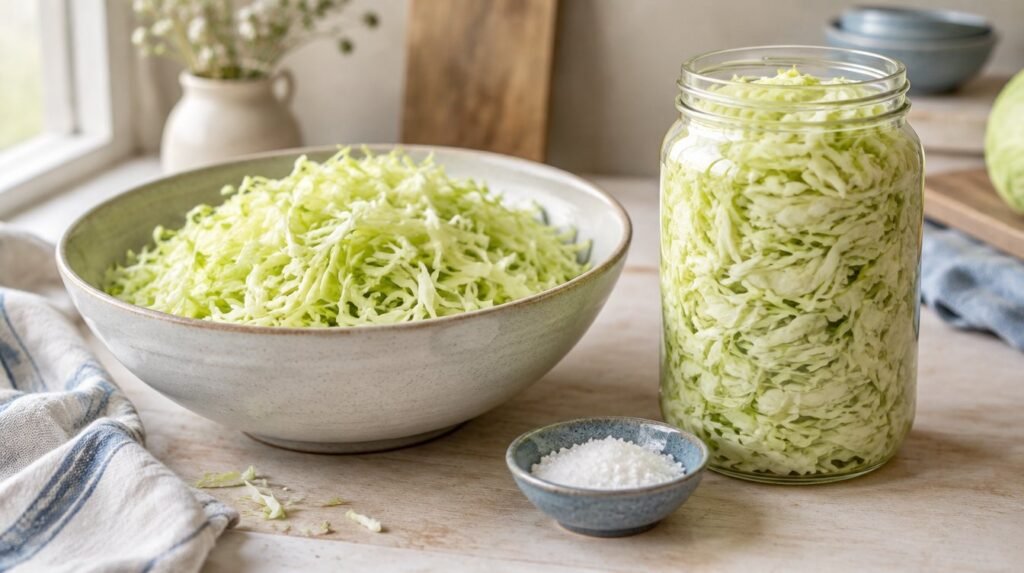
Homemade kraut keeps its live bacteria if you refrigerate it instead of canning it. The NCHFP recipe uses 25 pounds of cabbage and 3/4 cup of canning or pickling salt, mixed in 5-pound batches with 3 tablespoons of salt each, for about 9 quarts.
- Shred, salt and pack the cabbage firmly until juice forms. If the juice doesn’t cover it, add boiled, cooled brine of 1 1/2 tablespoons salt per quart of water (NCHFP).
- Keep the cabbage completely under the brine, covered by 1 to 2 inches, to limit air (Clemson Extension).
- Ferment at 70 to 75°F for about 3 to 4 weeks, or 5 to 6 weeks at 60 to 65°F. Below 60°F it may not ferment, and above 75°F it may turn soft (NCHFP).
- If you use jars as weights, check 2 to 3 times a week and remove any scum (NCHFP).
- Throw out slimy kraut, and discard the batch if there is a large amount of mold. Pink kraut is safe unless it is slimy (Oregon State University Extension).
- Fully fermented kraut keeps for several months, tightly covered, in the refrigerator (NCHFP).
Stick to tested salt amounts. For serving ideas, see the best time to eat sauerkraut.
Frequently asked questions
Does jarred sauerkraut have probiotics?
Only if it is sold refrigerated and labeled raw or unpasteurized. Shelf-stable jars are heat-treated or preserved.
Does cooking sauerkraut kill the probiotics?
Heat kills live bacteria, which is why ISAPP places heat-treated fermented vegetables in the group with no live microorganisms (ISAPP).
Is canned sauerkraut still good for you?
It keeps fiber and some vitamin C, and pasteurized kraut changed gut bacteria in small trials, but a half cup has about 469 mg of sodium.
Does sauerkraut juice have probiotics?
Brine from raw, unpasteurized kraut carries the same live bacteria as the cabbage. Brine from canned kraut does not.
How long does homemade sauerkraut last?
Fully fermented kraut keeps for several months, tightly covered, in the refrigerator (NCHFP).
Related topics
- Do Pickles Have Probiotics?: the same heat question for cucumbers.
- Fermented Foods for Gut Health: what the research says overall.
- Best Time to Eat Sauerkraut for Gut Health: when and how much.
- Probiotic Foods: foods with live cultures.
- Non Dairy Probiotics: live-culture options without milk.
Sources
- United States Standards for Grades of Canned Sauerkraut (USDA Agricultural Marketing Service, 2017)
- Marco ML, et al. The International Scientific Association for Probiotics and Prebiotics (ISAPP) consensus statement on fermented foods (Nature Reviews Gastroenterology & Hepatology, 2021)
- Sauerkraut (National Center for Home Food Preservation, University of Georgia)
- Hill C, et al. Expert consensus document: The International Scientific Association for Probiotics and Prebiotics consensus statement on the scope and appropriate use of the term probiotic (Nature Reviews Gastroenterology & Hepatology, 2014)
- Probiotics: Fact Sheet for Consumers (NIH Office of Dietary Supplements)
- Vermeersch M, et al. Microbiological survey of spontaneous vegetable fermentations: A food safety perspective (International Journal of Food Microbiology, 2026)
- Chan M, et al. Microorganisms in Whole Botanical Fermented Foods Survive Processing and Simulated Digestion to Affect Gut Microbiota Composition (Frontiers in Microbiology, 2021)
- Nielsen ES, et al. Lacto-fermented sauerkraut improves symptoms in IBS patients independent of product pasteurisation: a pilot study (Food & Function, 2018)
- Schropp N, et al. The impact of regular sauerkraut consumption on the human gut microbiota: a crossover intervention trial (Microbiome, 2025)
- Sauerkraut, canned, solids and liquids (FDC ID 169279) (USDA FoodData Central)
- Sodium in Your Diet (U.S. Food and Drug Administration)
- Daily Value on the Nutrition and Supplement Facts Labels (U.S. Food and Drug Administration)
- MAOIs and diet: Is it necessary to restrict tyramine? (Mayo Clinic)
- Probiotics: Usefulness and Safety (National Center for Complementary and Integrative Health)
- Making Sauerkraut (Clemson Cooperative Extension, Home and Garden Information Center)
- Sauerkraut: Problems and solutions (Oregon State University Extension Service)
This article is for general information and is not medical advice. Talk to your doctor or a registered dietitian before changing your diet, supplements or medication, especially if you have a health condition.