How Much Yogurt Starter for a Gallon of Milk? The Complete Answer
How much yogurt starter for a gallon of milk
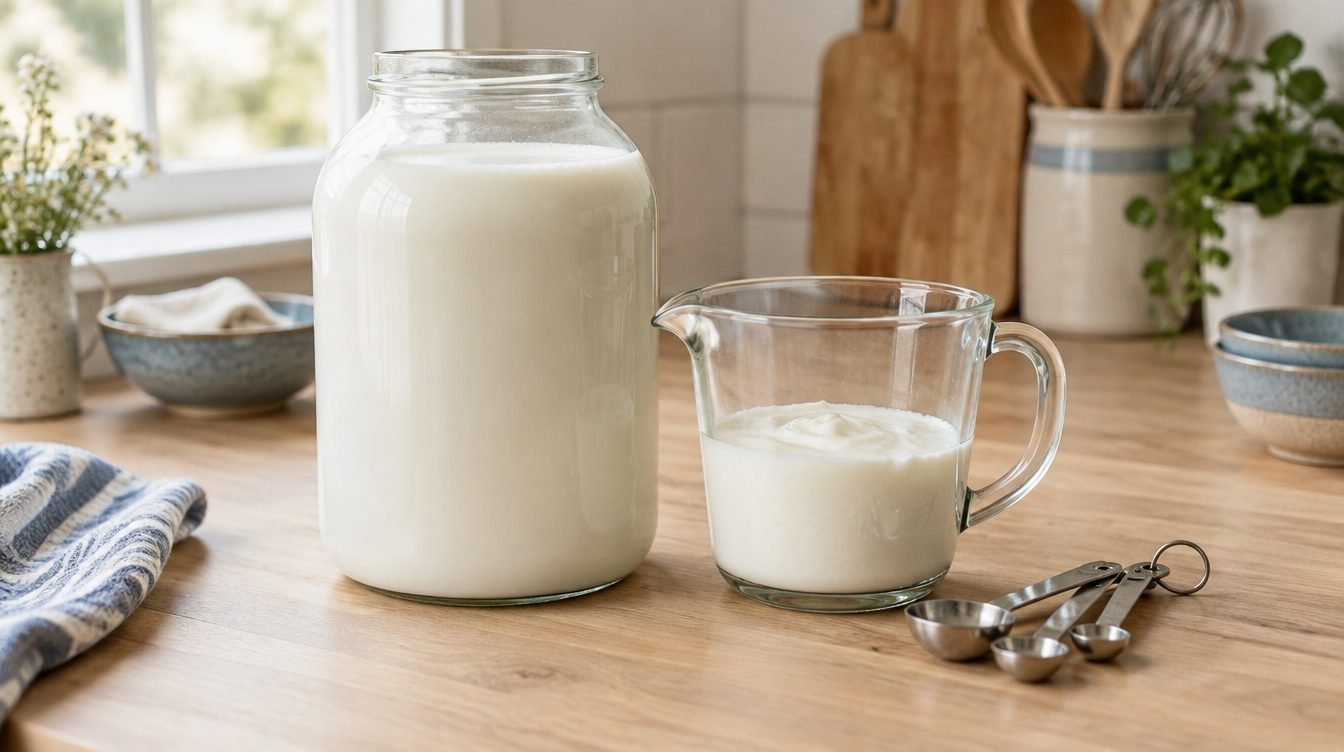
How much yogurt starter for a gallon of milk? Use about 1 cup of plain yogurt with live cultures, the amount most university extension guides give, or as little as ½ cup, the gallon equivalent of 2 tablespoons per quart. For ½ gallon, use ¼ to ½ cup. Freeze-dried starter goes by the package.
These figures all come from one ratio, scaled up. The National Center for Home Food Preservation (NCHFP) and University of Alaska Fairbanks (UAF) Extension use ¼ cup of starter per quart, and UAF’s gallon recipe uses 1 cup. Washington State University (WSU) Extension scales its recipe to ¼ cup for a quart, ½ cup for ½ gallon and 1 cup for a gallon. At the low end, University of Illinois Extension uses 2 tablespoons per quart, and an older University of Kentucky recipe uses 3 tablespoons for ½ gallon.
Whatever the amount, the starter must be alive: NCHFP specifies unflavored yogurt whose label says it contains a live culture, and Illinois Extension advises using it before its best-by date, because fresher starter has more active bacteria. Our yogurt starter guide compares the types.
Yogurt starter amounts for ½ gallon, 1 gallon and 1 quart
| Milk | Plain yogurt as starter | Freeze-dried packets | Capsule ferment (publisher’s method, scaled) |
|---|---|---|---|
| 1 quart (4 cups) | 2 tablespoons to ¼ cup | Generally 1 | The per-quart capsule dose, or 2 tablespoons (1 oz) of the last batch, plus 2 tablespoons inulin |
| ½ gallon (8 cups) | ¼ to ½ cup | Generally 2 | Twice the per-quart dose, or ¼ cup (2 oz) of the last batch, plus ¼ cup inulin |
| 1 gallon (16 cups) | ½ to 1 cup | Generally 4 | Four times the per-quart dose, or ½ cup (4 oz) of the last batch, plus ½ cup inulin |
Freeze-dried starter packets
The packet column assumes packets sized for 1 quart. UAF says to use dry starter according to package directions, generally one 5-gram package per quart, so read the package before multiplying. With only one quart-size packet, you can make a quart first, then use 1 cup of it to start a gallon, the amount UAF says to save for a 1-gallon batch.
Capsule starters, scaled up from the quart
Some home fermenters culture dairy with probiotic capsules instead, in long ferments the extension guides don’t cover. Ultimate Health Solutions, the company that publishes this site, writes its method per quart: the capsule maker’s dose for 1 quart, plus 2 tablespoons of chicory inulin as extra food for the long ferment, fermented for 24 hours at a temperature set by the species, such as 99°F (37°C) for L. reuteri or 109°F (43°C) for L. gasseri. After that, about 1 oz (2 tablespoons) of a finished batch starts the next quart.
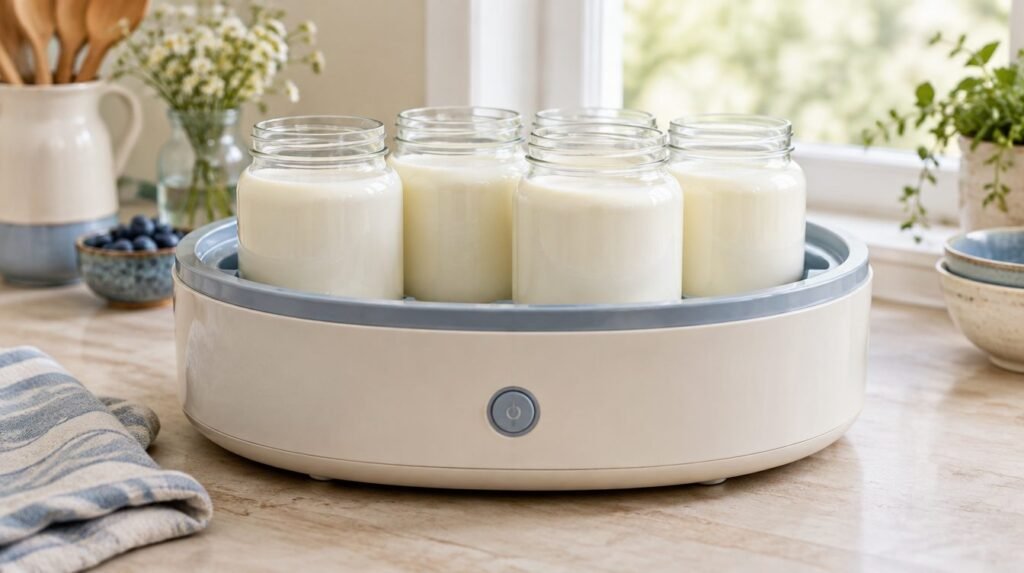
Scaled to a gallon, that is four times the per-quart capsule dose, or about 4 oz (½ cup) of the previous batch, plus ½ cup (8 tablespoons) of inulin; the time stays at 24 hours. This is simple multiplication of the company’s own recommendations, not a separately tested gallon recipe or independent guidance. Because the method is written for jars in a water-bath yogurt maker, a gallon is easiest as four quart jars. The full method is in how to make yogurt starter.
Why more starter isn’t better
Extra starter “for insurance” is tempting, but WSU Extension warns that too much starter can produce a sour taste rather than a pleasant tartness. In one study, extra culture changed speed more than quality: in a 2016 study of plain set yogurt, raising the culture from 2% to 3% of the milk shortened incubation significantly but made no significant difference to texture, whey separation or taste-panel scores. For comparison, 2 tablespoons per quart is about 3% of the milk by volume, and ¼ cup per quart about 6%.
Too little has its own problem. In University of Wisconsin research summarized in a USDA project report, low inoculation rates, like high incubation temperatures, increased whey separation. The aim is enough starter, not extra: pick an amount within the extension range and keep it consistent. If batches stay soft, check freshness and setup first; WSU lists an inactive culture, the wrong temperature and detergent residue as common causes.
How starter amount changes incubation time
More starter means more bacteria making acid from the start; in the 2016 study, acid developed significantly faster at higher culture levels. Yogurt sets firm at about pH 4.6, so a heavier dose gets there sooner. Add more starter but keep the same clock, and the batch sets early and keeps going: hours past the set mean more acid, a tarter flavor and eventually whey separation. Less starter, or older starter, stretches the time instead.
Batch size matters too: Illinois Extension notes that small containers incubate faster than a large one. Extension windows run from 4 to 7 hours at 110°F ± 5°F (43°C ± 3°C) (UAF) to 6 to 10 hours at 108–115°F (42–46°C) (Illinois). Go by the set rather than the clock, as explained in how long to incubate yogurt, and discard any batch that never sets, which UAF says may signal a bad culture or unwanted microorganisms.
Tips for a gallon batch
- Thin the starter first. UAF and Illinois blend it with about 1 cup of the warm milk, then stir that back into the pot.
- Add it at the right temperature. UAF cools the milk to 112–115°F (44–46°C); NCHFP warns that culture added above 115°F (46°C) can be killed.
- Split it into jars. Utah State University Extension pours its gallon batch, made with 1 cup of starter, into pint jars and incubates until the pH reaches 4.6 or lower.
- Save starter for next time. Set aside 1 cup from a gallon batch (UAF) and use it within 5 to 7 days (Illinois).
More on yogurt starters
- Yogurt Starter: What You Need to Know: the main starter types and how they differ.
- How to Make Yogurt Starter: A Step-by-Step Guide: saving, freezing and refreshing starter.
- How to Make Yogurt at Home: A Step-by-Step Guide: the full method, start to finish.
- How to Make Yogurt without Starter: A Step-by-Step Guide: options when you have no packet on hand.
- How to Make Greek Yogurt: A Step-by-Step Guide: straining a big batch into thicker yogurt.
Sources
- Cascio J, Dinstel RR. Making Yogurt at Home (FNH-00062, reviewed 2024), University of Alaska Fairbanks Cooperative Extension Service
- Making Yogurt at Home (2024), University of Illinois Extension
- Smith DK. Yogurt Made Simple, Washington State University Extension (distributed by the UC Master Food Preserver Program)
- Nummer BA. Fermenting Yogurt at Home (2002), National Center for Home Food Preservation (reprint hosted by UC Food Safety, UC Davis)
- Homemade Fermented Yogurt, Utah State University Extension
- Russell-Campbell E, Hicks CL, Maruyama FT. Making Yogurt at Home (IP-36), University of Kentucky Cooperative Extension Service
- Narayana NMNK, Gupta VK. Quality of Plain Set Yoghurt as affected by Levels of Ultrafiltration Concentration of Milk and Inoculum of Yoghurt Culture (2016), Turkish Journal of Agriculture: Food Science and Technology
- Understanding the structure-function relationships that control the rheological and sensory properties of stirred-type yogurt (University of Wisconsin project), USDA National Institute of Food and Agriculture, CRIS project reports
- The Ultimate Yogurt Guide (eBook), Ultimate Health Solutions, publisher of this site