Keto Chia Pudding with Greek Yogurt: What You Need to Know
What keto chia pudding with Greek yogurt is
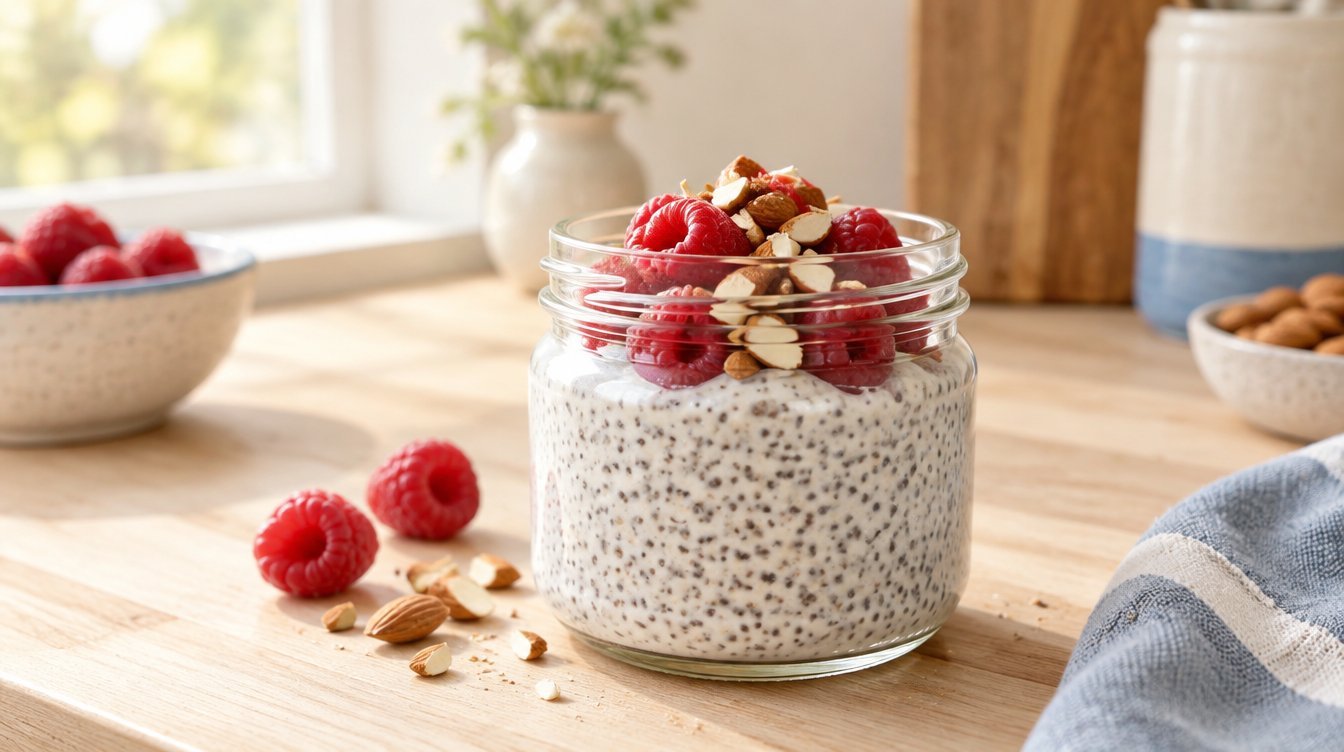
Keto chia pudding with Greek yogurt is a no-cook breakfast or snack. You stir chia seeds into unsweetened almond milk and plain whole-milk Greek yogurt, leave the jar in the fridge, and the seeds swell into a thick, spoonable pudding. No sugar, no oats and no fruit purée means it stays low in carbohydrates.
The thickening comes from the seeds themselves. Chia seeds release mucilage, a gel-forming fiber, when they sit in liquid, which is why food scientists study it as a natural thickener and coating (Fernandes 2023). The Greek yogurt adds protein, tang and a creamier texture than chia and milk alone.
The pudding combines three things a low-carb eater often wants: fiber that barely dents the carb budget, fat for fullness, and a fermented dairy food.
Why it fits a keto plan
A ketogenic diet is far stricter than general low-carb eating. Harvard Health describes it as fewer than 20 to 50 grams of carbohydrates a day, with fat supplying most of the calories. At that level, one serving of oatmeal or a banana can use up a large share of the day.
Keto plans usually count net carbs, meaning total carbohydrates minus fiber. UCLA Health explains that calculation and notes that the FDA doesn’t endorse the net-carb idea, so you won’t see it defined on a Nutrition Facts panel. It is a useful rule of thumb, not an official number.
Using USDA FoodData Central values, here is what one serving of the basic recipe below works out to. These are our calculations from USDA averages, not lab measurements, and your brands will vary.
| Ingredient (amount) | Total carbs | Fiber | Net carbs | Protein | Fat |
|---|---|---|---|---|---|
| Chia seeds (3 tbsp, about 31 g) | 13.3 g | 10.8 g | 2.4 g | 5.2 g | 9.7 g |
| Plain whole-milk Greek yogurt (½ cup, about 122 g) | 5.8 g | 0 g | 5.8 g | 10.8 g | 5.4 g |
| Unsweetened almond milk (½ cup, about 131 g) | 1.7 g | 0.3 g | 1.5 g | 0.5 g | 1.3 g |
| Raspberries (¼ cup, about 31 g) | 3.7 g | 2.0 g | 1.7 g | 0.4 g | 0.2 g |
| Total | 24.5 g | 13.1 g | 11.4 g | 16.9 g | 16.5 g |
Two things stand out. Chia seeds are mostly fiber, so 3 tablespoons add only about 2 grams of net carbs. The yogurt, not the chia, is the biggest net-carb source, because milk sugar remains after straining. If you are aiming near 20 grams a day, use a little less yogurt or skip the berries. The full serving is about 300 calories.
What it may do for your gut
Fiber is the first point. One serving supplies about 11 grams from the chia alone. Mayo Clinic lists daily targets of 21 to 25 grams for women and 30 to 38 grams for men, depending on age. A strict keto plan cuts out many high-fiber foods, and Harvard Health lists constipation as a common problem, so chia is one of the easier ways to keep some fiber in.
The yogurt is the second point. In a 17-week trial in 36 healthy adults, a diet high in fermented foods such as yogurt, kefir and kimchi steadily increased gut microbiome diversity and lowered several inflammatory markers (Wastyk 2021). It was a small study and didn’t test chia pudding, but it supports adding fermented foods to your week. The 2025–2030 Dietary Guidelines also name fermented and high-fiber foods as supportive of a diverse microbiome.
There is a caution on keto itself. In an 8-week inpatient study of 17 men, a ketogenic diet shifted the gut microbiome and lowered bifidobacteria, a group of bacteria often seen as beneficial (Ang 2020). What that means for long-term health isn’t known, but it is one more reason to keep fiber and fermented foods in a low-carb diet.
As for chia itself, the human evidence is thin. A review of 12 randomized trials found mostly no significant effects, with some lower blood sugar after meals at higher doses, and rated the overall evidence low or very low (Teoh 2018). Treat chia as a good source of fiber and plant omega-3 fat, not a remedy.
A basic recipe

Makes 1 serving. Prep time is 5 minutes, plus at least 4 hours or overnight in the fridge.
- 3 tablespoons chia seeds
- ½ cup plain whole-milk Greek yogurt
- ½ cup unsweetened almond milk (or more for a thinner pudding)
- ¼ teaspoon vanilla extract and a pinch of cinnamon
- Sweetener to taste (optional)
- ¼ cup raspberries or a few chopped nuts for the top (optional)
- Whisk the yogurt, almond milk and vanilla in a jar or bowl until smooth.
- Stir in the chia seeds and cinnamon. Wait 5 minutes, then stir again to break up clumps, since the seeds tend to settle and stick together.
- Cover and refrigerate for at least 4 hours, or overnight, until thick.
- Stir before serving. If it is too thick, loosen it with a splash of almond milk. Add the toppings just before eating.
If you are new to chia, start with 1 tablespoon and build up. Mayo Clinic advises adding fiber slowly over a few weeks, because adding too much too quickly can cause gas, bloating and cramping, and drinking plenty of water.
How to choose the ingredients
- Yogurt: pick plain, unsweetened Greek yogurt. Flavored versions usually contain added sugar, so check the Added Sugars line on the label. Whole-milk yogurt suits keto because it carries more fat, and the Dietary Guidelines now say to include full-fat dairy with no added sugars. See our guide to which yogurts contain live cultures.
- Milk: unsweetened almond or other nut milk keeps carbs low. Whole cow’s milk works but adds about 6 grams of carbohydrate per half cup, so it changes the math.
- Sweetener: many keto recipes use stevia or monk fruit. The Dietary Guidelines don’t recommend added sugars or non-nutritive sweeteners as part of a healthy diet, so try vanilla, cinnamon and berries first and add sweetener only if you need it.
- Toppings: berries, unsweetened coconut, toasted nuts, cacao nibs or a spoon of nut butter. Skip granola and dried fruit, which are high in carbs.
- Ratio: roughly 3 tablespoons of chia per cup of total liquid and yogurt gives a firm pudding. Use 2 tablespoons for a softer, drinkable texture.
For more ideas built on the same base, see our keto Greek yogurt recipes, or read what Greek yogurt is and how it differs from regular yogurt.
Making the Greek yogurt yourself
Homemade Greek yogurt gives you full control over the milk and the tang. The University of Illinois Extension method heats milk to 180 to 185°F, cools it to 108 to 115°F, adds a few spoonfuls of yogurt with live cultures, and incubates it at 108 to 115°F for 6 to 10 hours. For Greek-style yogurt, it drains the chilled yogurt in the fridge for 2 to 4 hours.
Longer straining removes more whey and gives a thicker yogurt that holds chia pudding together well. Our step-by-step guide on how to make Greek yogurt covers the details, and the leftover whey has uses of its own in recipes using whey from yogurt.
Storage and safety
Keep chia pudding covered in the fridge at 40°F or below. USDA guidance on leftovers is to refrigerate within 2 hours and eat within 3 to 4 days, a sensible limit for a mixed dish like this.
Let the seeds soak fully before eating, and add toppings just before serving so nuts stay crunchy and berries don’t weep into the pudding. If you have a medical condition or take medication for blood sugar, talk with your doctor before starting a ketogenic diet; Harvard Health also advises talking with a doctor and a dietitian before trying one.
Related topics
- Keto Greek Yogurt Recipes You Can Make at Home: more low-carb ideas with the same yogurt.
- How to Make Greek Yogurt: strain your own for the thickest pudding.
- Greek Yogurt Protein: how much protein each style carries.
- Fermented Foods for Gut Health: where yogurt fits among other fermented foods.
- Gut Healthy Breakfast: more breakfast options with fiber and live cultures.
Sources
- Chia seeds (USDA FoodData Central, FNDDS)
- Yogurt, Greek, whole milk, plain (USDA FoodData Central, FNDDS)
- Beverages, almond milk, unsweetened, shelf stable (USDA FoodData Central, SR Legacy)
- Raspberries, raw (USDA FoodData Central, SR Legacy)
- Milk, whole, 3.25% milkfat, with added vitamin D (USDA FoodData Central, SR Legacy)
- Should you try the keto diet? (Harvard Health Publishing)
- Net carbs are carbs minus fiber and sugar alcohols (UCLA Health, 2022)
- Dietary fiber: Essential for a healthy diet (Mayo Clinic)
- Fernandes SS, et al. Chia mucilage carrier systems: A review of emulsion, encapsulation, and coating and film strategies (Food Research International, 2023)
- Wastyk HC, et al. Gut-microbiota-targeted diets modulate human immune status (Cell, 2021)
- Ang QY, et al. Ketogenic diets alter the gut microbiome resulting in decreased intestinal Th17 cells (Cell, 2020)
- Teoh SL, et al. Clinical evidence on dietary supplementation with chia seed (Salvia hispanica L.): a systematic review and meta-analysis (Nutrition Reviews, 2018)
- Dietary Guidelines for Americans, 2025–2030 (U.S. Department of Health and Human Services and U.S. Department of Agriculture)
- Making Yogurt at Home (University of Illinois Extension)
- Leftovers and Food Safety (USDA Food Safety and Inspection Service)