Kefir Smoothie: What You Need to Know
What a kefir smoothie is
A kefir smoothie uses kefir, a fermented milk drink, as the liquid base in place of milk or yogurt. Because kefir is already pourable, you need little or no extra liquid, and the finished drink is tangier and thinner than a yogurt smoothie. Kefir is one of the fermented foods the 2025-2030 Dietary Guidelines name as supporting a diverse gut microbiome.
Ultimate Gut is published by Ultimate Health Solutions, which sells a yogurt maker, probiotic capsules and an inulin fiber supplement. None of the products reviewed here are ours, and these brands don’t pay us.
Kefir vs yogurt as a smoothie base
Kefir typically has a slightly viscous texture with a tart, acidic flavor, low levels of alcohol and sometimes slight fizz, according to a 2016 review in Frontiers in Microbiology. Traditional kefir is made with kefir grains, which hold a community of lactic acid bacteria and yeasts; the review notes that a large yeast population sets kefir apart from many other fermented dairy foods.
Yogurt, by contrast, is defined in federal rules by two characterizing cultures, Lactobacillus delbrueckii subsp. bulgaricus and Streptococcus thermophilus, though many brands add more. Store-bought kefir lists its own cultures: Lifeway’s plain lowfat kefir page, for example, says it has 12 live and active cultures without naming them on the page. So kefir usually carries more types of microbes, but the count depends on the product.
| Kefir base | Yogurt base | |
|---|---|---|
| Texture | Thin, pourable | Thick, spoonable |
| Flavor | Tart, sometimes slightly fizzy | Milder tang |
| Microbes | Bacteria, plus yeasts in traditional kefir | Two required bacteria, often more added |
| Protein per cup (USDA) | 9.2 g (lowfat, plain) | 8.5 g (whole milk, plain) |
| Extra liquid needed | Usually none | Often 1/4 to 1/2 cup |
If you want a thick, spoonable drink, a yogurt base still wins; our yogurt smoothie guide covers it. Kefir wins on ease and drinkability, and usually on microbial variety.
Ratios that work
- Base: 1 cup plain kefir to 1 to 1 1/2 cups frozen fruit. No ice or extra liquid needed.
- Thicker: add 1/2 frozen banana, 2 tablespoons rolled oats, 1 tablespoon chia seeds (let it sit 5 minutes), or 1/4 cup plain Greek yogurt.
- Thinner or milder: swap up to 1/2 cup of the kefir for milk or water.
- Sweetness: taste before adding any honey or maple syrup; ripe fruit is often enough to balance the tang.
Blend 30 to 60 seconds, until smooth. For more ways to work kefir into your day, see how to drink kefir.
Five kefir smoothie combinations
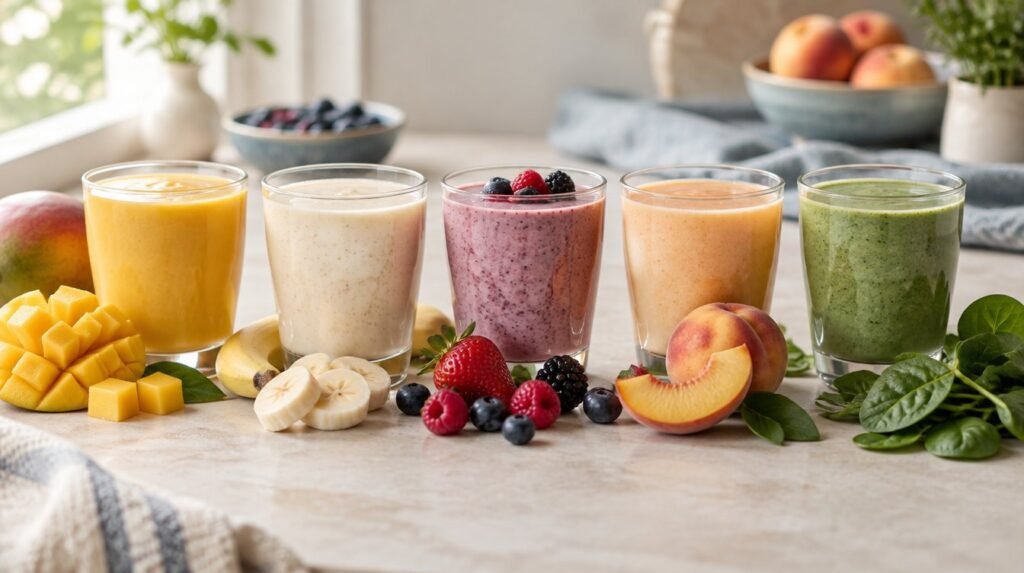
Each one starts with 1 cup plain kefir and makes one large glass.
| Combination | Add to 1 cup plain kefir | Tip |
|---|---|---|
| Cherry cocoa | 1 cup frozen dark sweet cherries, 1 tablespoon unsweetened cocoa powder, 1/2 frozen banana | Cocoa softens the sour edge |
| Mango lime | 1 cup frozen mango, juice of 1/2 lime, 2 tablespoons rolled oats | Oats add body to a thin blend |
| Peanut butter banana | 1 frozen banana, 1 tablespoon peanut butter, a pinch of cinnamon | The thickest of the five |
| Green apple ginger | 1 cup spinach, 1/2 cored apple, 1/2 frozen banana, 1 teaspoon grated fresh ginger | Blend the greens with the kefir first |
| Mixed berry chia | 1 cup frozen mixed berries, 1 tablespoon chia seeds, 1 teaspoon honey (optional) | Rest 5 minutes to thicken |
For combinations built around fiber, with fiber totals for each glass, see our gut health smoothie guide.
Kefir nutrition per cup
USDA FoodData Central has one detailed entry for plain kefir, and it is a single brand: Kefir, lowfat, plain, LIFEWAY. Other brands, whole-milk kefir and goat-milk kefir will differ. Values below are calculated for one cup (243 g).
| Nutrient | Per cup (243 g) |
|---|---|
| Calories | 104 |
| Protein | 9.2 g |
| Fat | 2.5 g |
| Carbohydrate | 11.6 g |
| Total sugars | 11.2 g |
| Lactose | 9.0 g |
| Calcium | 316 mg |
| Potassium | 399 mg |
| Vitamin D | 2.4 mcg |
| Sodium | 97 mg |
| Fiber | 0 g |
The brand’s current label for plain lowfat kefir is close: 110 calories, 10 grams of protein and 9 grams of total sugars per 1-cup (240 mL) serving, with 0 grams added sugars (label checked October 2026). For what the research says about drinking it, see kefir benefits.
Watch the added sugar in flavored kefir
Flavored kefir can double the sugar before you add any fruit. Lifeway’s Lowfat Strawberry Kefir label lists 140 calories, 18 grams of total sugars and 8 grams of added sugars per cup, with cane sugar as the second ingredient. The plain lowfat version lists 9 grams of total sugars and none added. Both labels were checked in October 2026.
Starting with plain kefir and letting fruit sweeten the blend keeps the sugar in your control. Our kefir brand comparison covers more labels.
Kefir and lactose
Kefir still contains lactose, about 9 grams per cup in the USDA entry. Even so, it may be easier to handle than milk for some people. In a 2003 study by Hertzler and Clancy, 15 adults with lactose maldigestion drank test meals each containing 20 grams of lactose as milk, plain or raspberry kefir, or plain or raspberry yogurt.
Breath hydrogen, a marker of undigested lactose, was about 60 percent lower after plain kefir than after milk, and flavored kefir fell in between. All the kefirs and yogurts cut the reported severity of gas by 54 to 71 percent compared with milk. It was a small, single-meal study, so it shows what happened after one serving, not over weeks.
The National Institute of Diabetes and Digestive and Kidney Diseases notes that many people with lactose intolerance can have about 12 grams of lactose, the amount in about 1 cup of milk, with no or mild symptoms. If kefir doesn’t agree with you, see a doctor when gas or other digestive symptoms are frequent, change suddenly, or come with abdominal pain, diarrhea, constipation or weight loss. This is general information, not medical advice. People who should be careful with kefir are covered in dangers of kefir.
How to store kefir and kefir smoothies
- The bottle: keep it in a refrigerator at 40°F (4°C) or below. USDA says most date labels are about quality, not safety, and spoiled food develops an off odor, flavor or texture. Kefir is sour by nature, so judge against how it usually tastes and discard it if you see mold.
- A blended smoothie: refrigerate within 2 hours, or 1 hour if it is above 90°F, such as outdoors in summer. USDA’s general rule for leftovers is 3 to 4 days in the fridge, but smoothies taste best the same day. Separation is normal; shake or stir before drinking.
- Freezing: pour extra into ice pop molds or ice cube trays. USDA says frozen leftovers stay safe but lose quality over time, and suggests 3 to 4 months for frozen leftovers.
Related topics
- Greek Yogurt Smoothie: the thick, high-protein alternative.
- Can you Make a Smoothie without Yogurt?: kefir and other substitutes compared.
- Fermented Foods for Gut Health: other ways to eat fermented foods.
- Probiotic Drinks: how kefir compares with other cultured drinks.
Sources
- Bourrie BC, et al. The microbiota and health promoting characteristics of the fermented beverage kefir (Frontiers in Microbiology, 2016)
- Hertzler SR, Clancy SM. Kefir improves lactose digestion and tolerance in adults with lactose maldigestion (Journal of the American Dietetic Association, 2003)
- 21 CFR 131.200: Yogurt (Electronic Code of Federal Regulations)
- Kefir, lowfat, plain, LIFEWAY (FDC ID 170904) (USDA FoodData Central)
- Yogurt, plain, whole milk (FDC ID 171284) (USDA FoodData Central)
- Lowfat Plain Kefir: product page and Nutrition Facts (Lifeway Foods, checked October 2026)
- Lowfat Strawberry Kefir: product page and Nutrition Facts (Lifeway Foods, checked October 2026)
- Dietary Guidelines for Americans, 2025-2030 (U.S. Department of Agriculture and U.S. Department of Health and Human Services)
- Eating, Diet, & Nutrition for Lactose Intolerance (National Institute of Diabetes and Digestive and Kidney Diseases)
- Symptoms & Causes of Gas in the Digestive Tract (National Institute of Diabetes and Digestive and Kidney Diseases)
- Cold Food Storage Chart (FoodSafety.gov)
- Food Product Dating (USDA Food Safety and Inspection Service)
- Leftovers and Food Safety (USDA Food Safety and Inspection Service)