How to Drink Kefir: A Step-by-Step Guide
How to drink kefir: the short answer
Start with a small glass of plain, cold kefir once a day and increase slowly over a week or two as your gut adjusts. Drink it at whatever time of day you will stick with, since no good evidence points to a best time. Keep it cold, because heat kills the live cultures, and choose plain over sweetened when you can.
The steps below cover how much kefir per day to start with, when to drink kefir, easy ways to use it, how to pick a bottle and how to store it once it’s open.
Step 1: Start small and build up
There is no official serving size for kefir. Stanford Medicine’s nutrition program advises people new to fermented foods to start slowly with small amounts of foods like yogurt or kefir, begin with one serving per day and increase over time, because too much too quickly can cause bloating, gas and discomfort (Stanford Medicine). A Cleveland Clinic dietitian gives the same advice for kefir and says an adjustment period with gas and bloating is common (Cleveland Clinic).
A practical way to follow that advice:
- Begin with a small glass, such as a quarter to half cup, once a day.
- Keep that amount for several days and notice how your stomach feels.
- If you feel fine, increase gradually toward a full cup.
- If gas or bloating bothers you, drop back to the last amount that felt comfortable and hold there longer.
How much kefir per day did studies use?
Research amounts are useful context, but they aren’t a prescription:
- In a Mayo Clinic safety study in 54 critically ill adults, staff gave kefir in escalating doses: 60 mL (about a quarter cup), then 120 mL 12 hours later, then 240 mL (about one cup) daily (Gupta et al., 2024).
- In a randomized trial of 65 healthy young adults, the kefir group drank 250 mL of lactose-free kefir daily for 6 weeks. Gastrointestinal symptoms decreased, but immune and inflammation markers did not improve, and the authors noted the small sample (Bakırhan et al., 2026).
- Lifeway, a kefir maker, suggests one to two 8-ounce servings a day while noting that people react differently (Lifeway FAQ). That is the company’s suggestion, not a research finding.
For most people, about one cup a day is a reasonable target once you have built up to it. More isn’t proven to be better.
Step 2: Pick a time you will stick with
No human trial has tested whether kefir works better in the morning, at night, with food or on an empty stomach. Any article that names a single best time is going beyond the evidence.
The closest research is a lab study using a model of the human stomach and upper gut. Probiotic bacteria from a capsule survived best when given with a meal or 30 minutes before one, and survival was better in 1% milk than in apple juice or spring water (Tompkins et al., 2011). It was a lab model, it tested a capsule rather than kefir, and the authors worked for a probiotic company. Kefir is already a milk drink, so it may not apply in the same way.
In practice, pairing kefir with a regular meal such as breakfast makes it easy to remember. If it makes you gassy, drinking it earlier in the day means any effects show up while you’re awake rather than at bedtime.
Step 3: Choose how to drink it
Plain and cold
Pour it into a glass straight from the fridge. Plain kefir tastes tart and slightly fizzy. If that is too sharp at first, stir in a little fruit or cinnamon rather than reaching for a sweetened bottle.
In smoothies
Cleveland Clinic suggests blending kefir into smoothies (Cleveland Clinic). Use it in place of milk or yogurt with frozen fruit and a handful of greens. Our Greek yogurt smoothie recipes work with kefir swapped in for part of the yogurt.
Over cereal or in overnight oats
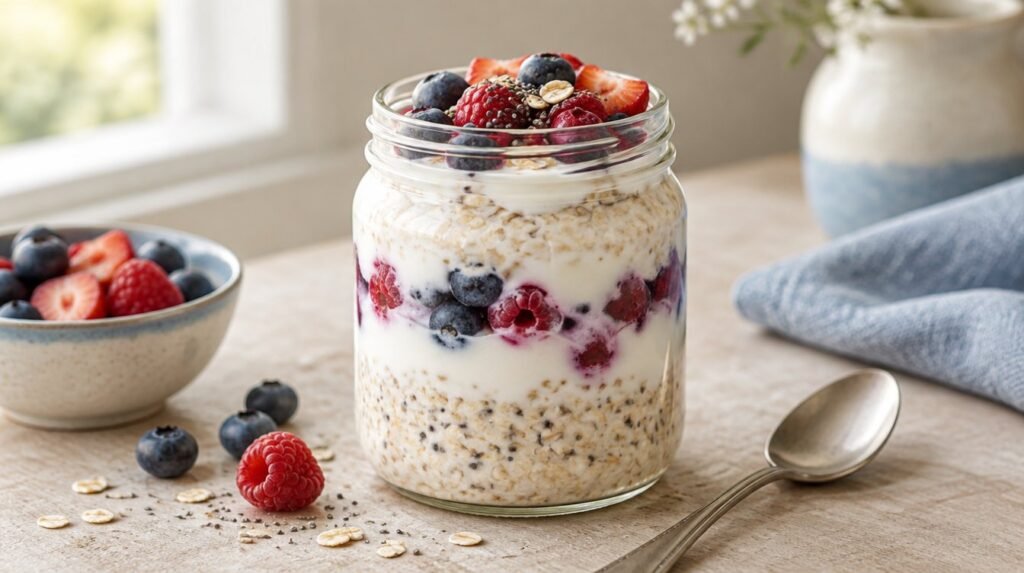
Pour kefir over cereal instead of milk, or add a small amount to overnight oats (Cleveland Clinic). Mix oats, kefir and fruit in a jar at night and eat it cold in the morning.
In dressings and cold soups
Kefir can replace milk in cold soups and salad dressings (Cleveland Clinic). Whisk it with lemon juice, garlic, herbs and salt for a ranch-style dressing, or use it as a base like our Greek yogurt dressing.
What about cooking with kefir?
You can bake with kefir, but don’t count on the cultures surviving. Lifeway says many of the probiotic bacteria won’t survive being cooked (Lifeway FAQ), and Cleveland Clinic advises keeping kefir to cold recipes if you want the live bacteria (Cleveland Clinic). Federal rules for yogurt even allow heat treatment after culturing to inactivate the microbes, and such yogurt must be labeled “does not contain live and active cultures” (21 CFR 131.200).
Use kefir in pancakes or muffins for tang and texture, and get your live cultures from a cold glass.
Step 4: Choose the right kefir
Plain kefir has only the sugar left from the milk. Flavored kefir adds more. Two Lifeway labels show the gap (labels checked October 2026):
| Lifeway kefir (1 cup) | Calories | Total sugars | Added sugars | Source |
|---|---|---|---|---|
| Lowfat Plain | 110 | 9 g | 0 g | Lifeway product page |
| Lowfat Strawberry | 140 | 18 g | 8 g | Lifeway product page |
The FDA Daily Value for added sugars is 50 grams a day on a 2,000-calorie diet (FDA). Cleveland Clinic advises picking lower-sugar options or sticking to plain (Cleveland Clinic).
- Live cultures: most bottles say they contain live cultures but don’t name strains or give a count. Lifeway’s plain kefir lists “12 Live and Active Probiotic Cultures” with no names or numbers (Lifeway). The NIH ODS notes that some products give counts only at the time of manufacture and that counts can decline over time (NIH ODS).
- Pasteurized milk: choose kefir made from pasteurized milk. The CDC warns that products made from raw milk can carry germs such as Listeria, E. coli and Salmonella (CDC).
- Lactose: in a small study of adults with lactose maldigestion, kefir was better tolerated than milk containing the same amount of lactose (Hertzler and Clancy, 2003). Lactose-free kefir is also available (UF/IFAS Extension).
Our best kefir brands guide compares more labels side by side.
Step 5: Store it right after opening
- Keep it cold: the FDA advises keeping your refrigerator at or below 40°F (4°C) (FDA). For homemade kefir, UF/IFAS advises refrigerating at 41°F or below after fermentation (UF/IFAS Extension).
- Don’t leave it out: the FDA says refrigerated foods shouldn’t sit at room temperature for more than two hours, or one hour above 90°F (FDA).
- Use it by the date: Lifeway says its kefir stays fresh after opening until the printed sell-by date, and recommends drinking it before then for the most probiotics (Lifeway FAQ). Other brands may differ, so check the label.
- Freezing: Lifeway doesn’t recommend freezing kefir in the bottle because it separates. It suggests freezing it in ice cube trays and blending the cubes into drinks (Lifeway FAQ).
- When to throw it out: USDA says to discard moldy yogurt and sour cream because mold can spread below the surface (USDA FSIS). Treat kefir the same way, and if it looks or smells questionable, throw it out (FDA).
For more on cold storage of cultured dairy, see what temperature yogurt needs to be stored at.
Who should be careful
Kefir is a food, but it still isn’t right for everyone. The NIH ODS says probiotics may cause bacterial infections in people who are seriously ill or have weak immune systems (NIH ODS), and NCCIH advises anyone with a serious underlying health condition to talk with a health care provider (NCCIH). Mayo Clinic notes that fermented drinks such as kefir may have higher tyramine levels, which matters for people taking MAOI antidepressants (Mayo Clinic). Dairy kefir also isn’t suitable for people with a cow’s milk allergy (UF/IFAS Extension).
Our article on the dangers of kefir covers these groups, alcohol in home ferments and when to see a doctor. This guide is general information, not medical advice.
Frequently asked questions
Can I drink kefir every day?
Many people do, and one 6-week trial had healthy adults drink 250 mL daily (Bakırhan et al., 2026). Build up slowly and stop or cut back if it upsets your stomach.
Should I drink kefir on an empty stomach?
There is no good evidence that an empty stomach helps. Drink it at a time that suits you, such as with breakfast.
Does heating kefir kill the probiotics?
Yes. Lifeway says many of its probiotic bacteria won’t survive cooking (Lifeway FAQ), so use cold recipes when you want live cultures.
How long does kefir last after opening?
Keep it refrigerated at or below 40°F and use it by the date on the bottle. Throw it out if it shows mold or smells off.
Is kefir better than yogurt?
Neither is proven better for gut health. Kefir grains carry lactic acid bacteria, acetic acid bacteria and yeast, while yogurt is usually made with two bacteria (UF/IFAS Extension).
Related topics
- Dangers of Kefir: side effects, raw-milk risks and who should ask a doctor first.
- Best Kefir Brands: labels compared for sugar, cultures and fat.
- Fermented Foods for Gut Health: the research on fermented foods as a group.
- Gut Health Drinks: how kefir compares with kombucha, prebiotic sodas and probiotic shots.
- Greek Yogurt Smoothie: recipes that also work with kefir.
Sources
- How to Start Eating Fermented Foods (Stanford Medicine)
- 7 Benefits That Prove Kefir Is Good for You (Cleveland Clinic)
- Gupta VK, et al. Safety, feasibility, and impact on the gut microbiome of kefir administration in critically ill adults (BMC Medicine, 2024)
- Bakırhan H, et al. Effects of kefir consumption on gastrointestinal health, biochemical parameters, sleep, and mental well-being in healthy young adults: a randomized controlled trial (Journal of Nutrition, 2026)
- Tompkins TA, et al. The impact of meals on a probiotic during transit through a model of the human upper gastrointestinal tract (Beneficial Microbes, 2011)
- Hertzler SR, Clancy SM. Kefir improves lactose digestion and tolerance in adults with lactose maldigestion (Journal of the American Dietetic Association, 2003)
- Frequently Asked Questions (Lifeway Kefir)
- Lowfat Plain Kefir (Lifeway Kefir product page)
- Lowfat Strawberry Kefir (Lifeway Kefir product page)
- 21 CFR 131.200 Yogurt (Electronic Code of Federal Regulations)
- Added Sugars on the Nutrition Facts Label (U.S. Food and Drug Administration)
- Probiotics: Fact Sheet for Consumers (NIH Office of Dietary Supplements)
- Probiotics: Usefulness and Safety (NCCIH)
- Raw Milk (Centers for Disease Control and Prevention)
- Skinner JR. Fermented Foods: Kefir (UF/IFAS Extension, EDIS FS457, 2024)
- Are You Storing Food Safely? (U.S. Food and Drug Administration)
- Molds on Food: Are They Dangerous? (USDA Food Safety and Inspection Service)
- MAOIs and diet: Is it necessary to restrict tyramine? (Mayo Clinic)