Baking with Plain Yogurt: What You Need to Know
Baking with plain yogurt: what it does in a batter
Baking with plain yogurt works because yogurt is a moist, acidic dairy ingredient. Its acid reacts with baking soda to make the gas that lifts a batter, and its water and milk fat keep the crumb moist. It can stand in for buttermilk cup for cup, but few, if any, of its live cultures survive the oven.
This page covers regular, unstrained plain yogurt. Greek yogurt has less water and more protein (USDA), so it behaves differently; see Baking with Greek Yogurt: What You Need to Know.
An acid that activates baking soda
Baking soda needs an acid to make the carbon dioxide that lifts a batter, and University of Illinois Extension and Iowa State University Extension both name yogurt as one. Its cultures ferment milk sugar into lactic acid (Allam et al., 2023), and the federal standard requires yogurt to reach a pH of 4.6 or lower (21 CFR 131.200).
Substitution charts show how much soda yogurt can balance: ¼ teaspoon of baking soda plus ½ cup of yogurt, buttermilk or sour milk can replace 1 teaspoon of baking powder, with ½ cup less of the recipe’s other liquid (NDSU Extension, Colorado State University Extension). That works out to about ½ teaspoon of soda per cup of yogurt.
Moisture in a thicker form
Yogurt is thick, but not dry. USDA lists 87.9 g of water per 100 g of plain whole-milk yogurt and 88.1 g for whole milk. The thickness comes from milk protein: as the cultures acidify the milk, casein coagulates at about pH 4.6 to 4.7 and sets into a gel (Allam et al.). A cup of yogurt brings about as much water as a cup of milk, but makes a stiffer batter.
Fat and tenderness
Fat is the ingredient that helps make quick breads tender (Mississippi State University Extension). Whole-milk yogurt has about as much fat as whole milk and far less than sour cream, so it adds moisture and tang rather than richness. Extension guides use it to replace part of the oil or butter in a recipe (University of Missouri Extension).
| Ingredient (1 cup) | Water (g) | Fat (g) | Calories |
|---|---|---|---|
| Whole milk | 215 | 7.9 | 149 |
| Plain whole-milk yogurt | 215 | 8.0 | 149 |
| Plain low-fat yogurt | 208 | 3.8 | 154 |
| Sour cream | 168 | 44.6 | 455 |
Calculated from USDA per-100 g values and cup weights; brands vary.
Why it matters for gut health: baking kills the cultures
Yogurt cultures are killed above 130°F (54°C), according to the University of Alaska Fairbanks Cooperative Extension Service, while Oregon State University’s Food Hero bakes its quick bread until the center reaches at least 190°F (88°C). Heat is also how dairies inactivate cultures: yogurt heat-treated after culturing must be labeled “does not contain live and active cultures” (21 CFR 131.200).
Even breads designed to carry probiotics lose nearly all of them. In a 2018 lab study, small rolls made with about 1 billion Lactobacillus plantarum per gram kept roughly 10,000 to 100,000 per gram after 8 minutes at 347 to 455°F (175 to 235°C), a loss of 99.99% or more. Yogurt needs only 10 million cultures per gram at manufacture to claim live cultures (21 CFR 131.200), batter dilutes it, and muffins and loaves bake longer. Treat anything baked with yogurt as having no meaningful live cultures.
Benefits tied to live cultures don’t carry over. The European Food Safety Authority’s approved claim that yogurt improves lactose digestion rests on the lactase activity of live yogurt cultures (ISAPP, 2021). And a yogurt bake is still a dairy food: milk is one of the nine major food allergens (FDA).
Two choices matter more than the bake itself. First, use plain yogurt. The FDA does not count milk’s own sugar as added sugar, while USDA lists 19.0 g of total sugars per 100 g of low-fat fruit yogurt against 7.04 g for plain low-fat yogurt, and the 2025–2030 Dietary Guidelines recommend no amount of added sugars. Second, for live cultures, eat fresh yogurt alongside the bake. Yogurt has more human research than most fermented foods, though much of it is observational (ISAPP); our guide to the best yogurt for gut health covers what to look for.
How to bake with plain yogurt: swaps, recipes and tips
Substitution ratios
Expect a slightly different result with any swap: NDSU notes that substitutions may change a product’s taste, color, moisture or texture.
| Recipe calls for | Use instead | Adjustments | Source |
|---|---|---|---|
| 1 cup buttermilk | 1 cup plain yogurt | None; same acid role | NDSU, CSU, Purdue |
| 1 cup sour cream | 1 cup plain yogurt | Leaner result; Missouri says it is not always one-to-one, so test it | CSU, NDSU, Missouri |
| 1 cup whole milk | 1 cup plain yogurt | Add ½ tsp baking soda; use 2 tsp less baking powder | NDSU, CSU (see below) |
| 1 cup oil | ½ cup oil plus ¾ cup plain yogurt | Replaces half the oil | Missouri |
| 1 cup butter | ½ cup butter plus ¼ cup plain yogurt | Replaces half the butter | Missouri |
| 1 egg | ¼ cup plain yogurt | None listed | Missouri |
| 1 tsp baking powder | ¼ tsp baking soda plus ½ cup plain yogurt | Use ½ cup less of other liquid | NDSU, CSU, Purdue |
No chart lists yogurt for milk directly; the milk row chains two entries (buttermilk for milk with that adjustment, then yogurt for buttermilk). Yogurt makes a stiffer batter, so try a small batch first.
Recipes it suits
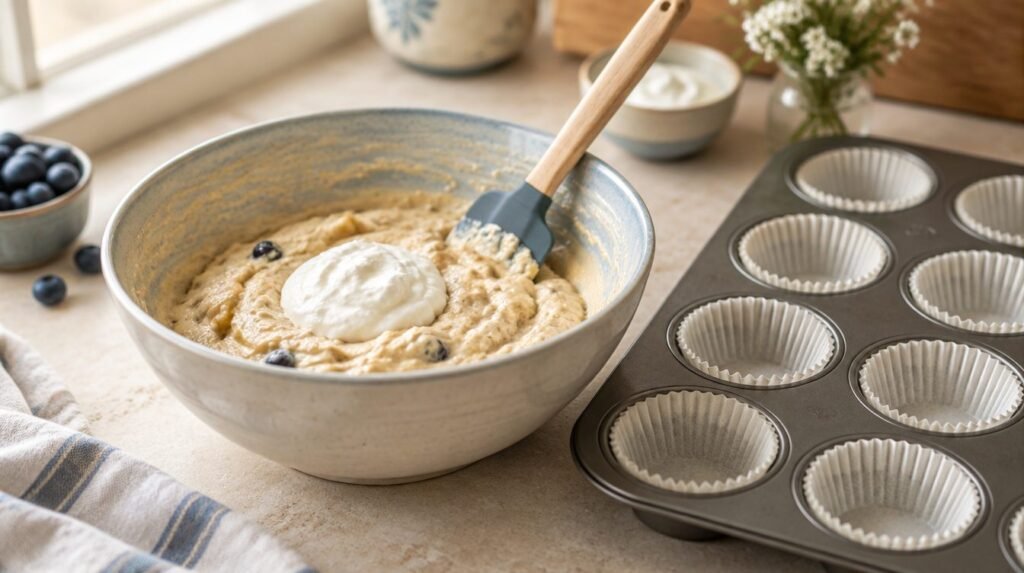
Start with recipes that already pair buttermilk or sour cream with baking soda, such as muffins, quick breads, pancakes, biscuits, soda bread and coffee cake: the swap is one-to-one and the leavening is already set up for an acid. Yogurt can also be the only liquid, as in University of Missouri Extension’s whole wheat yogurt rolls, baked at 450°F (232°C) for 10 to 15 minutes.
In hot sauces and casseroles, lower-fat yogurts are more prone to curdling. Missouri Extension suggests a higher-fat yogurt or a thickener such as cornstarch, and NDSU suggests 1 tablespoon of cornstarch per cup.
Tips for better results
- Balance the soda. Allow about ½ teaspoon of baking soda per cup of yogurt when yogurt is the main acid. Acidic swaps need neutralizing to avoid changes in flavor and texture (CSU), and too much soda without enough acid can taste metallic (Illinois Extension).
- Mix gently. When the acid is a liquid, stir the soda into the dry ingredients first, then mix only until blended; overbeating causes tunnels and peaked tops (Mississippi State).
- Bake until done. A wooden pick in the center should come out clean, or the center should reach at least 190°F (88°C) (Food Hero). Don’t taste raw batter: raw flour and eggs can carry harmful bacteria (FDA).
- Homemade yogurt works too. Plain yogurt you make at home works the same way; use it within 14 days (University of Illinois Extension) and discard any yogurt with mold (USDA FSIS).
More on cooking with plain yogurt
- Plain Yogurt: What You Need to Know: labels, fat levels and live cultures.
- Plain Yogurt Recipes You Can Make at Home: everyday dishes built on plain yogurt.
- Baking with Greek Yogurt: What You Need to Know: how strained yogurt changes a batter.
- How to Make Yogurt at Home: A Step-by-Step Guide: make your own plain yogurt for baking.
- Best Yogurt for Gut Health: choosing yogurt to eat fresh, cultures intact.
Sources
- Garden-Robinson J. Ingredient Substitutions (FN198), reviewed January 2023 (North Dakota State University Extension)
- Kendall P. Ingredient Substitutions, reviewed August 2025 (Colorado State University Extension)
- Howe J. Substitutions and Equivalents in Food Ingredients (CFS-145-W) (Purdue University Cooperative Extension Service)
- Mills-Gray S. Can-Do Recipes: Yogurt (N689) (University of Missouri Extension)
- Smith J. Baking soda vs. baking powder (December 6, 2024) (University of Illinois Extension)
- Geiger M. Natural vs Dutch-processed Cocoa (AnswerLine, February 4, 2025) (Iowa State University Extension and Outreach)
- Fun with Quick Breads: 4-H Bread Project, Basic Unit (Publication 1576) (Mississippi State University Extension Service)
- 21 CFR 131.200 Yogurt (Electronic Code of Federal Regulations, National Archives)
- Allam A, et al. Plain set and stirred yogurt with different additives: implementation of food safety system as quality checkpoints (PeerJ, 2023)
- Yogurt, plain, whole milk (FDC ID 171284) (USDA FoodData Central)
- Yogurt, Greek, plain, whole milk (FDC ID 171304) (USDA FoodData Central)
- Milk, whole, 3.25% milkfat, with added vitamin D (FDC ID 171265) (USDA FoodData Central)
- Yogurt, plain, low fat (FDC ID 170886) (USDA FoodData Central)
- Cream, sour, cultured (FDC ID 171257) (USDA FoodData Central)
- Yogurt, fruit, low fat, 10 grams protein per 8 ounce (FDC ID 171285) (USDA FoodData Central)
- Cascio J, Dinstel RR. Making Yogurt at Home (FNH-00062) (University of Alaska Fairbanks Cooperative Extension Service)
- Banana Oatmeal Bread (Food Hero, Oregon State University Extension Service)
- Zhang L, Taal MA, Boom RM, Chen XD, Schutyser MAI. Effect of baking conditions and storage on the viability of Lactobacillus plantarum supplemented to bread (LWT – Food Science and Technology, 2018, via Wageningen University & Research)
- Marco ML, et al. The International Scientific Association for Probiotics and Prebiotics (ISAPP) consensus statement on fermented foods (Nature Reviews Gastroenterology & Hepatology, 2021)
- Food Allergies: What You Need to Know (U.S. Food and Drug Administration)
- Added Sugars on the Nutrition Facts Label (U.S. Food and Drug Administration)
- Dietary Guidelines for Americans, 2025–2030 (U.S. Department of Agriculture and U.S. Department of Health and Human Services)
- Handling Flour Safely: What You Need to Know (U.S. Food and Drug Administration)
- Making Yogurt at Home (University of Illinois Extension)
- Molds on Food: Are They Dangerous? (USDA Food Safety and Inspection Service)